
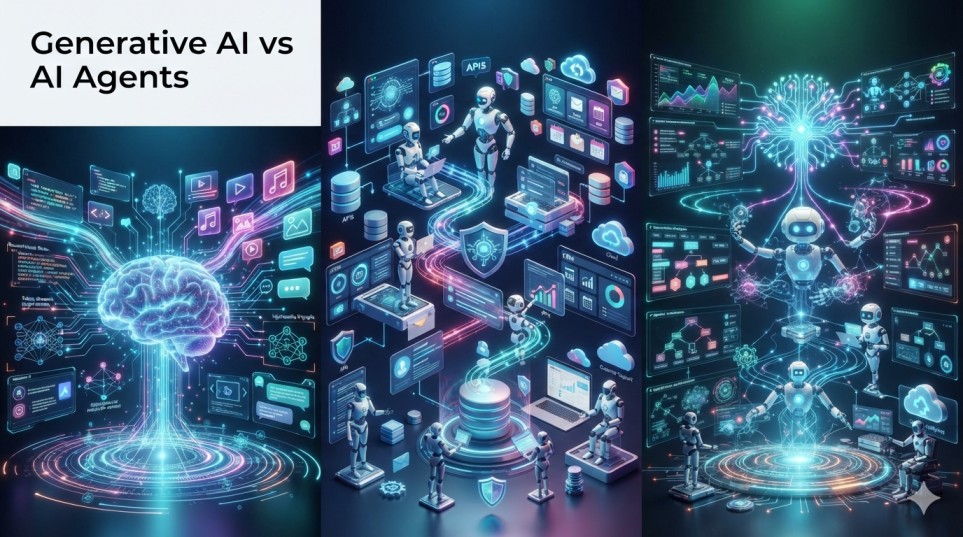
Artificial Intelligence is evolving faster than ever, introducing new technologies that are transforming how businesses, developers, and individuals work. While many people use terms like Generative AI, AI Agents, and Agentic AI interchangeably, they represent different stages of AI evolution with distinct capabilities and purposes.
Understanding these concepts is essential for anyone interested in the future of technology, digital transformation, and the growing impact of the Generative AI across industries. This guide explains each technology in simple language while highlighting their differences, advantages, challenges, and future potential.
Table of Contents
What is Generative AI?
Generative AI is a branch of artificial intelligence designed to create new content rather than simply analyze existing data. It can generate:
- Articles and blogs
- Images and artwork
- Videos
- Music
- Computer code
- Marketing content
- Business reports
At the heart of Generative AI are Large Language Models (LLMs) such as GPT, Claude, and Gemini. These models learn patterns from massive datasets and generate human-like responses based on prompts.
Unlike traditional software, Generative AI responds intelligently to user requests but remains reactive. It only produces output when prompted and generally does not make decisions independently.
Example
If you ask ChatGPT to write an email or generate Python code, it creates content instantly based on your instructions.
What are AI Agents?
AI Agents take artificial intelligence one step further.
Instead of simply generating information, AI Agents are designed to complete specific tasks with minimal user involvement.
Examples include:
- Customer support assistants
- Appointment scheduling systems
- Package tracking bots
- IT helpdesk assistants
- Automated data entry tools
Unlike Generative AI, AI Agents can:
- Access databases
- Use APIs
- Search the web
- Execute workflows
- Make limited decisions
- Complete assigned objectives automatically
Example
A customer support AI Agent can:
- Receive a customer query.
- Check order status.
- Verify shipping information.
- Generate a response.
- Update the CRM automatically.
The user only asks one question, while the agent performs multiple actions behind the scenes.
What is Agentic AI?
Agentic AI represents the next generation of intelligent systems.
Rather than solving a single task, Agentic AI focuses on achieving complete goals.
It works by:
- Breaking large goals into smaller tasks
- Assigning work to multiple AI Agents
- Monitoring progress
- Making decisions
- Adjusting strategies automatically
- Delivering final outcomes with minimal human intervention
This architecture enables complex workflows that previously required entire teams of people.
Example
Suppose a company wants to launch a new product.
Agentic AI could automatically:
- Conduct market research
- Analyze competitors
- Create marketing content
- Generate advertisements
- Schedule social media campaigns
- Build landing pages
- Monitor campaign performance
- Optimize results continuously
The human simply provides the business objective.
Evolution of AI Technologies
The progression of artificial intelligence can be understood as follows:
Traditional AI
- Rule-based systems
- Limited automation
- Fixed decision-making
Generative AI
- Creates content
- Responds to prompts
- Powered by LLMs
AI Agents
- Performs actions
- Uses external tools
- Executes workflows
Agentic AI
- Achieves goals
- Coordinates multiple agents
- Uses reasoning and planning
- Requires minimal supervision
Each stage represents greater autonomy and intelligence.
Generative AI vs AI Agents vs Agentic AI
| Feature | Generative AI | AI Agents | Agentic AI |
|---|---|---|---|
| Primary Purpose | Content generation | Task automation | Goal achievement |
| Autonomy | Low | Medium | High |
| Uses External Tools | Limited | Yes | Extensive |
| Multi-Step Reasoning | Minimal | Moderate | Advanced |
| Human Intervention | High | Medium | Low |
| Example | Writing blogs | Booking appointments | Running an entire marketing campaign |
Real-World Applications
Generative AI
- Content writing
- Software development
- Graphic design
- Education
- Customer communication
- Video creation
AI Agents
- HR automation
- Customer service
- IT support
- Sales assistance
- Finance operations
Agentic AI
- Enterprise workflow automation
- Healthcare management
- Supply chain optimization
- Autonomous research
- Business strategy execution
Challenges and Limitations
Although AI continues to improve, every technology has limitations.
Generative AI Challenges
- Can produce inaccurate information
- Knowledge may become outdated
- Requires human verification
- May generate biased outputs
AI Agent Challenges
- Integration complexity
- Security concerns
- Data privacy requirements
- Workflow management
Agentic AI Challenges
- Ethical decision-making
- Governance and accountability
- Transparency
- High implementation costs
- Regulatory compliance
Organizations must establish responsible AI practices to ensure safe adoption.
Opportunities for Businesses
The combination of these technologies is accelerating digital transformation across industries.
Major opportunities include:
- Increased productivity
- Faster decision-making
- Lower operational costs
- Improved customer experiences
- Personalized services
- Intelligent business automation
- Scalable enterprise operations
Businesses adopting AI today are positioning themselves for long-term competitive advantages.
Future Trends
The future of technology will increasingly rely on intelligent systems capable of planning, reasoning, and acting independently.
Emerging trends include:
- Multi-agent collaboration
- Autonomous business operations
- AI-powered software engineering
- Intelligent healthcare assistants
- Self-managing enterprise systems
- Personalized AI ecosystems
- Human-AI collaboration at scale
As these technologies mature, the impact of the Generative AI will extend far beyond content creation, becoming a critical component within broader autonomous AI ecosystems.