
Introduction
Software testing is entering a new phase.
Traditional applications generally follow predefined instructions. A user performs an action, the application processes it, and the system returns an expected result. QA engineers can design test cases around known workflows, expected inputs, and predictable outputs.
Agentic AI changes that model.
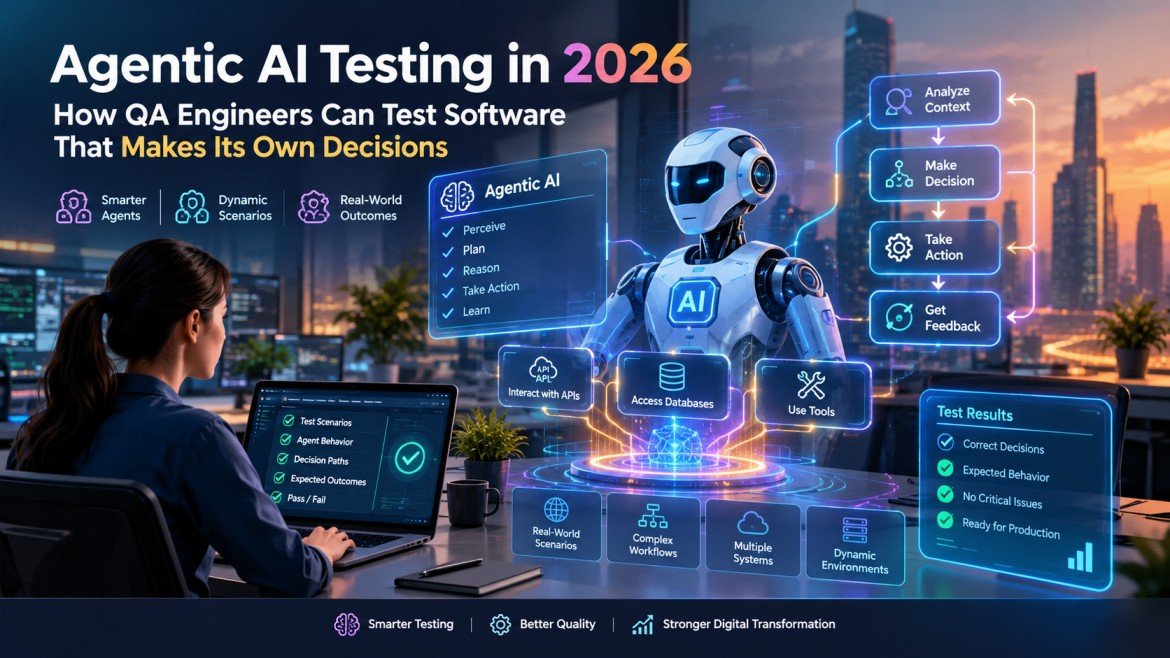
An AI agent can analyze information, create a plan, select tools, execute multiple steps, evaluate results, and adjust its next action without requiring a human to specify every individual step. This creates a new testing challenge: QA teams are no longer testing only whether software produces the correct output. They must also examine how an autonomous system reaches decisions and what happens when those decisions go wrong.
In 2026, this shift is becoming increasingly important as organizations adopt AI-powered customer-service agents, coding assistants, enterprise copilots, claims-processing systems, autonomous workflows, and intelligent business applications.
For QA engineers, the question is no longer simply:
“Did the application return the expected result?”
The more complex question is:
“Did the AI agent make a safe, reliable, explainable, and appropriate decision under the given circumstances?”
This article explores how QA professionals can approach modern AI-agent testing, the major challenges involved, emerging opportunities, and the future of quality engineering in an increasingly autonomous software environment.
Table of Contents
What Is Agentic AI?
Agentic AI refers to AI systems designed to pursue objectives by taking multiple actions rather than simply generating a single response.
A typical agent may perform a sequence such as:
Understand → Plan → Use Tools → Execute → Evaluate → Adapt
For example, consider an insurance claims application.
A traditional automation workflow might:
- Receive a claim.
- Validate mandatory fields.
- Check policy information.
- Calculate an amount.
- Send the claim for approval.
An AI agent could perform a more dynamic process:
- Understand the customer’s claim.
- Retrieve policy information.
- Identify missing documents.
- Search relevant claim history.
- Determine whether additional verification is necessary.
- Select an appropriate workflow.
- Request additional information.
- Re-evaluate the claim after receiving new data.
- Recommend or initiate the next action.
The agent is therefore not just executing a fixed script.
It is making decisions within a defined objective.
That difference has major implications for quality engineering.
Why Traditional Testing Is Not Enough
Traditional functional testing normally relies on predictable relationships between inputs and outputs.
For example:
Input: Valid username + valid password
Expected Result: User successfully logs in.
This works well when application behavior is deterministic.
AI agents introduce additional variables, including:
- Model responses
- Context
- Prompt variations
- Tool availability
- External data
- Memory
- Planning strategies
- Agent configuration
- Guardrails
- Model versions
- Temperature or sampling behavior
- Unexpected user instructions
Consequently, the same high-level request may produce different execution paths.
Example
Suppose a customer asks an AI banking assistant:
“Transfer money to my usual account.”
A conventional application might require an account number and transaction amount.
An agent may attempt to infer the intended destination from previous interactions.
QA engineers must then test questions such as:
- What does “usual account” mean?
- What if multiple accounts exist?
- What if the account is blocked?
- What if the transfer exceeds a threshold?
- What if the agent retrieves outdated information?
- Does the system request confirmation?
- Can the agent execute a transaction without authorization?
The testing surface becomes much larger.
What Is Agentic AI Testing?
Agentic AI Testing focuses on evaluating AI-powered systems that can independently reason, plan, use tools, and execute actions.
Instead of testing only predefined workflows, QA engineers need to validate the agent’s:
- Decision-making
- Planning
- Tool selection
- Tool execution
- Data retrieval
- Reasoning boundaries
- Error handling
- Security controls
- Policy compliance
- Recovery behavior
- Output quality
- Human handoff
The objective is not to prove that an agent behaves identically every time.
The objective is to establish whether its behavior remains safe, reliable, controlled, and acceptable across realistic variations.
How QA Engineers Can Test Autonomous AI Systems
1. Test the Agent’s Goals
Every agent should have clearly defined objectives.
QA engineers should verify whether the agent stays within those objectives.
Example
An HR assistant may be designed to:
- Search company policies.
- Answer employee questions.
- Create HR service requests.
It should not automatically:
- Change employee salaries.
- Delete employee records.
- Approve sensitive transactions.
Testing should therefore include both normal and boundary scenarios.
Test Questions
- Does the agent understand its assigned purpose?
- Can it distinguish allowed from prohibited tasks?
- Does it stop when a request exceeds its authority?
- Does it escalate sensitive actions?
- Does it maintain scope throughout a multi-step workflow?
2. Test Planning and Reasoning Paths
AI agents may create different plans for reaching the same goal.
QA engineers should therefore evaluate not only the final answer but also the execution path.
For example:
Goal: Resolve a customer insurance claim.
Possible agent path:
Claim received → Policy lookup → Document validation → Claim history → Fraud screening → Decision
Another path could be:
Claim received → Missing document detected → Customer notification → Wait → Re-evaluate
Both may be valid depending on the situation.
Testing should determine whether each path satisfies business rules.
3. Test Tool Usage
Modern AI agents often interact with external tools and APIs.
Examples include:
- REST APIs
- Databases
- Search engines
- CRM platforms
- Payment systems
- Ticketing systems
- Cloud services
- Internal enterprise applications
Tool-use testing should verify:
- Correct tool selection
- Correct parameters
- Authentication
- Authorization
- Error handling
- Timeout behavior
- Retry mechanisms
- Duplicate requests
- Invalid responses
- Rate limits
- Data exposure
Example
If an agent calls a claims API with an incorrect claim ID, the system should not blindly continue.
The agent should detect the failure, interpret the error appropriately, and follow an approved recovery path.
Scenario-Based Testing for AI Agents
One of the most important changes for QA teams is moving from individual test cases toward scenario-based testing.
A traditional test might say:
Verify that the claim status changes from “Submitted” to “Approved.”
An agent-oriented scenario could be:
A customer submits an incomplete claim while the policy contains conflicting information. The agent must identify the inconsistency, request the required documentation, avoid making an unauthorized decision, and correctly resume the workflow after the missing information is provided.
This scenario contains multiple decision points.
Important Scenario Categories
QA teams should consider:
- Normal workflows
- Ambiguous requests
- Incomplete information
- Contradictory information
- Invalid inputs
- Unexpected tool failures
- External API failures
- Unauthorized requests
- Prompt injection attempts
- Data privacy violations
- Repeated requests
- Long-running tasks
- Human intervention
- Recovery after failure
This approach gives teams a more realistic view of autonomous behavior.
Testing Non-Deterministic Behavior
One of the biggest differences between conventional software and AI-driven applications is variability.
A deterministic function may return the same output for the same input.
An AI system can produce different responses or take different paths.
That does not automatically mean the system is defective.
QA engineers need to define acceptable behavioral boundaries.
Example
Suppose an AI support agent receives:
“I cannot access my account.”
Multiple responses may be acceptable if they:
- Identify the correct problem category.
- Follow authentication requirements.
- Avoid requesting sensitive information unnecessarily.
- Provide accurate recovery instructions.
- Escalate when appropriate.
Testing should therefore focus on measurable acceptance criteria rather than requiring identical wording.
AI Agent Regression Testing
Regression testing becomes particularly important when the underlying model or agent architecture changes.
A seemingly small modification can affect:
- Tool selection
- Response quality
- Decision paths
- Safety behavior
- API usage
- Retrieval results
- Token consumption
- Response time
A strong regression strategy should maintain a representative evaluation dataset.
It can contain:
- Business scenarios
- Edge cases
- Security scenarios
- Historical failures
- Compliance cases
- Tool-use cases
- Adversarial prompts
- Human escalation cases
Every major model, prompt, tool, or orchestration change can then be evaluated against the same baseline.
API and Database Testing for AI Agents
QA engineers with API and SQL testing experience have an important role in agent-based applications.
Agents rarely operate in isolation.
They often depend on APIs, databases, event systems, and enterprise services.
API Testing
QA teams should validate:
- Request structure
- Authentication
- Authorization
- Response schema
- Error codes
- Timeout handling
- Retry behavior
- Duplicate requests
- Data consistency
- Idempotency
Example
If an AI agent attempts to create a customer ticket twice because of a retry, the backend should prevent unintended duplicate transactions where appropriate.
Database Testing
Database validation can include:
- Data accuracy
- Transaction integrity
- Record duplication
- Incorrect updates
- Missing relationships
- Audit trails
- Permission boundaries
- Data retention
- Sensitive-data exposure
For enterprise AI systems, database testing can become a critical component of end-to-end quality assurance.
Security Testing for Autonomous Agents
Autonomous systems introduce new security considerations.
An attacker may attempt to manipulate the agent instead of directly attacking the underlying application.
Common areas include:
Prompt Injection
An attacker attempts to manipulate an agent into ignoring its original instructions.
Excessive Agency
An agent may have more permissions than required.
The principle of least privilege becomes especially important.
Sensitive Data Exposure
The agent might unintentionally reveal:
- Customer information
- Internal documents
- Credentials
- Financial records
- Personal information
Tool Abuse
A malicious instruction could attempt to make the agent misuse an available API or system integration.
QA and security teams should therefore test both legitimate and adversarial scenarios.
Human-in-the-Loop Testing
Not every decision should be completely autonomous.
High-impact operations may require human approval.
Examples include:
- Large financial transactions
- Insurance claim settlements
- Employee termination workflows
- Medical decisions
- Security actions
- Legal processes
- Account closures
QA engineers should verify that human intervention works correctly.
Testing should cover:
- Agent identifies a high-risk situation.
- Agent pauses execution.
- Human reviewer receives sufficient context.
- Reviewer approves or rejects the action.
- Agent correctly continues or terminates the workflow.
- The decision is recorded for auditing.
The human handoff itself becomes a testable workflow.
Measuring AI Agent Quality
Traditional metrics such as pass/fail are still useful, but they are not sufficient for autonomous systems.
Organizations can introduce additional quality indicators.
Useful Metrics
Task Success Rate
Percentage of scenarios completed successfully.
Tool Accuracy
Percentage of tool calls using the correct service and parameters.
Policy Compliance
Percentage of decisions that remain within business and security rules.
Escalation Accuracy
Whether the agent correctly identifies situations requiring human intervention.
Recovery Rate
How effectively the agent recovers from failures.
Response Quality
Whether outputs meet predefined factual and business requirements.
Latency
Time required to complete an agent workflow.
Cost per Task
Tokens, API calls, infrastructure, and other resources consumed per completed task.
These metrics allow organizations to monitor quality over time.
The Role of QA Engineers in the Future of AI
AI does not eliminate the need for quality engineering.
Instead, it changes the nature of the work.
QA engineers will increasingly move from manually checking every expected result toward designing systems that continuously evaluate autonomous behavior.
The future QA professional may work across:
- Functional testing
- API testing
- AI evaluation
- Prompt testing
- Security testing
- Data validation
- Observability
- Automation
- Risk assessment
- Model evaluation
- Business-rule validation
This represents a significant expansion of the quality engineering discipline.
Challenges of Agentic AI Testing
1. Non-Deterministic Outputs
Different executions may produce different results.
QA teams need flexible evaluation criteria that distinguish acceptable variation from actual defects.
2. Complex Root-Cause Analysis
When an agent fails, the problem could originate from:
- The model
- Prompt
- Retrieval system
- API
- Database
- Tool
- Orchestration layer
- Business rule
- External service
Finding the root cause can therefore require distributed tracing and detailed observability.
3. Rapid Model Evolution
AI models can change frequently.
A test suite that passes today may reveal new behavior after a model update.
Continuous evaluation becomes essential.
4. Lack of Clear Expected Outputs
Traditional testing often has a predefined expected result.
Generative systems may produce multiple valid answers.
QA teams must define measurable quality criteria instead of relying solely on exact-match assertions.
5. Testing Emergent Behavior
An agent may behave differently when several components interact.
For example:
Model + memory + retrieval + tools + instructions + external API
Testing each component independently may not expose problems that emerge from their interaction.
Opportunities for QA Teams
The rise of autonomous AI also creates new career and business opportunities.
QA professionals can develop expertise in:
- AI quality engineering
- LLM evaluation
- Agent evaluation
- AI security testing
- AI API testing
- Prompt validation
- Data quality
- Model monitoring
- AI observability
- Responsible AI testing
- Autonomous workflow testing
Traditional testing knowledge remains valuable because AI applications still depend on software engineering fundamentals.
A QA engineer who understands APIs, databases, automation, cloud infrastructure, business processes, and AI systems can contribute across the entire quality lifecycle.
Agentic AI Testing and Digital Transformation
The impact of autonomous AI extends beyond testing teams.
Organizations are using AI to transform customer service, software development, insurance operations, financial processes, supply chains, marketing, and enterprise support.
This wider digital transformation creates a requirement for reliable autonomous systems.
If an AI agent can independently perform ten steps in a business workflow, a small defect in its decision-making can propagate through several downstream systems.
Quality engineering therefore becomes part of the governance layer for AI-driven digital transformation.
The impact of it can be particularly significant in regulated industries where decisions may affect customers, financial transactions, privacy, or compliance.
Organizations need testing strategies that connect technical quality with business risk.
Future Trends in AI Agent Testing
Autonomous Test Generation
AI systems will increasingly help QA teams generate scenarios from requirements, user stories, API specifications, production logs, and historical defects.
Human engineers will still need to validate whether generated scenarios represent meaningful business risks.
Continuous AI Evaluation
Instead of evaluating an agent only before release, organizations will increasingly monitor quality continuously.
Production signals can identify:
- Unexpected workflows
- New failure patterns
- Tool errors
- Increased escalation rates
- Changes in task success
- Performance degradation
AI-Powered Test Agents
QA teams may use specialized agents that independently explore applications, create test scenarios, execute workflows, and report anomalies.
This could reduce repetitive testing work while increasing exploratory coverage.
Risk-Based Autonomous Testing
Future testing platforms are likely to prioritize scenarios based on business impact.
A low-risk FAQ interaction may receive a different testing strategy from an AI agent capable of approving a financial transaction.
Greater Observability
Agent systems will require detailed traces showing:
User Request → Plan → Tool Call → Result → Decision → Action → Outcome
This traceability will become increasingly important for debugging, auditing, and compliance.
A Practical Strategy for QA Engineers
Organizations beginning their AI testing journey can follow a structured approach.
Step 1: Understand the Agent
Document:
- Purpose
- Goals
- Tools
- Permissions
- Data sources
- Models
- Memory
- Human approval points
Step 2: Identify Business Risks
Classify actions according to their potential impact.
Step 3: Build Scenario Libraries
Create realistic scenarios covering normal, edge, failure, security, and ambiguous situations.
Step 4: Establish Evaluation Criteria
Define what constitutes:
- Success
- Partial success
- Failure
- Unsafe behavior
- Required escalation
Step 5: Automate Repeatable Evaluation
Integrate AI evaluations into CI/CD pipelines where appropriate.
Step 6: Monitor Production Behavior
Testing should not end after deployment.
Use observability and production monitoring to identify emerging problems.
Step 7: Continuously Improve
Feed validated production failures back into the evaluation dataset.
This creates a continuous quality loop:
Test → Deploy → Observe → Learn → Improve → Retest
Example: Testing an Autonomous Insurance Agent
Consider an AI agent that helps process property insurance claims.
A QA team could create the following scenario:
Situation:
A customer submits a claim for water damage. The claim contains incomplete documentation, while policy data indicates a potential coverage limitation.
The agent should:
- Retrieve the correct policy.
- Identify missing information.
- Recognize the coverage issue.
- Avoid making an unauthorized final decision.
- Request the required documentation.
- Escalate the claim if business rules require human review.
- Maintain an audit trail.
QA engineers can then test:
- Correct policy retrieval
- API failures
- Incorrect customer information
- Missing documents
- Conflicting policy data
- Unauthorized approval attempts
- Duplicate actions
- Human escalation
- Data privacy
- Recovery after system failure
This is fundamentally different from testing one predefined screen or API response.
How QA Skills Will Evolve
The QA engineer of the future will need both traditional and AI-oriented skills.
Core Testing Skills
- Functional testing
- Regression testing
- API testing
- Database testing
- Integration testing
- Automation
- Performance testing
- Security testing
Emerging AI Skills
- LLM evaluation
- Agent behavior testing
- Prompt engineering
- AI observability
- RAG evaluation
- Model-risk assessment
- AI security
- Data quality
- AI governance concepts
Supporting Technical Skills
- Python or Java
- REST APIs
- SQL
- Git
- CI/CD
- Cloud platforms
- Containers
- Logging and monitoring
This combination can help QA professionals move toward modern Quality Engineering roles.
Conclusion
Autonomous software is changing what it means to test an application.
When software can interpret goals, make plans, call tools, evaluate information, and change its approach, testing must go beyond traditional input-and-output validation.
QA engineers need to evaluate decisions, workflows, permissions, recovery behavior, security, data quality, and human intervention.
The future of quality engineering will therefore involve a combination of conventional testing discipline and AI-specific evaluation techniques.
Organizations that treat AI quality as an afterthought may struggle to control increasingly autonomous workflows. Organizations that build continuous evaluation, observability, security, and risk-based testing into their development lifecycle can create stronger foundations for responsible AI adoption.
The most important shift is simple:
QA is no longer testing only what software does. It is increasingly testing how intelligent software decides what to do next.
Frequently Asked Questions
What is Agentic AI Testing?
It is the practice of evaluating AI-powered software that can independently plan, make decisions, use tools, and execute multi-step tasks.
Why is testing AI agents different from traditional software testing?
Traditional applications often have predictable workflows and deterministic outputs. AI agents can produce variable responses and dynamically select different execution paths.
Can traditional QA engineers work with AI agents?
Yes. Existing skills in functional testing, API testing, SQL, automation, integration testing, and defect management provide a strong foundation. Additional knowledge of AI evaluation, LLMs, prompts, security, and observability can extend those skills.
What should QA engineers test in an AI agent?
They should test decision-making, tool usage, data retrieval, security, permissions, business rules, error handling, recovery, human escalation, output quality, and end-to-end workflows.
Will AI replace QA engineers?
AI can automate parts of test creation and execution, but autonomous systems also create new quality, security, governance, and evaluation requirements. QA expertise remains important for defining risk, acceptance criteria, coverage, and business correctness.
Final Takeaway
The transition toward autonomous software represents a major change in software quality engineering. QA professionals who learn how to evaluate AI decisions, agent workflows, APIs, data, security boundaries, and real-world outcomes can play a central role in building trustworthy AI-powered products.
The goal is not simply to test whether an AI agent can complete a task.
The goal is to determine whether it can complete that task correctly, safely, consistently enough for its purpose, and within the boundaries established by the business.