
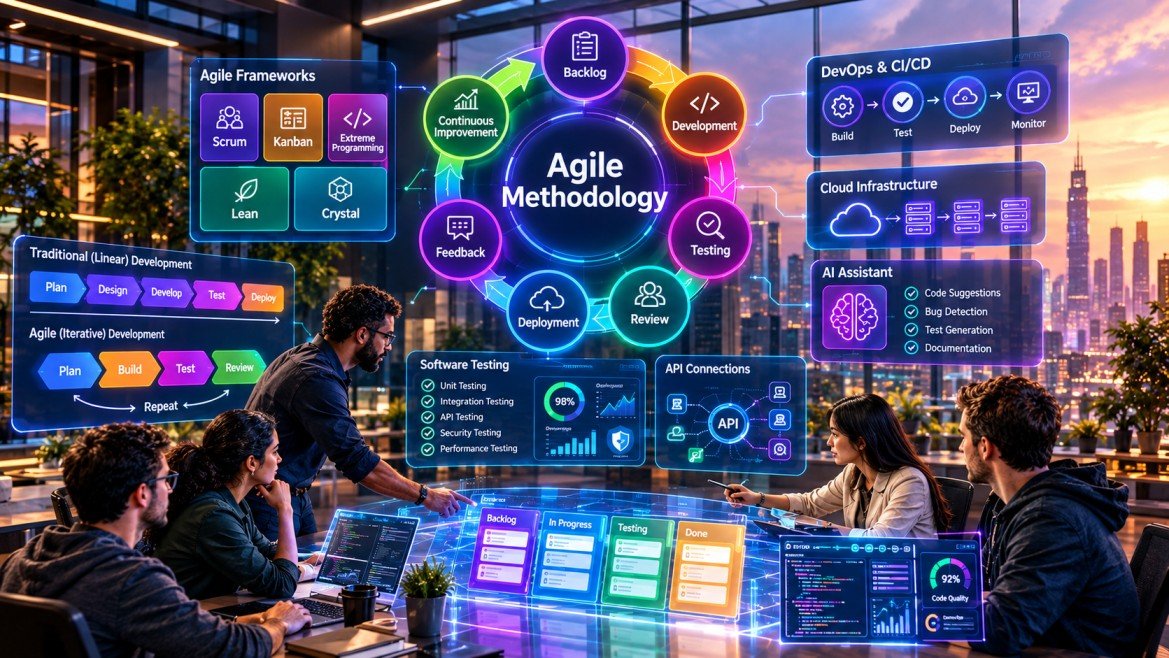
Introduction: What Is Agile?
Software development has changed dramatically. Customers expect faster releases, frequent improvements, better user experiences, and products that can adapt to changing market conditions. In this environment, traditional project management approaches can struggle when requirements change after development has already started.
This is where Agile methodology becomes important.
Agile is an approach to software development that emphasizes iterative development, continuous feedback, collaboration, adaptability, and frequent delivery of working software. Instead of trying to define every requirement at the beginning and deliver the complete product at the end, Agile divides work into smaller increments that can be developed, tested, reviewed, and improved continuously.
Agile is not simply a project-management technique. It represents a different way of thinking about how teams build products and respond to uncertainty.
Organizations going through digital transformation increasingly need development teams that can react quickly to customer expectations and technological changes. Agile frameworks provide practical ways to implement these ideas.
But what exactly is Agile? Why did organizations move away from traditional Waterfall development? How do Scrum, Kanban, XP, Lean, and Crystal implement Agile principles?
Let’s explore everything step by step.
Table of Contents
What Is Agile Methodology?
Agile methodology is a software development approach based on incremental and iterative delivery.
Instead of building an entire application in one long development cycle, an Agile team divides the product into smaller pieces of work. Each piece goes through development, testing, review, and feedback.
A simplified Agile cycle looks like this:
Plan → Develop → Test → Review → Feedback → Improve → Repeat
The objective is to deliver useful software frequently while remaining flexible enough to respond to changing requirements.
Key Characteristics of Agile
Agile development commonly emphasizes:
- Short development cycles
- Continuous customer feedback
- Frequent software releases
- Cross-functional teams
- Continuous testing
- Collaboration
- Adaptability
- Incremental delivery
- Continuous improvement
- Transparency
For example, imagine a company building an online insurance application.
Instead of spending a year developing the entire application, an Agile team might initially deliver:
Release 1: Customer registration
Release 2: Policy search
Release 3: Policy purchase
Release 4: Claims submission
Release 5: Claims tracking
Each release can be tested and evaluated independently.
This approach allows the organization to learn from real users before investing heavily in subsequent functionality.
Why Did Agile Become Necessary?
Moving Away From the Waterfall Model
The Waterfall model follows a sequential development process.
A typical Waterfall lifecycle may look like:
Requirements → Design → Development → Testing → Deployment → Maintenance
The model can work effectively when requirements are stable and well understood.
However, modern software projects frequently experience changing requirements.
A customer might initially request one feature but later discover that users need something completely different.
Under a rigid sequential model, changing requirements late in development can result in:
- Additional development costs
- Schedule delays
- Rework
- Complex change-management processes
- Testing challenges
- Customer dissatisfaction
Agile was developed as an alternative approach for environments where requirements and priorities can change.
Agile vs Waterfall
| Area | Waterfall | Agile |
|---|---|---|
| Development | Sequential | Iterative |
| Requirements | Defined early | Can evolve |
| Delivery | Usually at the end | Frequent increments |
| Feedback | Often later | Continuous |
| Testing | Later phase traditionally | Continuous |
| Change | More difficult | Expected |
| Customer involvement | Periodic | Frequent |
| Planning | Long-term detailed plan | Adaptive planning |
The important distinction is not that Waterfall is universally unsuitable and Agile is universally appropriate.
Instead, the choice depends on the project characteristics, regulatory requirements, uncertainty, organizational structure, and product goals.
Core Philosophy of Agile
Agile focuses on delivering value quickly while learning continuously.
Instead of asking:
“How can we follow the original plan exactly?”
Agile teams frequently ask:
“What is the most valuable thing we can deliver and learn from next?”
This creates a feedback-driven development cycle.
Breaking Large Projects Into Smaller Pieces
Large projects can be difficult to manage because many dependencies exist between requirements.
Agile reduces this complexity by dividing work into smaller units.
For example:
Large requirement:
Build an e-commerce platform.
Smaller increments:
- User registration
- Product catalog
- Product search
- Shopping cart
- Checkout
- Payment integration
- Order tracking
- Customer reviews
Each increment can be developed and validated separately.
Agile Values
The foundation of modern Agile thinking comes from the Agile Manifesto, which emphasizes four major value preferences.
1. Individuals and Interactions Over Processes and Tools
Agile recognizes that tools and processes are useful, but effective collaboration between people is critical.
A sophisticated testing platform cannot compensate for poor communication between developers, testers, product owners, and customers.
2. Working Software Over Comprehensive Documentation
Documentation remains valuable, especially in regulated industries and complex systems.
However, Agile places greater emphasis on producing software that actually works.
A 100-page specification is not a substitute for a functioning product that customers can evaluate.
3. Customer Collaboration Over Contract Negotiation
Agile encourages customers and stakeholders to remain involved throughout development.
Frequent collaboration helps teams identify misunderstandings early.
4. Responding to Change Over Following a Plan
Plans are useful, but software development operates in an environment of uncertainty.
Agile teams accept that:
- Market conditions can change.
- Customer expectations can change.
- Technology can change.
- Business priorities can change.
- Regulations can change.
The ability to adapt becomes a competitive capability.
Agile Principles
The Agile philosophy is supported by principles such as:
- Deliver valuable software frequently.
- Welcome changing requirements.
- Maintain close collaboration between business and technical teams.
- Build projects around motivated individuals.
- Prefer direct communication.
- Measure progress through working software.
- Maintain sustainable development.
- Continuously improve technical excellence.
- Keep solutions as simple as practical.
- Regularly reflect and adjust.
These principles are implemented differently by different Agile frameworks.
What Are Agile Frameworks?
An Agile framework provides a practical structure for applying Agile principles.
Agile itself is not a single process.
Different frameworks provide different mechanisms for organizing work, managing priorities, improving quality, and delivering value.
Popular Agile frameworks and methodologies include:
- Scrum
- Extreme Programming (XP)
- Kanban
- Lean
- Crystal
Let’s examine each one.
Scrum Framework
Scrum is one of the most widely recognized Agile frameworks.
It organizes work into short, fixed-duration iterations called Sprints.
A Sprint commonly lasts between one and four weeks, with two weeks being a common implementation.
Scrum Roles
Traditional Scrum includes three accountabilities:
Product Owner
The Product Owner is responsible for maximizing product value and managing the Product Backlog.
Typical responsibilities include:
- Prioritizing work
- Understanding customer needs
- Communicating product goals
- Managing backlog priorities
- Collaborating with stakeholders
Scrum Master
The Scrum Master helps the Scrum Team understand and apply Scrum.
The role commonly includes:
- Facilitating Scrum events
- Removing or helping address impediments
- Supporting team effectiveness
- Encouraging continuous improvement
Developers
Developers create the product increment.
The term encompasses the people responsible for creating the usable product, including relevant engineering, testing, design, and technical activities.
Scrum Events
Common Scrum events include:
- Sprint Planning
- Daily Scrum
- Sprint Review
- Sprint Retrospective
The team uses these events to plan work, inspect progress, gather feedback, and improve its way of working.
Scrum Example
Suppose an insurance company wants to create a digital claims application.
During one Sprint, the team might work on:
User Story:
“As a policyholder, I want to submit a motor insurance claim online.”
The team could:
- Design the claim form.
- Develop the API.
- Implement the user interface.
- Perform functional testing.
- Perform API testing.
- Validate database changes.
- Demonstrate the functionality.
- Collect feedback.
At the end of the Sprint, the objective is to have a potentially usable increment rather than merely partially completed components.
Extreme Programming (XP)
Extreme Programming, commonly called XP, is an Agile methodology that places significant emphasis on software engineering practices and technical discipline.
XP attempts to improve quality by integrating engineering practices directly into the development process.
Important XP practices include:
- Test-driven development
- Pair programming
- Continuous integration
- Refactoring
- Simple design
- Frequent releases
- Collective code ownership
- Continuous customer feedback
XP is particularly relevant when software quality and rapid feedback are critical.
Lean Software Development
Lean originated from principles associated with lean manufacturing and was adapted to software development.
The central idea is to maximize value while minimizing waste.
Common Lean concepts include:
- Eliminate waste
- Build quality in
- Create knowledge
- Defer commitment
- Deliver quickly
- Respect people
- Optimize the whole
What Is Waste in Software Development?
Waste can include:
- Unnecessary features
- Waiting time
- Rework
- Excessive handoffs
- Defects
- Unused documentation
- Unnecessary processes
- Delayed feedback
Lean encourages teams to identify these inefficiencies and improve the overall flow of value.
Kanban
Kanban is a flow-based approach that uses visual management to control and improve work.
Unlike Scrum, Kanban does not require fixed-duration Sprints.
A simple Kanban board might contain:
Backlog → To Do → In Progress → Testing → Done
Team members move work items across the board as progress occurs.
Work-in-Progress Limits
One important Kanban concept is Work in Progress (WIP) limits.
For example:
Testing column: WIP limit = 3
If three items are already being tested, the team should generally avoid starting additional testing work until capacity becomes available.
This helps expose bottlenecks.
Kanban Example
Imagine a QA team has:
- 10 items waiting for testing
- 3 items being tested
- 2 items waiting for deployment
The visualization immediately reveals that testing may be a bottleneck.
The team can then investigate why testing capacity is constrained.
Crystal Methodology
Crystal is a family of Agile methodologies designed around the idea that development approaches should consider factors such as team size and system criticality.
Crystal emphasizes:
- People
- Communication
- Frequent delivery
- Reflection
- Adaptability
Rather than forcing every project into exactly the same process, Crystal recognizes that different teams and projects may require different levels of process.
How Agile Frameworks Differ
Although these frameworks share Agile principles, their implementation differs.
| Framework | Primary Focus | Work Structure |
|---|---|---|
| Scrum | Iterative product delivery | Fixed Sprints |
| Kanban | Continuous flow | Visual workflow |
| XP | Engineering excellence | Technical practices |
| Lean | Value and waste reduction | Flow optimization |
| Crystal | People and adaptability | Context-dependent |
There is no requirement for an organization to treat these approaches as completely isolated.
Organizations may combine practices when appropriate.
For example, a Scrum team might use:
- Scrum for Sprint management
- Kanban boards for workflow visualization
- XP practices for engineering quality
- Lean principles for reducing waste
Agile and Software Testing
Agile significantly changes how testing is approached.
In traditional development models, testing may occur primarily after implementation.
In Agile, testing is expected to happen continuously.
This creates the concept of continuous quality.
Agile Testing Activities
An Agile tester may participate in:
- Requirement discussions
- Story refinement
- Acceptance criteria definition
- Test design
- Functional testing
- API testing
- Database testing
- Regression testing
- Exploratory testing
- Automation
- Defect analysis
Testing becomes a shared responsibility rather than an isolated final phase.
Agile Testing Example
Consider a new claims feature in an insurance application.
A QA engineer might validate:
Functional Testing
Does the claim submission process work correctly?
API Testing
Does the claims API return the expected response?
Database Testing
Are claim records stored correctly?
Security Testing
Can unauthorized users access another customer’s claim?
Regression Testing
Did the new functionality break existing policy or claims features?
Exploratory Testing
Can unexpected user behavior expose additional defects?
This broader approach supports faster feedback and improved product quality.
Agile and Digital Transformation
Agile is closely associated with modern digital transformation initiatives.
Digital transformation involves more than introducing new technology. Organizations often need to change how products are designed, delivered, operated, and improved.
Agile can support this transformation by encouraging:
- Faster experimentation
- Cross-functional collaboration
- Continuous delivery
- Customer feedback
- Incremental modernization
- DevOps collaboration
- Automation
- Data-driven decision-making
For example, a traditional insurance organization moving from branch-based processes toward a digital claims platform may need to continuously modify its product based on customer behavior.
An Agile approach can make these changes more manageable.
5 Skills Must Learn for an Agile Career
If you want to work successfully in Agile software development, technical knowledge alone may not be enough.
The 5 Skills Must Learn for professionals entering or advancing in Agile environments include:
1. Communication
Agile requires frequent interaction between developers, testers, product owners, business analysts, and customers.
Clear communication reduces misunderstandings.
2. Collaboration
Agile teams work collectively rather than operating as isolated departments.
3. Adaptability
Requirements can change. Professionals need to adapt without losing sight of product quality.
4. Technical Skills
Depending on the role, useful technical capabilities include:
- Software testing
- Automation
- API testing
- SQL
- Cloud technologies
- CI/CD
- Version control
- Observability
5. Continuous Learning
Agile encourages continuous improvement.
Professionals should regularly update their knowledge of tools, technologies, frameworks, and engineering practices.
These 5 Skills Must Learn can help professionals become more effective in modern Agile environments.
The 5 Skills Must Learn are especially relevant as organizations combine Agile with DevOps, cloud computing, AI, and automation.
For anyone planning an Agile career, the 5 Skills Must Learn should be treated as a starting point rather than a fixed checklist.
Benefits of Agile Methodology
Agile can provide several potential advantages when implemented appropriately.
Faster Feedback
Teams can receive feedback before completing the entire product.
Better Adaptability
Changing priorities can be incorporated into future iterations.
Early Defect Detection
Continuous testing can identify problems earlier.
Improved Collaboration
Cross-functional teams communicate more frequently.
Incremental Value Delivery
Customers can receive useful functionality without waiting for the entire project.
Greater Visibility
Boards, backlogs, Sprint reviews, metrics, and demonstrations can improve transparency.
Challenges of Agile
Agile is not automatically successful simply because an organization adopts Scrum, Kanban, or another framework.
Resistance to Change
Teams accustomed to traditional processes may initially struggle with Agile ways of working.
Poor Agile Implementation
Calling meetings “Daily Scrum” does not automatically make an organization Agile.
The underlying principles must influence behavior and decision-making.
Unclear Product Ownership
If priorities are unclear, teams may waste effort building low-value features.
Excessive Meetings
Agile ceremonies should create value. Too many meetings without clear outcomes can become process overhead.
Technical Debt
Rapid delivery without sufficient engineering discipline can accumulate technical debt.
Scaling Complexity
Large organizations may face challenges coordinating many Agile teams.
Measurement Problems
Teams can misuse metrics such as velocity as individual performance measures, which can encourage undesirable behavior.
Agile Metrics
Agile teams may use various metrics to understand delivery and quality.
Examples include:
- Lead time
- Cycle time
- Throughput
- Defect trends
- Escaped defects
- Deployment frequency
- Sprint completion trends
- Test automation coverage
- Mean time to recovery
Metrics should support learning and improvement rather than becoming targets that encourage teams to manipulate numbers.
Agile, DevOps, and Continuous Delivery
Agile and DevOps are related but are not identical concepts.
Agile primarily emphasizes iterative product development, collaboration, feedback, and adaptability.
DevOps extends collaboration across development and operations while emphasizing automation, continuous integration, continuous delivery, infrastructure practices, monitoring, and reliable software delivery.
Together they can create a continuous lifecycle:
Plan → Code → Build → Test → Deploy → Monitor → Learn → Improve
This model can be particularly valuable for organizations undergoing digital transformation.
The Future of Agile
The future of Agile is likely to involve increased integration with automation, AI, DevOps, cloud platforms, and data-driven engineering.
AI-assisted development tools can already help teams with activities such as:
- Generating code
- Creating test cases
- Analyzing defects
- Summarizing requirements
- Reviewing code
- Generating documentation
- Identifying potential risks
However, AI does not eliminate the need for human judgment.
Agile teams will increasingly need to validate AI-generated outputs, assess risks, and maintain quality standards.
Agile and AI-Powered Software Development
The next evolution of Agile may involve teams where human developers, testers, product professionals, and AI tools work together.
For example:
Product Owner: Defines business goals
↓
AI Assistant: Analyzes requirements
↓
Developer: Reviews and implements code
↓
AI Testing Tool: Generates test scenarios
↓
QA Engineer: Validates coverage and risk
↓
CI/CD: Executes automated validation
↓
Customer: Provides feedback
This can shorten feedback loops while maintaining human oversight.
Agile Opportunities for Professionals
Agile creates opportunities across many technology roles.
Professionals can specialize in areas such as:
- Scrum Master
- Product Owner
- Agile Coach
- Software Tester
- QA Engineer
- Quality Engineer
- Automation Engineer
- DevOps Engineer
- Business Analyst
- Product Manager
- Engineering Manager
Testing professionals can particularly benefit by combining Agile knowledge with automation, API testing, SQL, cloud technologies, and AI-assisted testing.
Agile Best Practices
Organizations adopting Agile can improve their implementation by focusing on practical behaviors.
Start Small
Begin with a manageable product or team before attempting organization-wide transformation.
Keep Feedback Short
Reduce the time between development and customer feedback.
Automate Repetitive Testing
Automation can support rapid regression testing and continuous delivery.
Maintain Technical Quality
Fast delivery should not mean ignoring maintainability, security, performance, or reliability.
Encourage Cross-Functional Teams
Bring relevant skills together instead of creating excessive handoffs.
Inspect and Adapt
Regularly examine what is working and what needs improvement.
Real-World Agile Example
Imagine a company developing a mobile insurance application.
The initial product backlog contains:
- Login
- Policy information
- Premium payment
- Claim submission
- Claim tracking
- Document upload
- Notifications
Instead of developing everything simultaneously, the team prioritizes the most valuable functionality.
Sprint 1
- Login
- Basic customer profile
Sprint 2
- Policy information
- Policy search
Sprint 3
- Claim submission
Sprint 4
- Document upload
After every iteration, stakeholders review the product.
Suppose customers report that claim tracking is more important than a planned notification feature.
The team can adjust future priorities accordingly.
This illustrates one of Agile’s central ideas: learning from feedback and adapting priorities rather than blindly following an outdated plan.
Agile in 2026 and Beyond
The future of Agile will likely be less about simply following a framework and more about creating an adaptive engineering culture.
Modern teams are increasingly combining:
- Agile
- DevOps
- CI/CD
- Cloud computing
- AI-assisted development
- Automated testing
- Platform engineering
- Observability
- Data analytics
The impact of these technologies will extend beyond development speed.
They can influence how organizations discover customer needs, prioritize work, test software, deploy changes, monitor production systems, and respond to incidents.
However, successful Agile adoption will continue to depend on people, leadership, engineering discipline, and organizational culture.
Frequently Asked Questions About Agile
What is Agile in simple words?
Agile is an approach to developing products through small, frequent increments while continuously collecting feedback and adapting to changing requirements.
Is Agile a methodology or a framework?
Agile is best understood as a set of values and principles. Frameworks such as Scrum provide structured ways to apply those principles.
What is the most popular Agile framework?
Scrum is one of the most widely used Agile frameworks, while Kanban, XP, Lean, and Crystal provide alternative or complementary approaches.
Is Agile better than Waterfall?
Agile and Waterfall are designed around different assumptions. The appropriate approach depends on factors such as requirements stability, project uncertainty, regulatory constraints, organizational structure, and delivery needs.
Is Agile only for software development?
No. Agile principles can also be applied to areas such as product management, marketing, operations, and other knowledge-work environments.
What skills are important for Agile professionals?
Communication, collaboration, adaptability, technical expertise, and continuous learning are particularly useful skills for working effectively in Agile teams.
Conclusion
Agile represents a fundamental shift from treating software development as a long sequence of predetermined activities toward treating it as a continuous process of delivery, feedback, learning, and adaptation.
Its principles prioritize collaboration, working software, customer involvement, and responsiveness to change.
Frameworks such as Scrum, Kanban, Extreme Programming, Lean, and Crystal provide different ways to put those principles into practice.
As digital transformation, cloud computing, DevOps, automation, and AI continue to reshape software engineering, Agile practices will also evolve.
The organizations that gain the most from Agile will not necessarily be those that simply adopt a particular framework. They will be those that create an environment where teams can deliver value, learn quickly, maintain engineering quality, and adapt intelligently to change.