
Software development has changed dramatically over the last decade. Customers expect faster releases, businesses need to respond quickly to market changes, and technology teams are increasingly expected to deliver continuous improvements instead of waiting months for a major release.
This is where Agile approaches have become important.
However, one common source of confusion remains: Agile, Scrum, and Kanban are often treated as if they mean the same thing. They don’t.
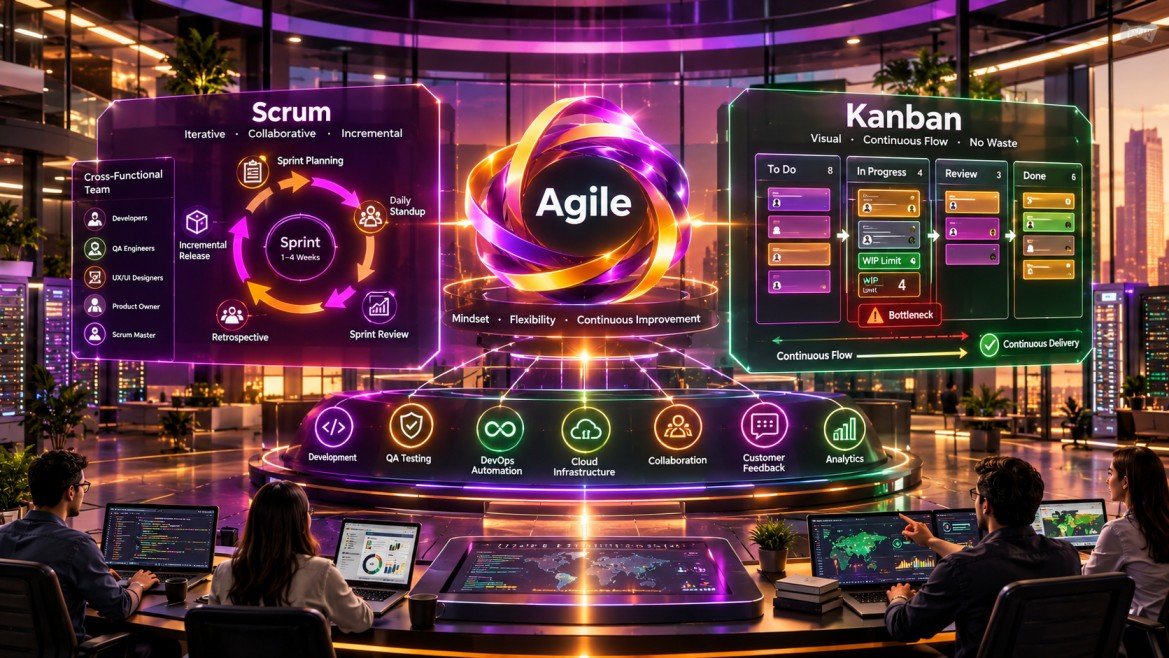
Agile is primarily a mindset and management philosophy, while Scrum and Kanban are different approaches for applying Agile principles to real-world work.
Understanding the difference between Agile vs Scrum vs Kanban can help organizations select a working model that fits their products, teams, priorities, and delivery environment.
In this guide, we will explore what Agile really means, how Scrum and Kanban work, their advantages and limitations, the lessons from Ford Motor Company’s transformation, and how to determine which approach is most suitable for your team.
Table of Contents
What Is Agile?
Agile is not simply a project-management tool or a software development methodology.
It is a mindset based on principles such as:
- Adaptability
- Collaboration
- Customer feedback
- Incremental delivery
- Continuous improvement
- Responding to change
- Working software
- Cross-functional teamwork
Traditional project approaches often attempt to define requirements, schedules, and deliverables far in advance.
Agile takes a different approach.
Instead of assuming that everything can be predicted at the beginning, Agile recognizes that requirements and market conditions can change during development.
Simple Example
Imagine a company is building a mobile banking application.
Under a rigid approach, the team might spend months defining every feature before development begins.
With an Agile approach, the team can build a smaller set of valuable features, release them, collect customer feedback, and use that information to improve subsequent versions.
The objective is not simply to work faster.
The objective is to deliver value sooner while remaining capable of adapting to change.
Agile vs Scrum vs Kanban: The Fundamental Difference
The easiest way to understand the relationship is:
Agile = Mindset
Scrum = Structured framework
Kanban = Flow-based method
Agile provides the philosophy and principles.
Scrum provides defined roles, events, artifacts, and an iterative delivery structure.
Kanban focuses on visualizing work, managing workflow, limiting work-in-progress, and improving flow.
Therefore, asking whether Agile is better than Scrum or Kanban is slightly misleading.
Scrum and Kanban can both be used to implement Agile principles.
What Is Scrum?
Scrum is a structured framework designed to help teams develop and deliver products incrementally.
Work is organized into fixed-length iterations called Sprints.
A Sprint commonly lasts between two and four weeks, although organizations may select a different duration according to their needs.
Key Scrum Roles
Scrum traditionally defines three important accountabilities:
Product Owner
The Product Owner focuses on maximizing product value and managing product priorities.
Responsibilities include:
- Maintaining the Product Backlog
- Prioritizing work
- Clarifying requirements
- Representing stakeholder interests
- Helping the team understand product goals
Scrum Master
The Scrum Master helps the team understand and apply Scrum effectively.
The role includes:
- Facilitating Scrum events
- Helping remove impediments
- Supporting continuous improvement
- Coaching the team
- Helping protect the Scrum process
Developers
Developers are responsible for creating the product increment.
The development group can include software engineers, testers, designers, analysts, and other specialists depending on the product.
Scrum Events
Scrum uses several structured events to create a regular delivery rhythm.
Sprint Planning
The team determines what work it intends to accomplish during the upcoming Sprint.
Daily Scrum
A short daily event where Developers inspect progress toward the Sprint Goal and adapt their plan as necessary.
Sprint Review
The team reviews the Sprint outcome with stakeholders and gathers feedback.
Sprint Retrospective
The team reflects on its way of working and identifies improvements for the next Sprint.
This regular inspect-and-adapt cycle is one of Scrum’s major strengths.
What Is Kanban?
Kanban is a flow-based approach to managing work.
Instead of organizing work into fixed Sprints, Kanban focuses on moving work continuously through a workflow.
A basic Kanban board might contain:
Backlog → To Do → In Progress → Testing → Done
The exact columns depend on the team’s process.
The visual board gives everyone visibility into what is happening.
The Importance of Work-in-Progress Limits
One of Kanban’s most important concepts is Work in Progress (WIP).
Without WIP limits, teams can start too many tasks simultaneously.
For example:
- Developer A starts five features.
- Developer B starts three bug fixes.
- Tester receives seven items simultaneously.
- Several tasks remain partially completed.
The result is often congestion and longer delivery times.
Kanban encourages teams to limit how much work can be active at each stage.
Example
Suppose the Testing column has a WIP limit of three.
If three items are already waiting for testing, developers should focus on helping complete existing work rather than continuously creating new work.
This encourages better flow.
Scrum vs Kanban: Key Differences
| Feature | Scrum | Kanban |
|---|---|---|
| Basic approach | Iterative | Continuous flow |
| Work structure | Sprints | Continuous workflow |
| Fixed iteration | Yes | No |
| Defined Scrum roles | Yes | No |
| WIP limits | Useful but not fundamental | Fundamental |
| Change during iteration | Generally controlled | Can be introduced continuously |
| Planning | Sprint-based | Continuous |
| Delivery | Usually Sprint-oriented | Continuous delivery possible |
| Best suited for | Product development | Flow-based/operational work |
| Metrics | Velocity, Sprint Goal, etc. | Lead time, cycle time, throughput |
Neither approach is universally superior.
The right choice depends on the team’s environment.
Agile vs Scrum vs Kanban: Which One Should You Choose?
Choosing between these approaches requires understanding how your team actually works.
Choose Scrum When Your Team Needs Structure
Scrum may be a strong option when:
- The product has a clear development roadmap
- The team benefits from regular planning cycles
- Requirements can be organized into Sprint-sized work
- Incremental releases are valuable
- The team needs defined accountabilities
- Product development is relatively complex
- Stakeholders benefit from regular review cycles
Example
A software company developing a new insurance platform could use Scrum to organize development into two-week Sprints.
One Sprint might focus on policy creation.
The next could address claims functionality.
Another could improve customer authentication.
The team continuously reviews the product and adapts priorities based on feedback.
Choose Kanban When Priorities Change Frequently
Kanban may be more appropriate when:
- Work arrives continuously
- Priorities change frequently
- Urgent requests are common
- Work items have different sizes
- Continuous delivery is important
- The team supports production systems
- Predicting Sprint scope is difficult
Example
An IT support team might receive:
- Password-reset requests
- Production incidents
- Access requests
- Application problems
- Security issues
- Infrastructure tickets
It can be difficult to organize this type of unpredictable workload into fixed two-week Sprints.
A Kanban workflow can allow work to enter and move through the system continuously.
Can Scrum and Kanban Be Combined?
Yes.
Organizations sometimes combine practices from both approaches when their circumstances require flexibility.
For example, a team might use:
- A Kanban board
- WIP limits
- Regular planning
- Retrospectives
- Continuous delivery
- Some Scrum events
The important consideration is not whether a team is following a fashionable methodology.
The real question is:
Does the chosen way of working help the team deliver valuable outcomes effectively?
Ford Motor Company: Agile Transformation Example
Ford Motor Company provides an interesting example of how large organizations can transform technology delivery.
The company moved toward more Agile and DevOps-oriented ways of working to improve software development and collaboration across teams.
The transformation was particularly important as modern vehicles increasingly became software-driven products.
Smart vehicles require software capabilities across areas such as:
- Connectivity
- Infotainment
- Driver assistance
- Mobile applications
- Cloud services
- Vehicle diagnostics
- Digital customer experiences
Traditional development approaches can struggle when software needs to evolve rapidly alongside hardware and customer expectations.
By adopting Agile and DevOps principles, Ford worked toward shorter development cycles, greater collaboration between disciplines, and faster delivery of software-enabled vehicle capabilities.
Key Lesson from Ford
The most important lesson is that Agile transformation is not simply about introducing daily meetings or putting tasks on a digital board.
Successful transformation requires changes in:
- Team collaboration
- Engineering practices
- Organizational culture
- Delivery processes
- Automation
- Feedback mechanisms
- Product development
This demonstrates how Agile principles can support large-scale digital transformation of IT and technology-enabled products.
Advantages of Agile
Agile approaches can provide several benefits.
Faster Feedback
Teams can receive customer and stakeholder feedback earlier.
Improved Adaptability
Changing requirements can be incorporated more effectively.
Better Collaboration
Cross-functional teams work together instead of operating in isolated departments.
Incremental Delivery
Value can be delivered in smaller increments instead of waiting for one large release.
Continuous Improvement
Teams regularly examine their processes and identify ways to improve.
Challenges of Agile
Agile is not a magic solution.
Organizations can face several challenges.
Poor Understanding of Agile
Some companies implement ceremonies without adopting Agile principles.
For example, conducting daily meetings does not automatically make an organization Agile.
Resistance to Change
Employees accustomed to traditional hierarchical processes may initially resist new ways of working.
Lack of Product Ownership
If product priorities are unclear, teams can struggle to determine what should be developed next.
Excessive Meetings
Agile events should create value rather than become administrative overhead.
Scaling Complexity
Large organizations may struggle to coordinate multiple Agile teams working on interconnected products.
Scrum Challenges
Scrum’s structure can become a limitation when teams treat its rules too rigidly.
Common problems include:
- Focusing on Sprint velocity instead of business value
- Overcommitting during Sprint Planning
- Treating Daily Scrum as a status meeting
- Poorly maintained Product Backlogs
- Inadequate stakeholder involvement
- Frequent interruption of Sprint work
The goal should be effective product delivery rather than maximizing the number of completed tasks.
Kanban Challenges
Kanban also has potential problems.
Unlimited Work
Without meaningful WIP limits, teams may create large queues.
Lack of Prioritization
A visual board alone does not guarantee that the most valuable work is being done.
Hidden Bottlenecks
Teams need appropriate metrics to identify where work is slowing down.
Poor Workflow Design
If the board does not reflect the actual workflow, it can provide a misleading picture of the team’s performance.
Metrics That Matter
The right metrics can help teams understand whether their delivery system is improving.
Scrum Metrics
Teams may monitor:
- Sprint Goal achievement
- Release progress
- Product quality
- Defect trends
- Customer feedback
- Delivery predictability
Velocity can be useful as a planning aid, but it should not become a performance target.
Kanban Metrics
Important flow metrics include:
- Lead time
- Cycle time
- Throughput
- Work-in-progress
- Blocked work
- Flow efficiency
These metrics help identify bottlenecks and improve delivery predictability.
Agile in Software Testing and QA
Agile has significantly changed how software testing teams operate.
In traditional development, testing might happen primarily after development has been completed.
In an Agile environment, testing is increasingly integrated throughout development.
QA professionals may participate in:
- Sprint planning
- Requirement analysis
- Test design
- API testing
- Functional testing
- Automation
- Regression testing
- Exploratory testing
- Defect analysis
- Sprint reviews
- Retrospectives
This supports the idea that quality is a shared responsibility rather than something performed only at the end.
Agile, DevOps and Continuous Delivery
Agile development and DevOps practices often complement each other.
Agile focuses heavily on iterative product development and feedback.
DevOps extends collaboration and automation across development and operations.
Together, they can support:
Plan → Develop → Test → Deploy → Monitor → Learn → Improve
Automation can accelerate this cycle.
Modern engineering organizations increasingly use:
- CI/CD pipelines
- Automated testing
- Infrastructure as Code
- Cloud platforms
- Observability
- Security automation
- Deployment automation
This is one reason Agile is increasingly connected to the broader digital transformation of IT.
Future Trends in Agile
The way teams work will continue changing.
AI-Assisted Agile
AI tools can help teams summarize requirements, generate documentation, analyze defects, create test cases, identify patterns, and support planning.
However, human judgment remains essential.
Autonomous Engineering Workflows
AI agents may increasingly assist with activities across development, testing, deployment, monitoring, and incident management.
Continuous Product Discovery
Organizations will increasingly combine development feedback with real-time customer and product data.
Outcome-Based Metrics
Companies are likely to move away from measuring productivity purely through task counts or story points.
Metrics will increasingly focus on:
- Customer value
- Quality
- Delivery speed
- Reliability
- Business outcomes
Hybrid Ways of Working
Many organizations will use combinations of Agile, Scrum, Kanban, DevOps, Lean, and continuous delivery practices rather than adopting one methodology rigidly.
The Future of IT and Agile
The future of IT will be shaped by AI, cloud computing, automation, cybersecurity, connected products, and continuous software delivery.
As technology becomes embedded in almost every business process, organizations will need delivery models capable of responding quickly to changing customer and market requirements.
The impact of IT is no longer restricted to the technology department. Software increasingly influences operations, finance, healthcare, insurance, transportation, manufacturing, retail, and customer experiences.
As a result, Agile practices will continue evolving.
The focus will increasingly shift from:
“How many tasks did we complete?”
to:
“What valuable outcome did we create?”
Agile Career Opportunities
Understanding Agile can benefit professionals across many technology roles.
Career paths that frequently interact with Agile ways of working include:
- Software Developer
- QA Engineer
- Test Engineer
- Scrum Master
- Product Owner
- Business Analyst
- DevOps Engineer
- Product Manager
- Agile Coach
- Project Manager
- Engineering Manager
- Release Manager
For QA and software testing professionals, Agile knowledge is particularly valuable because testing activities increasingly occur throughout the development lifecycle.
A Simple Decision Framework
Use this quick guide:
Select Scrum if:
- You develop a complex product.
- Your team benefits from fixed planning cycles.
- Incremental releases are important.
- Product priorities can be planned into iterations.
- Defined accountabilities would improve collaboration.
Select Kanban if:
- Work arrives continuously.
- Priorities change frequently.
- Production support is a major responsibility.
- You need continuous delivery.
- Work is difficult to estimate or batch into Sprints.
- You want to optimize workflow and reduce bottlenecks.
Start With Agile Principles if:
- Your organization is just beginning its transformation.
- Teams need greater collaboration.
- Customer feedback is limited.
- Existing processes are too rigid.
- Management wants faster adaptation but has not selected a specific framework.
Final Verdict: What’s the Best Agile Framework for You?
There is no universally “best” framework.
The right choice depends on the nature of your work.
Scrum is generally a strong choice for structured product development with iterative planning and regular increments.
Kanban is particularly useful for continuous, unpredictable, and flow-based workloads.
Agile is the broader mindset that encourages adaptability, collaboration, customer value, and continuous improvement.
Therefore, the real decision in Agile vs Scrum vs Kanban should not be about selecting the most popular methodology.
It should be about identifying the approach that helps your team deliver better outcomes.
Start with the problem.
Understand your workflow.
Identify bottlenecks.
Listen to customers.
Measure outcomes.
Then choose and adapt your way of working.
The best Agile implementation is not the one that follows the most rules. It is the one that enables people to collaborate effectively, respond to change, deliver valuable software, and continuously improve.