
Artificial intelligence is evolving from standalone chatbots into autonomous systems that can understand goals, use tools, exchange information, and complete tasks. As this evolution accelerates, AI agents need reliable ways to communicate with people, other agents, databases, APIs, and enterprise applications.
This is where AI Agent Protocols become important.
Much like HTTP established common rules that allow different systems to communicate across the internet, agent protocols are designed to create standardized ways for intelligent systems to exchange information, coordinate tasks, access resources, and interact with humans.
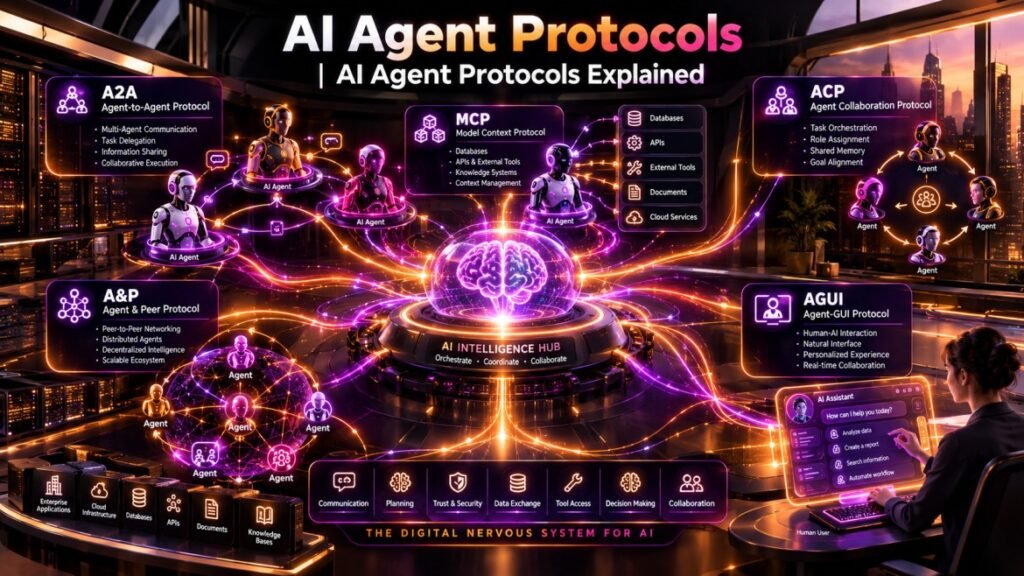
In this guide, you’ll learn what AI Agent Protocols are, how they work, the difference between A2A, MCP, ACP, A&P and AGUI, their business applications, challenges, future trends, and their potential impact on digital transformation.
Table of Contents
What Are AI Agent Protocols?
AI Agent Protocols are standardized communication and interaction mechanisms that allow AI agents to communicate, collaborate, access external resources, and interact with users in structured ways.
An AI agent is more than a conventional chatbot. It can understand a goal, reason about possible actions, use tools, retrieve information, communicate with other systems, and perform authorized tasks.
For example, imagine a travel-planning agent receiving the request:
“Plan a three-day business trip and find suitable transportation and accommodation.”
Instead of simply generating recommendations, an agent could potentially:
- Understand the travel requirements.
- Search available transportation.
- Communicate with a hotel-search agent.
- Retrieve information from external APIs.
- Compare options.
- Check company travel policies.
- Present recommendations to the user.
- Request approval before making a booking.
Protocols provide the communication foundation needed for this type of coordinated AI workflow.
Why Do AI Agents Need Protocols?
AI agents may eventually be created by different companies, organizations, and development teams.
Without common standards, every agent would need a custom integration for every other agent or application it interacts with. This could make large-scale AI ecosystems difficult to build and maintain.
Protocols can establish common approaches for:
- Communication
- Authentication
- Authorization
- Identity
- Trust
- Context sharing
- Tool access
- Task delegation
- Error handling
- Human approval
The internet provides a useful analogy. Websites, servers, browsers, and applications can communicate because they follow standardized protocols.
Similarly, AI Agent Protocols can help create an interoperable environment where intelligent systems can work together.
How Do AI Agents Interact?
There are three important interaction patterns to understand.
Agent-to-Agent (A2A)
Agent-to-Agent communication allows one autonomous AI agent to communicate directly with another.
Consider an employee’s scheduling agent that needs to arrange a meeting with another employee.
Instead of asking both people to compare calendars manually, one agent could communicate with another agent to determine:
- Available times
- Meeting duration
- Time-zone differences
- Calendar conflicts
- Scheduling preferences
The agents can exchange structured information and coordinate the task according to their permissions.
Agent-to-User (AGUI)
Agent-to-User interaction represents the interface between humans and AI agents.
As AI systems become more autonomous, users need to understand what an agent is doing and maintain appropriate control.
A useful agent interface can communicate:
- The user’s request
- The agent’s intended plan
- Information being accessed
- Actions being proposed
- Approval requirements
- Completed actions
This is particularly important when an agent performs sensitive or consequential tasks.
Agent-to-Resource (A2R)
AI agents frequently need information from external resources.
These resources can include:
- Databases
- APIs
- Cloud storage
- Enterprise documents
- Files
- Search systems
- Business applications
A2R describes the interaction between an agent and these external resources.
For example, a financial agent may need to access a customer’s approved account information without receiving unrestricted access to an organization’s entire database.
Security and authorization are therefore critical parts of resource access.
Five Important AI Agent Protocols
Several protocols and protocol concepts are becoming increasingly relevant to the development of interconnected AI systems.
1. A2A — Agent-to-Agent
A2A enables AI agents to communicate and collaborate directly.
A standardized agent-to-agent mechanism can support:
- Message exchange
- Task delegation
- Capability discovery
- Collaboration
- Status updates
- Trust relationships
Example of A2A
A customer-service agent receives a question about an order.
It could communicate with:
Customer Service Agent → Order Agent → Shipping Agent
The specialized agents can provide information to the primary agent, which then gives the customer a consolidated response.
2. MCP — Model Context Protocol
Model Context Protocol, or MCP, provides a standardized approach for connecting AI applications with external data sources and tools.
An AI application may need access to:
- Files
- Databases
- APIs
- Development tools
- Enterprise systems
- Knowledge repositories
Instead of building completely different integration mechanisms for every application, MCP provides a common framework for exposing context and capabilities to compatible AI systems.
MCP can therefore simplify how AI applications interact with external information and tools.
3. ACP — Agent Communication Protocol
Agent Communication Protocol focuses on communication and coordination between collaborative agents.
A complex business process might use several specialized agents.
For example:
Research Agent → Analysis Agent → Planning Agent → Execution Agent
Each agent has a different responsibility.
A communication protocol can help these systems exchange information, coordinate activities, and work toward a shared objective.
4. A&P — Agent Network Protocol
Agent Network Protocol can be considered a networking layer for distributed AI agents.
This becomes particularly relevant when agents operate across:
- Organizations
- Cloud environments
- Enterprise networks
- Geographic locations
- Distributed platforms
Future agent ecosystems may contain systems belonging to different organizations. Network-oriented protocols could help authorized agents communicate across those environments.
5. AGUI — Agent User Interface Protocol
AGUI focuses on interactions between AI agents and humans.
As agents become more capable, the user interface must evolve beyond a simple chat window.
An advanced agent interface could show:
User Request → Agent Plan → Data Access → Proposed Action → Approval → Execution
This gives users better visibility into autonomous workflows.
How AI Agent Protocols Work Together
The greatest potential may come from combining different interaction layers rather than using a single protocol.
Consider an enterprise procurement workflow.
A user asks:
“Find suitable suppliers and prepare a purchase recommendation.”
The workflow could involve several stages.
Step 1: User Interaction
The user communicates with a procurement agent.
Step 2: Planning
The agent determines which tasks are required.
Step 3: Agent Collaboration
The procurement agent communicates with specialized research or supplier agents.
Step 4: Resource Access
Agents retrieve information from databases, APIs, supplier catalogs, and internal documents.
Step 5: Analysis
The system evaluates price, delivery time, quality, availability, and business requirements.
Step 6: Validation
The recommendation is checked against company policies.
Step 7: Human Approval
The user reviews the proposed recommendation.
Step 8: Authorized Action
The system performs the approved workflow.
This illustrates how protocols can connect humans, AI agents, data, tools, and enterprise applications.
Benefits of AI Agent Protocols
Improved Interoperability
Standardized communication can make it easier for agents developed by different teams or organizations to interact.
Better Automation
Agents can delegate tasks and coordinate activities without requiring humans to manually move information between applications.
Faster AI Development
Reusable communication standards can reduce the amount of custom integration work required.
Scalable Multi-Agent Systems
Organizations can build networks of specialized agents instead of relying on a single general-purpose AI system.
Greater Transparency
Human-facing protocols can provide users with more visibility into agent activities and decisions.
Real-World Applications
Customer Support
A customer-service agent could coordinate with specialized billing, shipping, product, and technical-support agents.
This could help resolve complex requests without requiring the customer to interact with multiple departments.
Healthcare
AI systems could potentially coordinate administrative workflows, information retrieval, scheduling, and clinical support.
However, healthcare applications require strict privacy protection, security, validation, regulatory compliance, and human oversight.
Financial Services
Agent-based systems could assist with:
- Document processing
- Customer onboarding
- Compliance research
- Financial analysis
- Risk assessment
- Fraud investigation
Supply Chain
Multiple agents could coordinate:
- Inventory
- Procurement
- Supplier information
- Transportation
- Demand forecasting
Software Development
Specialized development agents could collaborate on:
- Code generation
- Testing
- Documentation
- Security analysis
- Deployment preparation
Challenges of AI Agent Protocols
Security and Trust
Autonomous agents may receive access to important business systems.
A compromised or incorrectly configured agent could therefore create serious security risks.
Organizations need strong:
- Authentication
- Authorization
- Access controls
- Sandboxing
- Monitoring
- Audit logging
Data Privacy
Agents can potentially process confidential business and personal information.
Organizations must control how information is accessed, transmitted, stored, and shared.
Interoperability
Multiple protocols do not automatically guarantee universal compatibility.
Successful interoperability requires consistent schemas, capabilities, authentication models, and implementation standards.
AI Hallucinations
AI agents can still make incorrect assumptions or generate inaccurate information.
In a multi-agent environment, an incorrect output from one agent could influence another agent.
Validation and monitoring are therefore essential.
Human Oversight
Not every decision should be fully autonomous.
High-impact workflows should provide mechanisms for human review, approval, intervention, and escalation.
Future Trends in AI Agent Protocols
The development of interoperable AI systems is likely to accelerate as autonomous agents become more capable.
Multi-Agent Ecosystems
Instead of one AI performing every task, businesses may deploy networks of specialized agents.
Cross-Organization Collaboration
Authorized agents could eventually communicate between companies to automate selected business processes.
For example, a buyer’s procurement agent could communicate with an authorized supplier agent.
Agent Discovery
Future systems may need ways to identify agents based on their capabilities.
A business agent could ask:
“Which authorized agent can verify international shipping requirements?”
The ecosystem could then locate an appropriate service.
Stronger Agent Identity
Digital identity, authorization, reputation, and trust will become increasingly important as agents gain access to more systems.
Human-Agent Collaboration
Rather than completely replacing humans, many enterprise AI systems may combine autonomous execution with human approval for important decisions.
These developments could make AI Agent Protocols an important part of the future of technology.
Opportunities for Businesses
Organizations interested in agent-based AI can begin with narrowly defined workflows.
Potential opportunities include:
- Enterprise knowledge management
- Customer support automation
- Document processing
- IT service management
- Research automation
- Software development
- Supply-chain coordination
- Business intelligence
- Workflow orchestration
The strongest opportunities are likely to appear where employees currently move information manually between multiple systems.
Impact of AI Agent Protocols on Digital Transformation
The impact of it could extend well beyond conversational AI.
Many organizations currently operate separate systems for CRM, ERP, databases, email, spreadsheets, ticketing, documentation, and business applications.
Employees often have to manually transfer information between these systems.
AI agents could eventually act as an intelligent coordination layer.
A protocol-enabled workflow could allow an agent to:
- Understand a business objective.
- Identify the required resources.
- Communicate with specialized agents.
- Retrieve information.
- Analyze the results.
- Validate the outcome.
- Request human approval.
- Execute authorized actions.
- Report the result.
This could accelerate digital transformation by connecting previously disconnected applications through intelligent software agents.
AI Agent Protocols vs APIs
APIs already allow software applications to communicate, so why do AI agents need protocols?
Traditional APIs typically expose predefined functions.
For example, an API might provide a specific operation for retrieving customer information.
An AI agent may need to determine:
- Which system should be accessed?
- Which information is required?
- Which tool should be used?
- What should happen if information is missing?
- Should another agent be contacted?
- Does the user need to approve the action?
Agent protocols address the dynamic nature of agent-based workflows.
They do not necessarily replace APIs. Instead, they can help AI systems discover, communicate with, and use APIs and other resources more effectively.
Conclusion
AI Agent Protocols provide an important foundation for a future in which intelligent systems can communicate, collaborate, access resources, and work alongside humans.
A2A can facilitate agent-to-agent communication, MCP can connect AI applications with external context and tools, ACP can support collaborative agent communication, A&P can support distributed agent networking, and AGUI can improve human-agent interaction.
Together, these technologies represent a potential digital nervous system for intelligent software.
The long-term opportunity is substantial. Instead of operating hundreds of isolated AI applications, businesses could build interconnected ecosystems of specialized agents.
As interoperability, security, governance, and standards mature, AI Agent Protocols could become an important foundation for enterprise AI and a major component of the future of technology.