
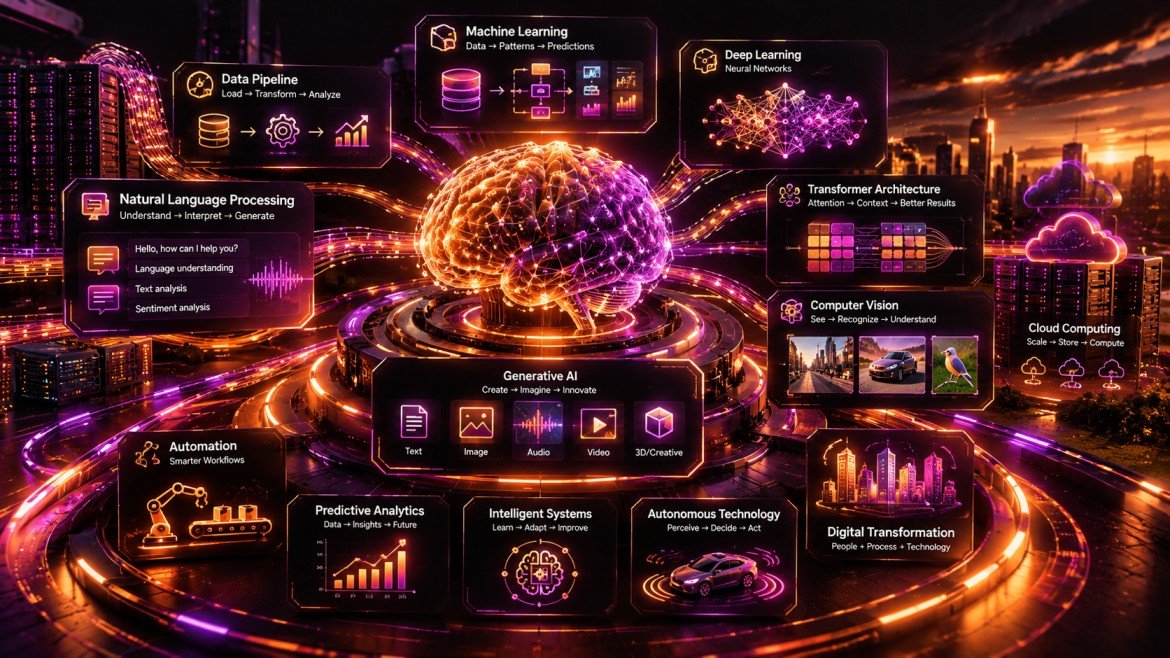
Artificial Intelligence (AI) has moved from being a futuristic concept to becoming an important part of everyday technology. When you use a voice assistant, receive a personalized recommendation, unlock a device using your face, interact with a chatbot, or generate an image from a text prompt, AI may be working behind the scenes.
But what exactly is Artificial Intelligence? How does a machine learn from data? What is the difference between AI, Machine Learning, Deep Learning, Generative AI, Natural Language Processing, and Computer Vision?
This AI Explained guide provides a clear introduction to the major concepts behind modern Artificial Intelligence. It explores how machines learn, how neural networks process information, and how technologies such as Transformers, ChatGPT, image generation, and autonomous systems are shaping the future.
Understanding these foundations is increasingly important because AI is becoming a major driver of digital transformation across businesses, education, healthcare, finance, manufacturing, software development, and many other industries.
Table of Contents
What Is Artificial Intelligence?
Artificial Intelligence (AI) is a field of computer science focused on creating systems capable of performing tasks that traditionally require human intelligence.
These tasks can include:
- Recognizing patterns
- Understanding speech
- Analyzing images
- Understanding language
- Making predictions
- Solving problems
- Supporting decisions
- Generating content
- Learning from data
A traditional software program generally follows rules explicitly defined by developers. AI systems can use data, statistical methods, and learned patterns to produce predictions or decisions.
Simple Example of AI
Suppose an application receives thousands of images containing different types of objects.
An AI-powered system can be trained to recognize patterns within these images and subsequently identify objects in images it has never seen before.
This ability to identify patterns is one of the fundamental capabilities behind modern AI applications.
AI vs Machine Learning
One of the most common sources of confusion is the difference between Artificial Intelligence and Machine Learning.
AI is the broader field. Machine Learning (ML) is a major subset of AI.
Machine Learning allows computer systems to learn patterns from data rather than relying entirely on manually programmed rules.
For example, instead of writing thousands of rules to identify fraudulent transactions, an ML system can analyze historical transaction data and learn patterns associated with suspicious activity.
How Machine Learning Works
Machine Learning can broadly be understood through two important stages:
1. Training
During training, an algorithm processes historical data to identify useful patterns.
For example:
Historical customer data → ML algorithm → Learned model
The quality and relevance of the training data can strongly influence the resulting model.
2. Inference
After training, the model can process new data and generate a prediction or output.
For example:
New transaction → Trained model → Fraud probability
This stage is called inference.
The distinction between training and inference is fundamental to understanding how modern AI systems operate.
Types of Machine Learning
Machine Learning is commonly divided into three major categories: supervised learning, unsupervised learning, and reinforcement learning.
Supervised Learning
In supervised learning, the model learns from labeled data.
The training dataset contains examples where the desired output is already known.
For instance:
| Input | Label |
|---|---|
| Email A | Spam |
| Email B | Not Spam |
| Email C | Spam |
The model learns the relationship between the input and the corresponding label.
Classification
Classification assigns data to predefined categories.
Examples include:
- Spam vs non-spam email
- Fraud vs legitimate transaction
- Disease categories
- Customer segments
- Image categories
Regression
Regression predicts a numerical value.
Examples include:
- House price prediction
- Sales forecasting
- Demand prediction
- Temperature forecasting
- Revenue estimation
The key difference is simple: classification predicts a category, while regression predicts a numerical value.
Unsupervised Learning
Unsupervised learning works with unlabeled data.
Instead of providing the correct answers during training, the algorithm attempts to discover useful structures or relationships within the dataset.
Two common applications are clustering and association.
Clustering
Clustering groups similar data points together.
For example, an online retailer could analyze customer behavior and automatically identify groups such as:
- Frequent buyers
- Occasional buyers
- Discount-focused customers
- High-value customers
The groups are discovered from patterns in the data rather than being manually assigned beforehand.
Association
Association techniques identify relationships between items or events.
A classic example is market basket analysis.
If customers frequently purchase products A and B together, an association algorithm may identify that relationship.
Retailers can use such information to improve:
- Product recommendations
- Promotions
- Store layouts
- Cross-selling
- Personalized shopping experiences
Reinforcement Learning
Reinforcement Learning (RL) uses a different approach.
An agent interacts with an environment and learns which actions produce better outcomes.
The basic concept can be represented as:
Agent → Action → Environment → Reward → Learning
The agent attempts to maximize its cumulative reward over time.
Example
Imagine an AI system learning to play a game.
- A successful move receives a positive reward.
- A poor move may receive a negative reward.
- The system gradually learns which actions produce better results.
Reinforcement learning has applications in areas such as robotics, game-playing systems, optimization, autonomous decision-making, and control systems.
What Is Deep Learning?
Deep Learning is a specialized subset of Machine Learning that uses multi-layer neural networks to learn complex patterns.
Traditional ML approaches may require carefully selected features for particular problems. Deep learning can automatically learn increasingly sophisticated representations from large datasets.
Deep learning has contributed significantly to advances in:
- Computer vision
- Speech recognition
- Natural language processing
- Generative AI
- Autonomous systems
- Recommendation systems
What Are Neural Networks?
Artificial Neural Networks are computational models inspired loosely by the structure and information-processing principles of biological neural networks.
A neural network consists of interconnected computational units commonly organized into layers.
A simplified architecture contains:
Input Layer → Hidden Layers → Output Layer
The network uses parameters called weights and biases to transform input data.
During training, these parameters are adjusted so that the model becomes better at producing the desired output.
Forward Propagation
During forward propagation, information moves from the input layer through the network toward the output layer.
Each layer performs mathematical transformations on the information it receives.
The final layer produces the model’s prediction or output.
Backward Propagation
During backpropagation, the model calculates how much its prediction differs from the expected result.
An optimization algorithm then adjusts the network’s weights to reduce the error.
This process is repeated many times during training.
Major Neural Network Architectures
Different neural network architectures are designed for different types of problems.
Feed Forward Neural Networks
Feed Forward Neural Networks (FNNs) process information in one direction, from input toward output.
They can be useful for structured prediction and classification tasks.
Recurrent Neural Networks
Recurrent Neural Networks (RNNs) were designed to process sequential information by maintaining information from previous steps.
They have been used for:
- Speech processing
- Time-series analysis
- Text processing
- Sequential prediction
LSTM Networks
Long Short-Term Memory (LSTM) networks are a type of recurrent architecture designed to handle longer-term dependencies more effectively than basic RNNs.
They have historically been useful in language and sequence-processing applications.
Convolutional Neural Networks
Convolutional Neural Networks (CNNs) are particularly important in computer vision.
CNNs can learn visual patterns such as:
- Edges
- Shapes
- Textures
- Object features
They have been widely used for image classification, object detection, facial recognition, medical imaging, and other visual tasks.
Transformers
Transformers have become one of the most influential neural network architectures in modern AI.
They use attention mechanisms to process relationships between different parts of an input sequence.
Transformers have played a major role in the development of modern language models and Generative AI systems.
Their influence extends beyond text to areas such as images, audio, video, and multimodal AI.
What Is Generative AI?
Generative AI refers to AI systems capable of creating new content based on patterns learned from training data.
Depending on the system, generated content can include:
- Text
- Images
- Audio
- Video
- Code
- Structured information
A chatbot that generates an answer to a question is an example of generative AI.
An image-generation system that creates artwork from a text description is another example.
Generative AI represents an important stage in the evolution of AI because systems are no longer limited to classification or prediction. They can also produce new content.
Natural Language Processing
Natural Language Processing (NLP) focuses on enabling computers to process and understand human language.
NLP technologies support applications such as:
- Chatbots
- Translation
- Sentiment analysis
- Text summarization
- Speech-related systems
- Search
- Question answering
- Document analysis
Modern language models have significantly expanded the capabilities of NLP by allowing AI systems to work with complex language and context.
Computer Vision
Computer Vision enables machines to interpret and analyze visual information.
A computer vision system can process images or video to identify objects, detect patterns, or extract useful information.
Applications include:
- Medical image analysis
- Autonomous vehicles
- Security systems
- Manufacturing inspection
- Facial recognition
- Retail analytics
- Agricultural monitoring
For example, a manufacturing company can use computer vision to automatically detect defects on a production line.
How ChatGPT Fits Into AI
ChatGPT is an example of a modern AI application powered by large language model technology.
At a high level, a language model learns statistical patterns in language from large datasets and can use those learned patterns to generate responses.
Users can interact with such systems for tasks including:
- Question answering
- Writing assistance
- Summarization
- Brainstorming
- Coding support
- Translation
- Information organization
This illustrates how several AI concepts come together: machine learning, deep learning, neural networks, Transformers, NLP, and Generative AI.
AI and Digital Transformation
AI is becoming one of the major technologies driving digital transformation.
Organizations are integrating AI into existing workflows instead of treating it only as an experimental technology.
Business Impact of AI
AI can help organizations:
- Automate repetitive processes
- Analyze large datasets
- Improve customer experiences
- Support employees
- Detect anomalies
- Personalize services
- Accelerate software development
- Improve operational decision-making
Example of Digital Transformation
Consider an insurance company.
Traditional claims processing may involve manually reviewing documents, extracting information, classifying claims, and routing cases.
AI can assist with:
Document → AI extraction → Classification → Risk assessment → Human review
The goal is not necessarily to remove humans from the process. Instead, AI can automate repetitive activities and allow employees to focus on complex decisions.
Real-World Applications of AI
AI is already influencing numerous industries.
Healthcare
AI can support:
- Medical image analysis
- Clinical research
- Patient-service automation
- Drug discovery
- Administrative workflows
Finance
Financial institutions use AI for:
- Fraud detection
- Risk analysis
- Customer support
- Algorithmic decision support
- Transaction monitoring
Education
AI can support:
- Personalized learning
- Automated feedback
- Content creation
- Learning assistants
- Knowledge discovery
Manufacturing
AI can improve:
- Predictive maintenance
- Quality inspection
- Supply-chain forecasting
- Production optimization
Retail
Retail businesses can use AI for:
- Recommendations
- Demand forecasting
- Customer segmentation
- Inventory optimization
- Conversational commerce
Challenges of Artificial Intelligence
Although AI offers enormous opportunities, its adoption also introduces important challenges.
Data Quality
AI systems depend heavily on data. Poor-quality, incomplete, outdated, or biased data can produce unreliable results.
Bias and Fairness
AI models can reproduce undesirable patterns present in their training data.
Organizations therefore need appropriate testing, monitoring, governance, and human oversight.
Explainability
Some sophisticated AI systems can be difficult to interpret.
In high-impact applications, organizations may need to understand why a system produced a particular recommendation or prediction.
Security
AI systems can introduce new security risks, including attacks designed to manipulate inputs or exploit model behavior.
Privacy
AI applications may process sensitive or confidential information. Organizations must therefore establish appropriate data-handling and access controls.
Hallucinations and Reliability
Generative AI systems can sometimes produce convincing but incorrect information.
For important applications, AI-generated outputs should be appropriately validated rather than automatically treated as factual.
Future of Artificial Intelligence
The future of AI is likely to be defined by increasingly capable, efficient, multimodal, and specialized systems.
Several developments are particularly important.
Multimodal AI
Future AI systems will increasingly combine text, images, audio, video, and other data types.
This can enable more natural interaction between humans and machines.
AI Agents
AI systems are moving beyond answering individual prompts toward completing multi-step tasks.
AI agents may be able to plan activities, use tools, retrieve information, and execute workflows under appropriate controls.
Smaller and More Efficient Models
Advances in model optimization will make powerful AI capabilities more accessible on local devices and specialized hardware.
AI at the Edge
More processing may happen directly on smartphones, computers, vehicles, industrial equipment, and IoT devices.
This can reduce latency and improve data control.
Human-AI Collaboration
Rather than simply replacing human workers, many AI systems will increasingly function as collaborative tools.
The greatest value may come from combining machine speed and pattern recognition with human judgment, creativity, and domain expertise.
Opportunities Created by AI
The growth of AI is creating opportunities for both organizations and professionals.
Career Opportunities
Demand is increasing across areas such as:
- AI engineering
- Machine Learning
- Data Science
- Prompt Engineering
- AI Product Management
- MLOps
- AI Testing
- Cybersecurity
- Data Engineering
- AI Governance
Business Opportunities
Companies can create AI-powered products and services in areas such as:
- Customer experience
- Automation
- Analytics
- Healthcare
- Financial technology
- Education
- Marketing
- Enterprise software
Professionals who combine AI knowledge with domain expertise may have a particularly strong advantage as adoption grows.
AI Explained: Why Understanding the Basics Matters
The AI ecosystem can initially appear complicated because it contains many related technologies.
A simple hierarchy makes the relationship easier to understand:
Artificial Intelligence
↓
Machine Learning
↓
Deep Learning
↓
Neural Networks
↓
Modern architectures such as Transformers
↓
Generative AI applications
At the same time, areas such as NLP and Computer Vision apply these technologies to language and visual information.
Understanding this structure provides a foundation for exploring more advanced AI concepts.
Conclusion
Artificial Intelligence is not a single technology. It is a broad field that includes Machine Learning, Deep Learning, neural networks, NLP, Computer Vision, Generative AI, reinforcement learning, and many other techniques.
As this AI Explained guide demonstrates, each component plays a different role in building intelligent systems.
Machine Learning enables systems to learn from data. Deep Learning uses neural networks to learn complex representations. CNNs are highly important for visual tasks, recurrent architectures have supported sequential processing, and Transformers have become foundational to many modern AI systems.
Generative AI is now expanding what machines can produce, while AI is becoming an increasingly important driver of digital transformation.
The future will likely bring more capable, efficient, multimodal, and specialized AI systems. At the same time, organizations will need to address challenges involving privacy, security, bias, reliability, governance, and responsible deployment.
The most important lesson from this AI Explained overview is that understanding AI is no longer relevant only to data scientists or AI engineers. As AI becomes embedded into products, businesses, and everyday digital experiences, basic AI literacy will become increasingly valuable for professionals across industries.