
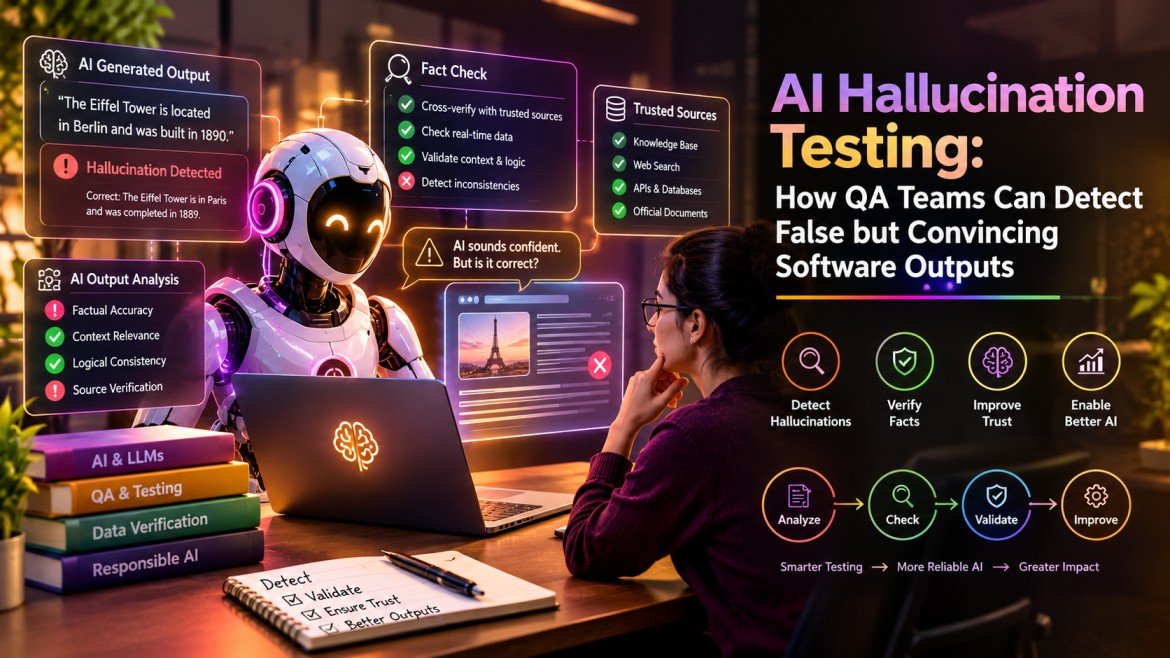
Artificial intelligence is changing how modern software is designed, developed, tested, and maintained. Generative AI systems can write code, summarize documents, answer questions, analyze data, generate test cases, and support customer-facing applications. But there is a critical quality problem behind these capabilities: AI can produce information that sounds correct while being factually wrong.
These incorrect but convincing responses are commonly known as AI hallucinations.
For traditional software, QA teams generally verify whether an application produces the expected result for a defined input. AI-powered software introduces another layer of complexity because the same input may produce different outputs, and an incorrect answer may look completely reasonable.
This is where AI Hallucination Testing becomes important.
QA engineers must increasingly validate not only whether an AI application responds, but whether its response is accurate, relevant, grounded, consistent, explainable, and safe.
As organizations accelerate digital transformation through generative AI, hallucination detection is becoming an important part of modern Quality Engineering. The future of software testing will therefore require QA professionals to understand both traditional testing principles and AI-specific validation techniques.
Table of Contents
What Is AI Hallucination?
An AI hallucination occurs when an AI system generates information that is unsupported, inaccurate, fabricated, or inconsistent with the available evidence while presenting it with confidence.
For example, imagine an insurance chatbot connected to a policy database.
A customer asks:
“Does my policy cover windshield damage?”
The AI responds:
“Yes, windshield damage is covered under your comprehensive policy.”
However, the actual policy may exclude glass damage unless a specific endorsement is present.
The response sounds professional and plausible, but it is incorrect.
This is particularly dangerous in domains such as:
- Insurance
- Healthcare
- Banking
- Legal services
- Financial services
- Customer support
- Enterprise knowledge management
- Software development
The challenge for QA teams is that traditional pass/fail testing may not adequately capture these failures.
Why AI Hallucinations Are a QA Problem
Traditional applications usually follow deterministic business rules.
For example:
Input → Business Logic → Expected Output
AI applications can behave differently:
Input → Retrieval/Context → Model Reasoning → Generated Output
Several variables can influence the final response, including:
- Prompt wording
- Context
- Retrieved documents
- Model version
- Temperature and sampling
- System instructions
- Conversation history
- External tools
- Knowledge sources
Consequently, testing AI systems requires more than checking whether a predefined output matches an expected string.
AI Hallucination Testing focuses on determining whether generated information can be trusted within the application’s intended context.
Common Types of AI Hallucinations
1. Factual Hallucination
The model provides information that is factually incorrect.
Example:
A customer asks for a product’s cancellation period, and the AI invents a 30-day cancellation policy when the actual period is 14 days.
2. Fabricated References
The system creates nonexistent documents, URLs, research papers, regulations, or case numbers.
For example, an AI assistant might cite a research paper that sounds authentic but cannot actually be found.
3. Contextual Hallucination
The information may be generally true but does not apply to the user’s specific situation.
For example:
“This insurance policy covers flood damage.”
The statement might be true for one product but incorrect for the customer’s actual policy.
4. Numerical Hallucination
AI systems may produce incorrect calculations, percentages, dates, totals, or financial figures.
This is particularly important when AI is integrated with enterprise applications.
5. Conversational Hallucination
The model may contradict information provided earlier in the conversation.
For example:
- User provides a policy number.
- AI confirms the policy is active.
- Later, the same AI claims the policy expired.
- No underlying data changed.
6. Instruction-Based Hallucination
Conflicting or ambiguous instructions can cause an AI system to produce an answer that violates application requirements.
QA teams need to test how the application behaves under normal, ambiguous, incomplete, and adversarial inputs.
What Is AI Hallucination Testing?
AI Hallucination Testing is the systematic process of identifying, measuring, and preventing unsupported or incorrect outputs generated by AI-powered applications.
It combines conventional software testing with AI-specific evaluation techniques.
A QA team may evaluate:
- Factual accuracy
- Contextual relevance
- Groundedness
- Completeness
- Consistency
- Citation accuracy
- Instruction following
- Safety
- Robustness
- Response variability
The objective is not necessarily to force an AI system to produce identical responses every time.
Instead, QA engineers need to determine whether different acceptable responses remain correct and trustworthy.
How QA Teams Can Detect AI Hallucinations
1. Establish a Ground Truth
The first step is creating a reliable source of truth.
This could include:
- Approved business documents
- Product specifications
- Insurance policy rules
- API responses
- Database records
- Regulatory documentation
- Knowledge-base articles
- Verified datasets
The AI response can then be compared with this reference information.
Example
Suppose a chatbot retrieves an insurance policy document.
Ground truth:
Collision coverage has a deductible of $500.
AI response:
Your collision coverage has a $500 deductible.
This response is grounded in the source.
If the AI responds:
Your collision coverage has a $1,000 deductible.
The response should be flagged for investigation.
2. Build a Hallucination Test Dataset
QA teams should create dedicated datasets containing realistic AI scenarios.
A test dataset can include:
| Test Category | Example |
|---|---|
| Correct information | Ask about known policy details |
| Missing information | Ask about unavailable data |
| Ambiguous question | Ask an unclear customer question |
| Contradictory information | Provide conflicting inputs |
| Out-of-scope question | Ask unrelated questions |
| Adversarial prompt | Attempt to override system rules |
| Numerical question | Ask for calculations |
| Citation question | Request supporting sources |
This dataset becomes a reusable regression suite.
3. Test Against Trusted Sources
For enterprise AI applications, QA engineers should compare responses against authoritative data.
Consider a retrieval-augmented generation system.
The testing flow can be:
User Question → Retrieval → Context → LLM → Generated Answer
QA can validate each stage separately.
Retrieval Validation
Check whether the correct documents were retrieved.
Context Validation
Check whether relevant information was supplied to the model.
Generation Validation
Check whether the final response accurately represents the supplied information.
This layered approach can help determine where the hallucination originated.
4. Validate Citations and References
An AI response containing a citation is not automatically trustworthy.
QA teams should verify:
- Does the cited source exist?
- Does the URL work?
- Does the document contain the claimed information?
- Is the citation relevant to the answer?
- Has the AI misunderstood the source?
- Is the citation fabricated?
For enterprise applications, citation validation can become an automated test step.
5. Test Numerical Accuracy
Numbers deserve special attention.
Suppose an AI assistant receives:
- Premium = $1,200
- Deductible = $500
- Tax = $120
The assistant should not randomly generate a different total.
QA teams can validate calculations against deterministic logic or an external calculation service.
A useful architecture is:
AI → Extract Values → Deterministic Calculator → Compare Result
This reduces dependence on the language model for arithmetic operations.
6. Test Different Prompt Variations
AI applications can respond differently depending on how a question is phrased.
QA engineers should create multiple variations of the same intent.
For example:
- “Is flood damage covered?”
- “Does my policy cover flooding?”
- “What happens if my property is damaged by flood water?”
- “Would I be insured if heavy rain causes flooding?”
The underlying business question is similar.
The responses should remain consistent with the authoritative policy information.
7. Perform Negative Testing
Negative testing is particularly important for AI applications.
QA teams should intentionally provide:
- Incorrect assumptions
- Missing information
- Conflicting instructions
- Unsupported claims
- Impossible scenarios
- Malformed input
- Irrelevant questions
The expected behavior is not necessarily an answer.
Sometimes the correct result is:
“I don’t have enough information to answer that accurately.”
A controlled refusal or clarification request can be a successful test outcome.
8. Measure Groundedness
Groundedness measures whether an AI response is supported by the information available to the system.
For example:
Retrieved information:
Policy excludes flood damage.
Generated answer:
Flood damage is excluded under this policy.
This is grounded.
But:
Flood damage is covered after a 30-day waiting period.
If no such waiting period exists in the source, the answer is unsupported.
Groundedness testing is especially important for RAG applications.
9. Perform Regression Testing
AI models, prompts, retrieval systems, and knowledge bases can change frequently.
A model update that improves one scenario may unintentionally introduce failures elsewhere.
Therefore, QA teams should maintain a reusable hallucination regression suite.
The suite can run after:
- Model upgrades
- Prompt changes
- RAG configuration changes
- Knowledge-base updates
- API changes
- Application releases
- Fine-tuning
- System instruction changes
This makes AI Hallucination Testing an ongoing Quality Engineering activity rather than a one-time test phase.
AI Hallucination Testing Metrics
Traditional testing uses metrics such as pass rate, defect density, and test coverage.
AI applications require additional measurements.
Important AI Quality Metrics
Hallucination Rate
Percentage of tested responses containing unsupported or incorrect information.
Groundedness Score
Measures how strongly responses are supported by available context.
Factual Accuracy
Measures whether statements correspond to verified facts.
Citation Accuracy
Measures whether citations actually support the generated claims.
Consistency
Measures whether similar prompts generate logically compatible answers.
Abstention Quality
Measures whether the AI appropriately refuses or requests clarification when sufficient information is unavailable.
Toxicity and Safety
Checks whether the system produces unsafe, harmful, or inappropriate responses.
These metrics can be tracked across releases to identify quality trends.
Example: Testing an AI Insurance Assistant
Consider an AI assistant used by an insurance company.
A customer asks:
“Is theft of personal belongings covered under my policy?”
The AI retrieves the customer’s policy information.
Test Case 1: Correct Information
Source: Personal belongings are covered up to $20,000.
AI: Personal belongings are covered up to $20,000.
Result: Pass.
Test Case 2: Incorrect Limit
AI: Personal belongings are covered up to $50,000.
Result: Potential hallucination.
Test Case 3: Missing Information
The policy does not specify whether a particular item is covered.
A responsible response would request clarification or direct the customer to the relevant policy terms.
Test Case 4: Fabricated Clause
The AI claims:
“Section 12.4 automatically covers all electronic devices.”
If Section 12.4 does not exist, the response should be classified as a hallucination.
This example demonstrates why AI testing needs domain-specific ground truth.
Challenges in AI Hallucination Testing
Non-Deterministic Responses
Traditional automation expects predictable outputs.
AI systems can generate multiple valid responses for the same question.
QA automation therefore needs semantic validation rather than simple string comparison.
Defining Expected Results
For conventional software:
Expected Output = Exact or predefined result
For generative AI:
Expected Output = Acceptable range of correct responses
This makes test design more complex.
Context Dependency
An answer may be correct in one context and incorrect in another.
QA engineers therefore need to validate the relationship between:
- User input
- Retrieved context
- System instructions
- Generated response
Model Updates
Changing the underlying model can change application behavior.
A previously stable test suite may suddenly identify new failures.
Measuring Partial Correctness
AI responses are not always completely right or completely wrong.
A response may contain:
- 80% correct information
- One inaccurate statement
- One unsupported assumption
QA teams need classification rules for such cases.
How Automation Can Improve AI Testing
Automation can significantly expand the number of AI scenarios that QA teams can evaluate.
A modern AI testing pipeline could include:
Test Data → Prompt Generator → AI Application → Response Capture → Evaluation → Reporting
Automated checks can verify:
- Required information
- Forbidden information
- Source references
- Numerical values
- Response structure
- Groundedness
- Semantic similarity
- Policy compliance
Human review can then focus on ambiguous or high-risk cases.
This hybrid approach combines automated scalability with human judgment.
Role of QA Engineers in the AI Era
AI does not eliminate the need for QA engineers.
Instead, the role is evolving.
Traditional QA focuses heavily on:
- Functional correctness
- Regression testing
- Integration testing
- UI testing
- API testing
- Database validation
AI Quality Engineering adds:
- Prompt testing
- Model evaluation
- Dataset testing
- RAG validation
- Hallucination detection
- AI safety testing
- LLM response evaluation
- AI observability
- Semantic testing
QA engineers who understand both software testing and AI systems can contribute significantly to enterprise AI initiatives.
AI Hallucination Testing and Digital Transformation
Digital transformation is moving beyond simply migrating manual processes to software platforms.
Organizations are increasingly embedding AI into:
- Customer service
- Claims processing
- Software development
- Document processing
- Knowledge management
- Fraud detection
- Business analytics
- Enterprise search
The impact of AI therefore extends directly into software quality.
If an AI-powered process produces incorrect information, the problem can propagate into downstream systems and business decisions.
For example:
AI Recommendation → Employee Decision → Business Transaction → Customer Impact
A hallucination at the first stage can therefore create a chain of downstream errors.
This is why AI quality assurance needs to become part of broader digital transformation governance.
Future Trends in AI Hallucination Testing
1. Continuous AI Evaluation
Testing will increasingly move from release-based validation toward continuous evaluation.
AI applications can be monitored against production-like datasets and predefined quality thresholds.
2. AI-Powered QA Assistants
AI tools themselves will help QA engineers generate:
- Test scenarios
- Edge cases
- Prompt variations
- Evaluation datasets
- Failure classifications
- Regression suites
However, these AI-generated tests will also require validation.
3. Automated Ground-Truth Comparison
Future testing platforms will increasingly compare generated answers against authoritative knowledge sources automatically.
This can reduce manual evaluation effort.
4. Explainable AI Evaluation
Testing will increasingly examine not only what an AI system answered but also whether its supporting evidence is appropriate.
For enterprise applications, evidence-backed responses will become increasingly important.
5. Domain-Specific AI Testing
Generic AI testing will not be sufficient for high-risk industries.
Insurance, healthcare, banking, legal technology, and other regulated sectors will require domain-specific evaluation frameworks.
6. AI Quality Gates in CI/CD
AI evaluation can become part of the software delivery pipeline.
A release could be blocked if:
- Hallucination rate exceeds a threshold
- Citation accuracy falls
- Groundedness decreases
- Critical safety scenarios fail
- Regression performance deteriorates
This represents an important direction for the future of Quality Engineering.
Opportunities for QA Professionals
The growth of AI creates new career opportunities for testing professionals.
QA engineers can develop expertise in:
- Generative AI testing
- LLM evaluation
- RAG testing
- Prompt engineering
- AI API testing
- Python-based test automation
- Data validation
- AI observability
- Model evaluation
- AI governance
- Responsible AI testing
Professionals with existing experience in API testing, SQL, automation, insurance applications, and enterprise systems can build on those foundations rather than starting completely from scratch.
Practical AI Testing Checklist
Before releasing an AI-powered application, QA teams should ask:
- Is there a reliable source of truth?
- Can the AI generate unsupported information?
- Are citations verified?
- Are numerical responses validated?
- Are ambiguous questions tested?
- Are out-of-scope questions tested?
- Are hallucination scenarios included in regression testing?
- Are model changes evaluated?
- Is response consistency measured?
- Is the system able to acknowledge uncertainty?
- Are high-risk business scenarios covered?
- Are human-review mechanisms available?
- Are production responses monitored?
- Are AI quality metrics tracked over time?
A structured checklist can help organizations identify AI-specific risks before they reach customers.
Conclusion
Generative AI is creating new possibilities for software development and digital transformation, but it also introduces a new category of quality risks.
An AI system can produce an answer that is grammatically perfect, highly confident, and completely wrong.
That makes hallucination detection an important responsibility for modern QA teams.
AI Hallucination Testing provides a structured approach for evaluating factual accuracy, groundedness, consistency, citations, numerical correctness, and responsible AI behavior.
The future of Quality Engineering will increasingly combine traditional testing disciplines with AI evaluation techniques. QA professionals who learn how to validate AI-generated outputs will be better positioned to support organizations as AI becomes embedded in critical business processes.
The objective is not simply to make AI systems produce more answers.
It is to make those answers more trustworthy, measurable, testable, and appropriate for their intended use.