
Introduction
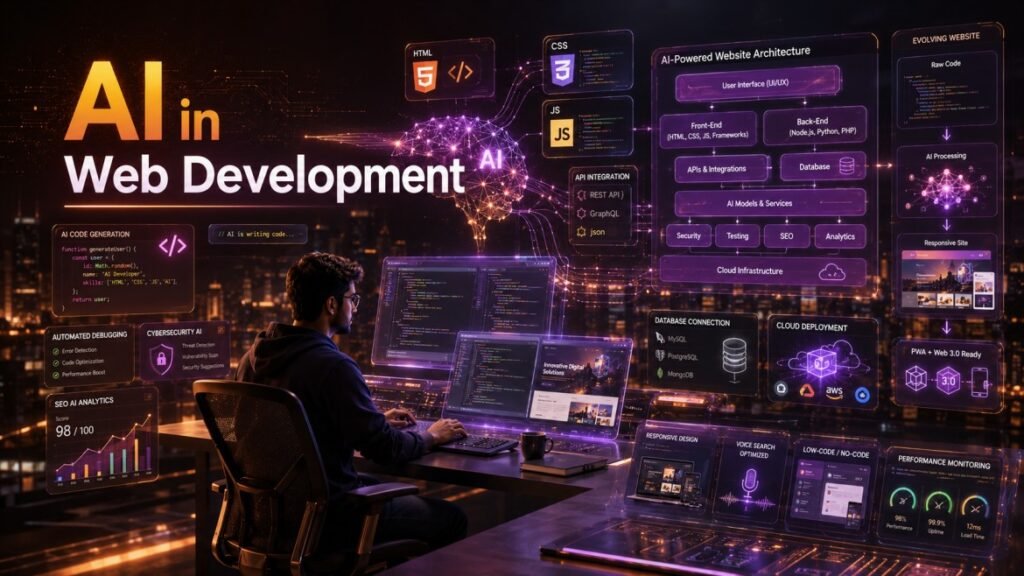
The internet is evolving rapidly, and AI in Web Development is becoming one of the most important forces behind this transformation. From generating code and identifying bugs to creating personalized user experiences, Artificial Intelligence is changing how websites and web applications are designed, developed, tested, and maintained.
Traditionally, web development required developers to manually write code, test applications, troubleshoot errors, optimize performance, and analyze user behavior. Today, AI-powered tools can automate many repetitive activities and provide intelligent assistance throughout the development lifecycle.
The rise of Generative AI, machine learning, natural language processing, automation, and intelligent security systems is creating a new development ecosystem. As businesses accelerate their digital transformation, developers are increasingly expected to combine traditional programming expertise with AI capabilities.
AI in Web Development This evolution does not mean developers will disappear. Instead, their responsibilities are changing. Developers are moving toward roles that require problem-solving, system architecture, AI integration, cybersecurity, and strategic decision-making.
Table of Contents
What Is AI in Web Development?
AI in Web Development refers to the use of Artificial Intelligence technologies to assist, automate, or improve different stages of website and web application development.
AI can support developers with:
- Code generation
- Bug detection
- Debugging
- Automated testing
- UI/UX recommendations
- Content generation
- Search optimization
- Personalization
- Cybersecurity
- Performance monitoring
- Customer support automation
For example, a developer can describe a required website component using natural language and an AI coding assistant can generate an initial version of the HTML, CSS, JavaScript, or framework-specific code.
The developer can then review, modify, test, and integrate that code into the application.
How AI Is Transforming Web Development
1. AI-Powered Code Generation
One of the most visible applications of AI is automated code generation.
Developers can use AI assistants to generate:
- HTML structures
- CSS layouts
- JavaScript functions
- API integrations
- Database queries
- Unit tests
- Documentation
- Code refactoring suggestions
This can reduce the amount of repetitive coding required and allow developers to concentrate more on architecture and business requirements.
Example
Suppose a developer needs a responsive registration form with validation. Instead of creating every component manually, an AI assistant can generate a starting implementation based on the developer’s requirements.
The developer remains responsible for reviewing the generated code, validating security, and ensuring that it meets the application’s requirements.
2. Faster Debugging and Testing
Finding software defects can consume significant development time.
AI-powered development tools can analyze code, identify potential problems, suggest fixes, and assist with automated testing.
AI can help identify:
- Syntax errors
- Logical problems
- Potential security vulnerabilities
- Performance bottlenecks
- Repeated code
- Test cases that may be missing
This can contribute to shorter development cycles and potentially improve software quality.
3. Personalized User Experiences
Modern websites increasingly adapt content and functionality according to individual users.
Recommendation engines can analyze user behavior and provide personalized suggestions.
For example:
- E-commerce websites can recommend products.
- Streaming platforms can recommend entertainment.
- Learning platforms can recommend courses.
- News websites can personalize content feeds.
This is an important impact of it because websites can become more responsive to individual customer needs rather than providing exactly the same experience to every visitor.
Industries Benefiting From AI-Powered Web Development
Software and Technology
Technology companies are using AI to accelerate software development, testing, documentation, and application maintenance.
AI-assisted development can help engineering teams prototype ideas faster and automate repetitive workflows.
Healthcare
Healthcare platforms can use AI for appointment systems, medical information interfaces, patient support, data analysis, and personalized digital experiences.
However, healthcare applications require particularly strong privacy, security, accuracy, and regulatory controls.
E-Commerce
AI is transforming online shopping through:
- Product recommendations
- Intelligent search
- Personalized offers
- Automated customer support
- Fraud detection
- Demand forecasting
An e-commerce website can use AI to understand what customers are interested in and dynamically improve their shopping experience.
Media and Entertainment
Streaming services and digital media platforms use AI-driven recommendation systems to personalize content discovery.
AI can also assist media organizations with content workflows, metadata generation, audience analysis, and moderation.
Finance
Financial websites and applications can use AI for fraud detection, customer service, risk analysis, personalization, and anomaly detection.
Because financial data is highly sensitive, security and responsible AI implementation are essential.
Education
AI-powered educational websites can deliver personalized learning experiences.
For example, an online learning platform can analyze a student’s performance and recommend additional lessons or exercises based on areas that need improvement.
New Job Roles Created by AI
The growth of AI is changing the web development job market.
Traditional roles remain important, but new hybrid positions are emerging.
Front-End Developer
Front-end developers continue to build interfaces using technologies such as HTML, CSS, JavaScript, and modern frameworks.
AI tools can help them generate components, improve accessibility, and identify UI problems.
Back-End Developer
Back-end developers build APIs, databases, business logic, authentication systems, and server-side applications.
AI can assist with code generation, database queries, testing, and performance optimization.
AI-Integrated Web Developer
This emerging profile combines web development with AI technologies.
Professionals may work on:
- AI APIs
- Chatbots
- Recommendation engines
- Generative AI features
- AI agents
- Machine-learning integrations
AI Security Specialist
As AI adoption increases, security professionals will be needed to protect applications, models, APIs, data, and AI-generated workflows.
Understanding both cybersecurity and AI will become increasingly valuable.
Emerging Trends in AI and Web Development
Web 3.0
Web 3.0 focuses on decentralization, blockchain technologies, digital ownership, and enhanced security.
AI could complement Web 3.0 by providing intelligent data analysis, automated agents, fraud detection, and personalized decentralized applications.
Progressive Web Apps
Progressive Web Apps, or PWAs, provide web experiences that can offer app-like functionality across devices.
Important characteristics include:
- Cross-platform compatibility
- Offline functionality
- Fast loading
- Responsive design
- Push notifications
AI can enhance PWAs through personalization, intelligent search, recommendations, and automation.
Voice Search Optimization
Voice interfaces are becoming increasingly important as users interact with smartphones, smart speakers, vehicles, and IoT devices.
Natural Language Processing allows systems to understand conversational queries.
Web developers therefore need to consider conversational search behavior and structured, easily understandable content.
Low-Code and No-Code Development
Low-code and no-code platforms are lowering the technical barrier to application development.
AI can make these platforms even more powerful by allowing users to describe what they want in natural language.
For example, a business owner could describe a customer-management application and an AI-powered platform could generate much of the initial application structure.
Benefits of AI in Web Development
Organizations adopting AI strategically can gain several advantages.
Faster Development
Automating repetitive tasks can reduce development time and accelerate prototyping.
Improved Security
AI-assisted security systems can help identify suspicious behavior and potential vulnerabilities.
Better SEO
AI can assist with:
- Keyword analysis
- Content optimization
- Search intent analysis
- Metadata generation
- Content structure
- Technical SEO analysis
However, AI-generated content still requires human review and quality control.
Personalized Experiences
AI allows websites to understand behavioral patterns and provide more relevant recommendations.
Reduced Development Costs
Automation can reduce the time spent on repetitive activities, potentially improving development efficiency.
Challenges of AI in Web Development
Despite its advantages, AI is not a perfect solution.
Accuracy Problems
AI-generated code can contain errors, inefficient logic, or insecure implementation.
Developers must review and test AI-generated output.
Security Risks
Poorly implemented AI integrations can introduce new vulnerabilities.
Developers need to protect:
- API credentials
- User data
- Authentication systems
- AI prompts
- Databases
- Application endpoints
Data Privacy
AI systems may process large amounts of information. Organizations must ensure that sensitive data is handled appropriately.
Skill Gaps
Developers who rely entirely on AI without understanding programming fundamentals may struggle to troubleshoot complex problems.
AI should therefore be treated as an engineering assistant rather than a replacement for technical knowledge.
Over-Automation
Not every development decision should be automated.
Architecture, security decisions, business logic, accessibility, compliance, and user experience often require human judgment.
The Future of AI in Web Development
The future of technology will likely involve deeper collaboration between developers and intelligent software systems.
AI-powered development environments may become capable of understanding entire applications rather than individual code snippets.
Future systems could assist with:
- Application architecture
- Automated testing
- Continuous monitoring
- Security analysis
- Performance optimization
- Documentation
- Deployment workflows
- User-experience analysis
AI Agents for Web Applications
AI agents could become an important part of future web applications.
Instead of simply responding to a user, an AI agent may be able to understand a goal, access authorized tools, retrieve information, and complete multiple steps.
For example, a travel website could potentially allow an AI agent to search destinations, compare options, create an itinerary, and interact with connected services.
Opportunities for Web Developers
The AI revolution creates opportunities for developers who are willing to adapt.
Developers can strengthen their careers by learning:
- Generative AI
- AI APIs
- Prompt engineering
- Machine learning fundamentals
- Python
- JavaScript and modern frameworks
- Cloud computing
- Cybersecurity
- API integration
- Data handling
- AI-assisted development workflows
The most valuable professionals may increasingly be those who understand both software engineering and AI.
How Businesses Can Prepare for AI-Powered Web Development
Businesses should avoid adopting AI simply because it is popular.
A practical approach is to:
- Identify repetitive development tasks.
- Determine where AI can provide measurable value.
- Establish data-security policies.
- Test AI tools in controlled environments.
- Maintain human review.
- Measure productivity and quality improvements.
- Continuously update employee skills.
AI adoption should support business objectives rather than become technology for technology’s sake.
Conclusion
AI in Web Development is fundamentally changing how websites and applications are created and maintained. From automated coding and debugging to personalized experiences and intelligent security, AI is becoming part of the modern web development workflow.
The technology is also creating new professional opportunities. Front-end and back-end developers remain important, while AI-integrated developers, AI security specialists, and other hybrid technology roles are gaining importance.
At the same time, challenges involving security, privacy, accuracy, skills, and responsible automation cannot be ignored.
As digital transformation accelerates, successful web developers will need to combine programming fundamentals with AI literacy and strong problem-solving skills.
Ultimately, the future of technology in web development is unlikely to be about humans versus AI. It will be about developers using AI intelligently to build faster, safer, more accessible, and more personalized digital experiences.