
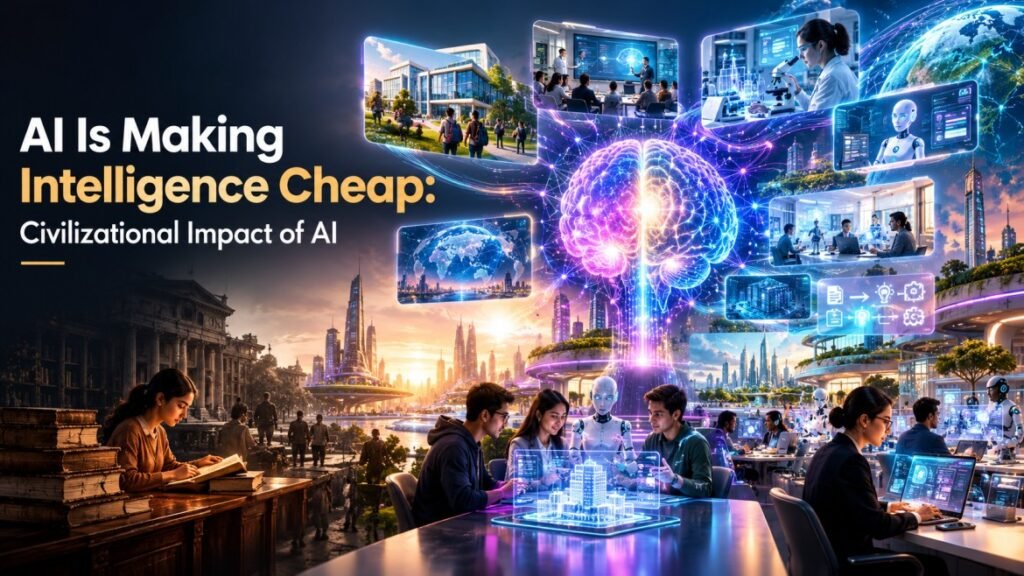
Artificial intelligence is changing more than the way we use technology. It is beginning to change the economic and social value of one of humanity’s most important resources: intelligence.
For centuries, societies built institutions, careers, and economic systems around the ability to acquire, organize, analyze, and communicate knowledge. Universities trained people to perform intellectual work. Companies hired analysts, researchers, programmers, consultants, writers, and other knowledge workers. Education was largely designed around transferring information from experts to learners.
Now, AI can perform many of these activities in seconds.
AI Is Making Intelligence Cheap, and this shift could have consequences far beyond productivity. It may reshape education, employment, universities, organizations, and even our understanding of what human intelligence is worth.
The important question is not simply whether AI will replace people. The deeper question is: What happens to civilization when access to cognitive capability becomes inexpensive, scalable, and available almost everywhere?
Table of Contents
What Does “AI Is Making Intelligence Cheap” Mean?
The phrase does not mean that human intelligence has suddenly become worthless.
Instead, it describes the falling cost of accessing certain forms of cognitive work.
AI systems can already assist with tasks such as:
- Research and information synthesis
- Writing and editing
- Software development
- Data analysis
- Translation
- Customer support
- Documentation
- Image and video creation
- Mathematical reasoning
- Business analysis
- Educational tutoring
- Software testing and quality assurance
Previously, organizations often needed specialists or assistants to perform many of these tasks. AI can increasingly provide similar capabilities at a fraction of the traditional marginal cost.
This creates a major economic transformation: intelligence becomes more abundant while human attention, judgment, trust, creativity, relationships, and responsibility may become relatively more valuable.
The Crisis of Intelligence
The industrial revolution made physical labor more productive through machines. The digital revolution made information easier to store, copy, and distribute.
AI is extending this transformation into cognitive work.
That creates a difficult question:
If machines can explain, research, summarize, calculate, write, code, and analyze increasingly well, what should humans spend years learning?
Traditional education has often operated under a relatively simple model:
Learn knowledge → develop expertise → obtain credentials → perform specialized work.
AI challenges every part of this chain.
A student can now ask an AI system to explain a difficult concept at multiple levels, generate examples, identify mistakes, create practice questions, and provide feedback.
A professional can use AI to accelerate research and documentation.
An entrepreneur can use AI to investigate markets, draft plans, analyze competitors, and create prototypes.
This does not eliminate the need for human expertise, but it changes where expertise creates value.
From Scarce Knowledge to Abundant Intelligence
For much of history, high-quality knowledge was expensive.
Books were difficult to produce and distribute. Expert advice required access to specialists. Research could take weeks or months. Learning often depended heavily on teachers, libraries, institutions, and geographical access.
The internet dramatically reduced the cost of accessing information.
AI goes another step further by reducing the cost of interacting with and transforming information.
Instead of searching through dozens of pages, a person can ask a system to explain a concept, compare alternatives, organize evidence, or produce a structured starting point.
This is why AI Is Making Intelligence Cheap is potentially a civilization-level development rather than simply another software trend.
Intelligence Becomes Scalable
Human workers have physical and temporal limits.
An individual researcher has only a certain number of working hours per day. An organization can hire more researchers, but salaries, recruitment, management, and coordination create costs.
AI agents can potentially operate across many tasks simultaneously.
The economic consequence could be significant:
- More experiments can be performed.
- More business ideas can be evaluated.
- More software can be tested.
- More documents can be analyzed.
- More customers can receive personalized assistance.
- More individuals can access specialized knowledge.
The bottleneck may gradually move from access to intelligence toward knowing what questions to ask and what actions to take.
AI and the Future of Employment
One of the most immediate consequences of this transformation is its impact on employment.
Knowledge-based economies created millions of jobs around activities that involve manipulating information.
Examples include:
- Research assistants
- Junior analysts
- Content writers
- Customer-support agents
- Basic programmers
- Administrative workers
- Data-processing specialists
- Documentation teams
- Entry-level consultants
AI does not necessarily eliminate all these professions, but it can reduce the amount of human labor required for particular tasks.
From Hiring People to Deploying AI Agents
A particularly important organizational shift is the movement from hiring an individual for a defined cognitive task toward deploying an AI system that can perform a workflow.
Consider a research project.
A traditional organization might:
- Hire a research assistant.
- Define the research question.
- Assign research tasks.
- Review collected information.
- Ask for revisions.
- Produce the final report.
An AI-enabled organization might instead:
- Define the objective.
- Deploy an AI research agent.
- Give it access to approved information sources and tools.
- Ask it to collect and organize evidence.
- Have another system validate the output.
- Send the final result to a human decision-maker.
The human role does not disappear completely. It moves upward toward problem definition, validation, judgment, accountability, and decision-making.
The Entry-Level Job Problem
One of the most difficult consequences could involve entry-level positions.
Many professionals develop expertise by performing relatively simple tasks first.
A junior employee might spend years learning through:
- Basic research
- Documentation
- Data preparation
- Testing
- Customer interactions
- Administrative analysis
- Drafting
- Repetitive technical work
If AI performs a large percentage of these tasks, organizations may need fewer junior workers.
This creates a potential paradox.
AI may make experienced professionals more productive while simultaneously making it harder for new professionals to obtain the experience required to become experienced.
This is one of the most important challenges for employers, universities, and policymakers.
The Future of Universities
Universities were historically designed around knowledge acquisition, specialization, research, and social development.
But if AI can explain a topic instantly, traditional lecture-based education may face increasing pressure.
A professor delivering information to hundreds of students is no longer the only way students can access explanations.
AI tutors can potentially provide:
- Personalized explanations
- Unlimited practice
- Immediate feedback
- Multiple teaching styles
- Customized examples
- Language translation
- Adaptive difficulty
- On-demand revision
This raises a fundamental question:
What should universities provide when information itself becomes abundant?
From Information Centers to Intellectual Gyms
One possible future is that universities become less focused on information transfer and more focused on intellectual development.
Instead of treating a university primarily as a place where professors deliver information, it could become a kind of “gym for the mind.”
A gym does not exercise your muscles for you.
It provides an environment, equipment, structure, coaching, discipline, and community.
Universities could similarly provide:
- Intellectual communities
- Difficult problems
- Collaborative projects
- Mentorship
- Debate
- Research environments
- Laboratories
- Professional networks
- Social development
- Ethical reasoning
- Real-world experimentation
AI could become a learning assistant rather than the enemy of education.
Redefining the Classroom
The classroom of the future may look very different from the traditional lecture hall.
Instead of spending most of the session listening to information, students might:
- Solve complex problems collaboratively.
- Challenge AI-generated answers.
- Conduct experiments.
- Debate competing interpretations.
- Build products.
- Analyze real datasets.
- Defend their conclusions.
- Review one another’s work.
- Present evidence to experts.
In this environment, the professor becomes less of an information broadcaster and more of a mentor, evaluator, researcher, facilitator, and intellectual coach.
AI Is Making Intelligence Cheap—but Judgment Remains Difficult
Cheap intelligence does not automatically produce good decisions.
An AI system can generate ten possible strategies in seconds. Determining which strategy should actually be implemented is a different problem.
Consider a business leader deciding whether to enter a new market.
AI may analyze:
- Market size
- Competitors
- Customer segments
- Pricing
- Trends
- Regulations
- Historical performance
But the final decision involves risk tolerance, organizational values, timing, ethics, capital constraints, and uncertainty.
These are not simply information problems.
They are judgment problems.
This distinction will become increasingly important as AI capabilities expand.
The New Value of Human Skills
If some forms of intelligence become inexpensive, certain human capabilities may become more economically and socially important.
1. Critical Thinking
People need to determine whether an AI-generated answer is actually correct.
2. Problem Definition
The quality of an AI result depends heavily on the quality of the problem being defined.
3. Judgment
Organizations still need people who can make decisions when evidence is incomplete.
4. Communication
Explaining decisions, negotiating with stakeholders, and building relationships remain fundamentally important.
5. Creativity
AI can generate possibilities, but humans still play an important role in selecting meaningful goals and directions.
6. Ethics
AI can optimize an objective without determining whether that objective is morally appropriate.
7. Leadership
People need to coordinate humans and machines toward shared goals.
Digital Transformation Enters a New Phase
The first phase of digital transformation focused heavily on moving physical processes into software.
The next phase automated information workflows.
AI introduces another layer: the automation of cognitive processes.
Organizations may increasingly create AI-powered workflows for:
- Research
- Customer service
- Software development
- Quality assurance
- Marketing
- Finance
- Legal operations
- Human resources
- Supply-chain analysis
- Insurance claims processing
This could make small organizations capable of performing work that previously required much larger teams.
For startups and small businesses, this may lower barriers to entry.
For large organizations, it may create pressure to redesign entire operating models.
Future Trends: Where Could AI Take Us?
The future of AI will likely involve more than chatbots.
Several developments could accelerate the transformation.
AI Agents
AI systems are increasingly moving toward agentic workflows where they can plan tasks, use tools, interact with software, and execute multi-step processes.
AI-Powered Education
Students may increasingly receive personalized AI tutoring alongside traditional teachers.
Human-AI Teams
Instead of treating AI as a replacement for every worker, organizations may design teams where humans provide direction and AI handles large portions of execution.
AI-Native Companies
Some future companies may be designed around AI from the beginning, requiring fewer employees to perform large volumes of knowledge work.
Personalized Knowledge Systems
Individuals may have AI systems that understand their projects, learning goals, professional workflows, and preferred ways of working.
Autonomous Research
AI systems could increasingly assist with hypothesis generation, literature analysis, simulation, experimentation, and documentation.
Challenges of an Intelligence-Abundant Society
The opportunities are substantial, but so are the risks.
Economic Inequality
If access to advanced AI is uneven, productivity gains could concentrate among individuals and organizations that control the best systems, data, infrastructure, and capital.
Job Displacement
Some occupations and tasks may experience significant disruption.
Loss of Human Expertise
If people outsource too much thinking to AI, certain skills could deteriorate through lack of practice.
Misinformation
Cheap content generation can also mean cheap misinformation.
Overdependence
Organizations may become dangerously dependent on AI systems without sufficient human oversight.
Education Integrity
Schools and universities will need new approaches to assessment when students have access to powerful AI tutors and content-generation systems.
Accountability
When an AI-assisted decision causes harm, determining responsibility may become more complicated.
Opportunities Created by Cheap Intelligence
The same transformation that disrupts existing systems can create enormous opportunities.
For Students
Students can access personalized tutoring and practice that previously required expensive private instruction.
For Entrepreneurs
Small teams can conduct research, develop software, produce marketing material, and analyze markets with fewer resources.
For Researchers
AI can accelerate information discovery and help researchers process enormous volumes of literature and data.
For Developing Economies
Affordable AI services could provide access to expertise that was previously concentrated in wealthy institutions and countries.
For Individuals
A person with limited resources may gain access to capabilities that once required an entire professional team.
This could democratize certain forms of expertise.
How Education Should Adapt
The answer may not be to prohibit AI.
Instead, education may need to change what it considers valuable.
A modern curriculum could place greater emphasis on:
- Problem-solving
- Critical reasoning
- Collaboration
- Original research
- Communication
- Ethical decision-making
- AI literacy
- Verification
- Practical projects
- Interdisciplinary thinking
Students should learn not merely how to obtain answers but how to question, test, interpret, and apply those answers.
Assessment Must Change
Traditional homework may become less useful when AI can complete it easily.
Universities could increasingly use:
- Oral examinations
- Project-based assessments
- Live problem-solving
- Research presentations
- Collaborative projects
- Practical demonstrations
- AI-assisted but transparent assignments
The objective should be to measure understanding rather than merely measuring the ability to produce text.
What Happens to Human Intelligence?
Perhaps the biggest philosophical question is whether cheap machine intelligence reduces the value of human intelligence.
There are two possible interpretations.
One view is that human cognitive labor becomes less valuable because machines can perform many intellectual tasks faster and cheaper.
Another view is that cheaper intelligence increases the value of human ambition, creativity, judgment, curiosity, and purpose.
History offers an important lesson.
When technology makes one capability abundant, society often reorganizes around new capabilities.
The calculator did not eliminate mathematics.
The internet did not eliminate knowledge.
Automation did not eliminate every form of work.
Instead, technology changed which human activities were economically important.
AI may produce a similar transformation—but at a much larger scale because it operates directly on cognitive tasks.
The Civilizational Impact of AI
The most important consequence of AI may not be the creation of individual products or applications.
It may be the transformation of how civilization allocates cognitive resources.
Imagine a world where a student in a remote community can access an expert-level AI tutor.
Imagine a small company that can conduct sophisticated market research without employing a large research department.
Imagine a scientist who can use AI systems to analyze thousands of research papers in a fraction of the traditional time.
Imagine a doctor supported by AI that can process vast medical information while the physician remains responsible for patient care and judgment.
These possibilities demonstrate why AI Is Making Intelligence Cheap can be understood as a structural economic and social transformation rather than simply a technological trend.
How Humans Can Stay Valuable in an AI-Driven Future
The objective should not be to compete with AI on every task.
Humans should increasingly focus on areas where human judgment and responsibility create distinctive value.
A practical strategy is to develop a combination of:
Domain expertise + AI literacy + critical thinking + communication + judgment.
For example, a software tester who understands AI can use it to generate test scenarios, analyze defects, create test data, and accelerate documentation.
The tester’s value then shifts toward risk assessment, exploratory thinking, domain understanding, quality strategy, and validation.
The same pattern can occur across many professions.
Conclusion
AI Is Making Intelligence Cheap, but that does not necessarily mean that human intelligence is becoming worthless.
It means that access to certain forms of cognitive capability is becoming dramatically cheaper and more scalable.
That change could transform employment, education, universities, entrepreneurship, research, and the broader economy.
The greatest challenge may not be teaching people how to use AI. It may be redesigning institutions around a world where intelligence is no longer scarce in the same way it once was.
Universities may become intellectual communities rather than information warehouses. Companies may operate with smaller, AI-augmented teams. Workers may need to develop stronger judgment and domain expertise. Students may need to learn how to challenge AI rather than simply ask it for answers.
The future will not be determined solely by how intelligent machines become. It will also depend on how intelligently humans redesign education, work, institutions, and society around them.
The real impact of AI Is Making Intelligence Cheap may therefore be measured not by the number of jobs AI replaces, but by what humanity chooses to do with an unprecedented abundance of cognitive capability.