
Introduction
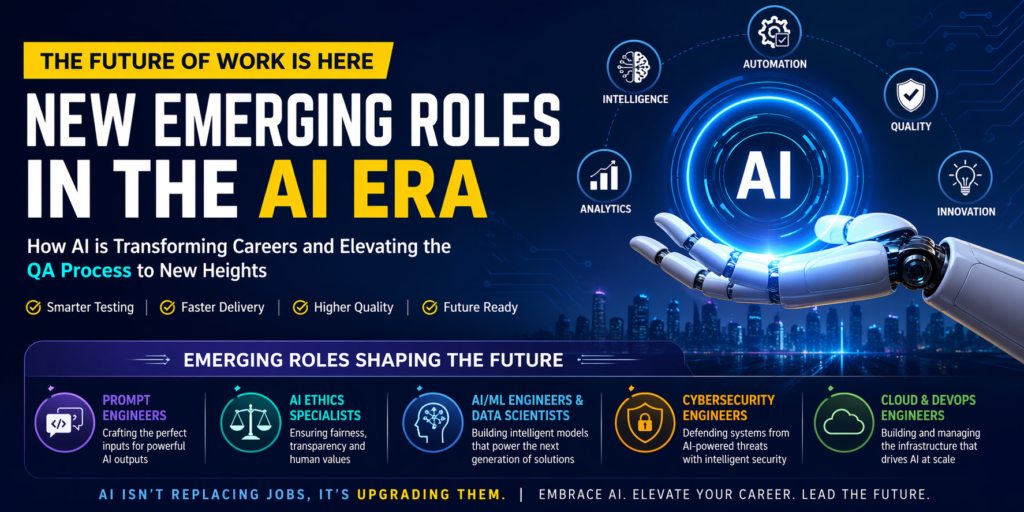
AI-Powered Careers , Artificial Intelligence is no longer just a futuristic concept – it is actively reshaping industries, workflows, and career paths. Instead of simply replacing jobs, AI is enhancing them, pushing professionals toward more strategic, analytical, and supervisory roles.
One area experiencing a major transformation is the QA Process, where traditional testing responsibilities are being augmented with AI-driven tools and intelligent automation. As organizations adopt AI at scale, new roles are emerging that directly influence how the QA Process is designed, executed, and optimized.
In this guide, we explore the most in-demand emerging roles in 2026 and how they align with the evolving QA Process.
Table of Contents
How AI is Transforming the QA Process
AI-Powered Careers, The modern QA Process is no longer limited to manual testing or basic automation. AI introduces predictive analytics, self-healing scripts, and intelligent defect detection.
Key Transformations in QA Process
- Automated test generation using AI
- Predictive defect analysis
- Faster regression cycles
- Self-healing automation frameworks
- Enhanced decision-making using data insights
The QA Process now demands professionals who understand both testing principles and AI capabilities.
Emerging Roles Driven by AI
Prompt Engineers
AI-Powered Careers – Prompt Engineers are specialists who design and refine inputs for AI systems to generate accurate and meaningful outputs.
Role in QA Process
- Creating test scenarios using AI prompts
- Automating test case generation
- Improving AI-driven validation workflows
Example
A Prompt Engineer can generate hundreds of edge-case test scenarios instantly, significantly improving the QA Process efficiency.
AI Ethics Specialists / Trainers
AI-Powered Careers- As AI becomes integral to business systems, ensuring ethical and unbiased outputs is critical.
Role in QA Process
- Validating fairness in AI-driven testing
- Ensuring compliance with regulations
- Monitoring bias in automated test outcomes
Why It Matters
Ethical oversight ensures the QA Process produces reliable and unbiased software outcomes.
AI/ML Engineers & Data Scientists
AI-Powered Careers- These professionals build and optimize the models powering AI tools.
Role in QA Process
- Developing AI-based testing tools
- Enhancing predictive analytics
- Improving defect detection algorithms
Impact
Their work directly strengthens the QA Process by making it smarter and more adaptive.
Cybersecurity Engineers
AI-Powered Careers- With AI-driven threats on the rise, cybersecurity experts play a vital role.
Role in QA Process
- Identifying vulnerabilities using AI tools
- Simulating advanced cyber-attacks
- Securing test environments
Example
AI-powered penetration testing enhances the QA Process by identifying hidden security risks early.
Cloud & DevOps Engineers
AI systems require scalable infrastructure, making Cloud and DevOps expertise essential.
Role in QA Process
- Managing CI/CD pipelines
- Integrating AI testing tools
- Ensuring scalability of testing environments
Outcome
A seamless QA Process with faster deployment cycles and continuous testing.
Why the QA Process is Central to These Roles
The QA Process acts as the backbone of software reliability. With AI integration, it becomes even more critical.
Key Benefits of an AI-Enhanced QA Process
- Faster time-to-market
- Higher product quality
- Reduced manual effort
- Improved accuracy in testing
- Continuous improvement through data
Professionals who understand the QA Process alongside AI technologies will dominate the job market.
Skills Required for the Future QA Process
To stay relevant in 2026, professionals must upgrade their skillsets.
Essential Skills
- Understanding of AI/ML fundamentals
- Automation testing expertise
- Data analysis and interpretation
- Knowledge of cloud platforms
- Ethical AI awareness
Mastering these skills ensures success in a modern QA Process environment.
Real-World Example of AI in QA Process
Consider a fintech company implementing AI testing tools:
- AI detects anomalies in transactions
- Automated scripts validate thousands of scenarios
- Security systems simulate attacks
This results in a highly efficient QA Process that reduces defects by over 40%.
Future Outlook of QA Process
The future of the QA Process is intelligent, autonomous, and data-driven.
What to Expect
- Fully autonomous testing systems
- AI-driven decision-making
- Continuous testing integrated with DevOps
- Hyper-personalized testing environments
The QA Process will shift from execution to strategy and governance.
Conclusion
AI is not eliminating jobs—it is redefining them. Emerging roles such as Prompt Engineers, AI Ethics Specialists, and AI/ML Engineers are shaping the future of work.
At the core of this transformation lies the evolving QA Process, which is becoming smarter, faster, and more efficient. Professionals who embrace AI and adapt to these new roles will lead the next wave of innovation.