
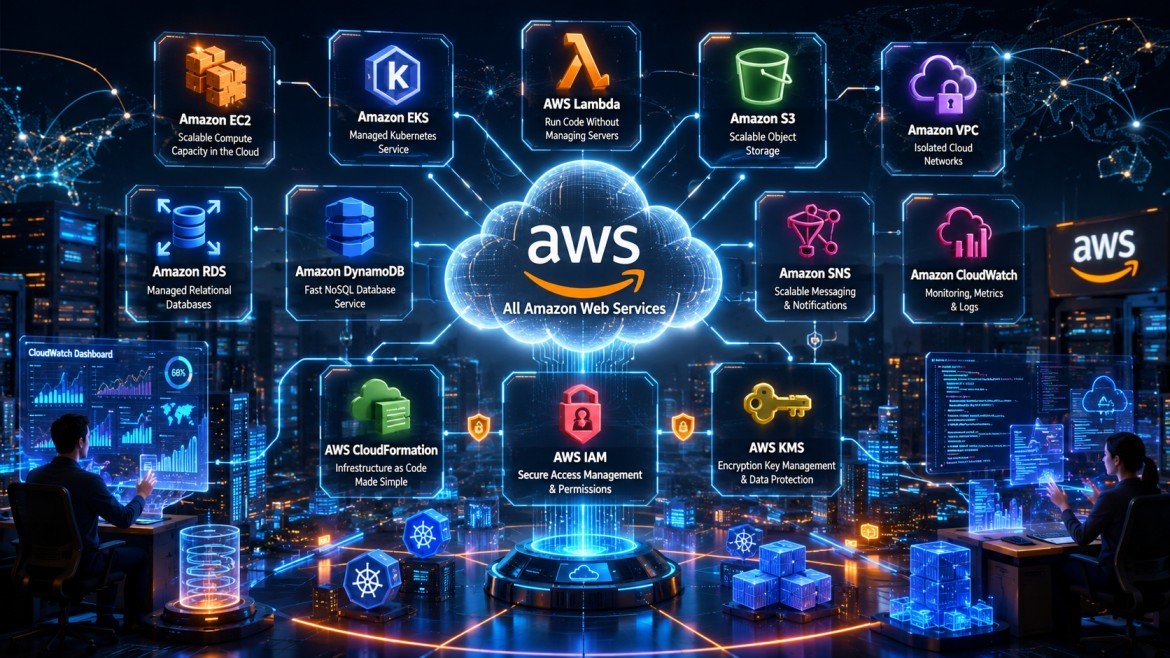
Amazon Web Services (AWS) Cloud computing has transformed how businesses build, deploy, and manage applications. From startups to Fortune 500 companies, organizations rely on Amazon Web Services (AWS) to scale operations, reduce infrastructure costs, and innovate faster.
Understanding all Amazon Web Services (AWS) has become an essential skill for developers, DevOps engineers, cloud architects, and IT professionals. Whether you’re launching a web application, deploying machine learning models, or managing enterprise databases, AWS offers specialized services for every workload.
This comprehensive guide explores all Amazon Web Services (AWS), their capabilities, practical use cases, future trends, challenges, and the impact of the all Amazon Web Services (AWS) on modern businesses and the future of technology.
Table of Contents
Why AWS Dominates Cloud Computing
AWS is the world’s leading cloud platform because it provides:
- Highly scalable infrastructure
- Global availability
- Enterprise-grade security
- Pay-as-you-go pricing
- Extensive developer ecosystem
- AI and automation capabilities
Today, organizations undergoing digital transformation increasingly depend on AWS to accelerate innovation while minimizing operational complexity.
Amazon Web Services (AWS) Explained
1. Amazon EC2 (Elastic Compute Cloud)
Amazon EC2 provides secure and scalable virtual servers in the cloud.
Key Features
- Multiple instance types
- Auto Scaling
- Load balancing
- GPU-enabled instances
- High availability
Best Use Cases
- Hosting websites
- Enterprise applications
- Gaming servers
- AI workloads
- Development environments
Example
A streaming platform automatically launches additional EC2 instances during live sporting events to handle millions of viewers.
2. Amazon EKS (Elastic Kubernetes Service)
Amazon EKS simplifies Kubernetes deployment and management.
Benefits
- Fully managed Kubernetes
- Automatic updates
- High availability
- Integrated security
- Easy scaling
Ideal For
- Microservices
- Containerized applications
- CI/CD pipelines
- Enterprise deployments
3. AWS Lambda
AWS Lambda allows developers to run code without managing servers.
Advantages
- Serverless architecture
- Pay only for execution time
- Automatic scaling
- Fast deployment
- Event-driven execution
Common Applications
- Image processing
- File uploads
- API backends
- Scheduled jobs
- IoT processing
4. Amazon S3 (Simple Storage Service)
Amazon S3 is one of the most popular cloud storage solutions.
Features
- Unlimited storage
- Versioning
- Lifecycle management
- Encryption
- Cross-region replication
Typical Uses
- Website hosting
- Data backups
- Media storage
- Data lakes
- Disaster recovery
5. Amazon VPC (Virtual Private Cloud)
Amazon VPC creates isolated virtual networks inside AWS.
Capabilities
- Private networking
- Public and private subnets
- Security groups
- Network ACLs
- VPN connectivity
Organizations use VPC to secure sensitive workloads and separate production from development environments.
6. Amazon RDS (Relational Database Service)
Amazon RDS simplifies relational database management.
Supported Databases
- MySQL
- PostgreSQL
- MariaDB
- Oracle
- SQL Server
Benefits
- Automatic backups
- Multi-AZ deployment
- Performance monitoring
- Automatic patching
- High availability
7. Amazon DynamoDB
DynamoDB is AWS’s fully managed NoSQL database.
Strengths
- Millisecond response time
- Unlimited scalability
- High availability
- Serverless architecture
- Automatic replication
Perfect For
- Gaming
- Mobile apps
- IoT
- Real-time analytics
- Shopping carts
8. Amazon SNS (Simple Notification Service)
SNS delivers notifications across multiple communication channels.
Supports
- SMS
- Mobile push notifications
- HTTP endpoints
- AWS Lambda triggers
Business Example
An e-commerce company instantly notifies customers when an order is shipped.
9. Amazon CloudWatch
CloudWatch monitors AWS resources and applications.
Features
- Metrics
- Dashboards
- Alarms
- Log management
- Performance insights
CloudWatch helps operations teams quickly identify and resolve issues before they affect customers.
10. AWS CloudFormation
CloudFormation automates infrastructure deployment using Infrastructure as Code (IaC).
Benefits
- Consistent deployments
- Version control
- Faster provisioning
- Reduced human error
- Automated environments
11. AWS IAM (Identity and Access Management)
IAM controls authentication and authorization across AWS resources.
Security Features
- Role-based access
- Multi-factor authentication
- Policies
- User groups
- Temporary credentials
IAM is the foundation of AWS cloud security.
12. AWS KMS (Key Management Service)
AWS KMS manages encryption keys for protecting sensitive data.
Highlights
- Centralized key management
- Automatic rotation
- Compliance support
- Encryption integration
- Audit logging
Financial institutions commonly use KMS to safeguard confidential customer information.
How All Amazon Web Services (AWS) Work Together
One of AWS’s biggest strengths is seamless service integration.
Example architecture:
- Users access an application hosted on EC2
- Application stores files in S3
- User information is stored in RDS
- Session data resides in DynamoDB
- Infrastructure runs inside a secure VPC
- Notifications are sent through SNS
- Performance is monitored using CloudWatch
- Infrastructure is deployed with CloudFormation
- Access is controlled by IAM
- Sensitive data is encrypted using KMS
- Event-driven tasks execute via Lambda
- Containerized services run on EKS
This integrated ecosystem demonstrates the impact of the all Amazon Web Services (AWS)
on building scalable, secure, and resilient cloud applications.
Benefits of Learning All Amazon Web Services (AWS)
Organizations prefer professionals familiar with multiple Amazon Web Services (AWS) because they can:
- Design scalable systems
- Improve application security
- Reduce infrastructure costs
- Automate deployments
- Build serverless applications
- Optimize cloud performance
Mastering all Amazon Web Services (AWS) significantly enhances career opportunities in cloud engineering and DevOps.
Future Trends in AWS Cloud Services
The future of technology is closely tied to cloud innovation, and AWS continues to lead with new capabilities.
AI-Powered Cloud Operations
AWS is integrating generative AI into monitoring, automation, and development workflows.
Serverless Expansion
Lambda-based architectures will become the preferred model for many modern applications.
Kubernetes Growth
EKS adoption will continue to grow as enterprises migrate from monolithic systems to microservices.
Stronger Cloud Security
Advanced encryption, zero-trust networking, and intelligent identity management will become standard practices.
Sustainable Cloud Computing
AWS is investing in energy-efficient infrastructure and carbon reduction initiatives.
These advancements reinforce the role of all Amazon Web Services (AWS) in shaping the future of technology and accelerating digital transformation across industries.
Challenges of Using AWS
Despite its advantages, organizations should consider several challenges.
Cost Management
Improper resource allocation can increase cloud expenses.
Learning Curve
AWS provides hundreds of services that require continuous learning.
Security Configuration
Incorrect IAM permissions or network settings may introduce vulnerabilities.
Multi-Cloud Complexity
Managing AWS alongside other cloud providers can increase operational complexity.
Opportunities for Businesses
Organizations leveraging all Amazon Web Services (AWS) can unlock numerous opportunities:
- Faster product development
- Global application deployment
- AI-driven innovation
- Improved disaster recovery
- Secure digital infrastructure
- Enhanced customer experiences
- Reduced operational costs
- Scalable business growth
As businesses continue their digital transformation journey, AWS will remain a cornerstone of modern cloud strategies.
Final Thoughts
AWS has evolved far beyond basic cloud hosting into a comprehensive ecosystem that powers everything from startups to global enterprises. By understanding all Amazon Web Services (AWS), professionals and organizations can build secure, scalable, and intelligent cloud solutions that meet today’s demands while preparing for tomorrow’s innovations.
Whether you’re deploying containerized applications with EKS, creating serverless workflows using Lambda, securing resources through IAM and KMS, or monitoring infrastructure with CloudWatch, mastering these services equips you for success in the rapidly evolving cloud landscape.
The continued evolution of all Amazon Web Services (AWS) will play a defining role in the future of technology, empowering organizations to innovate faster, strengthen security, and accelerate digital transformation worldwide.