
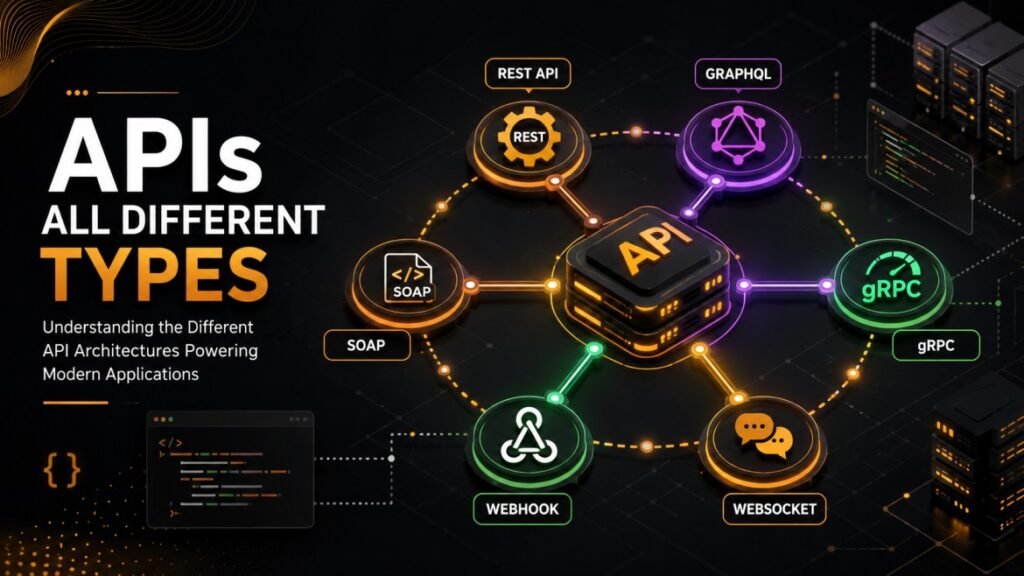
APIs have become the foundation of modern software development. From mobile applications and cloud platforms to payment gateways and real-time communication systems, APIs enable seamless data exchange between different applications and services.
Understanding APIs all different types is essential for developers, businesses, and technology enthusiasts looking to build scalable and efficient digital solutions. Each API type serves a unique purpose, offering different levels of flexibility, speed, security, and performance.
In this comprehensive guide, we will explore APIs all different types, their working mechanisms, advantages, disadvantages, real-world applications, future trends, challenges, and opportunities.
Table of Contents
What Are APIs?
An API (Application Programming Interface) is a set of rules and protocols that allows different software applications to communicate with each other.
Think of an API as a waiter in a restaurant:
- The customer places an order.
- The waiter delivers the request to the kitchen.
- The kitchen prepares the meal.
- The waiter returns the meal to the customer.
Similarly, APIs act as intermediaries between applications, facilitating requests and responses.
Why APIs Matter in Modern Development
APIs provide several benefits:
- Faster software development
- Better system integration
- Enhanced scalability
- Improved user experiences
- Automation of business processes
- Secure data exchange
As digital transformation continues to accelerate, understanding APIs all different types becomes increasingly important for organizations.
APIs All Different Types Explained
There are several major API architectures used today. Each serves specific business and technical requirements.
1. REST API (Representational State Transfer)
REST API is the most commonly used API architecture across industries.
It uses standard HTTP methods to manage resources:
- GET – Retrieve data
- POST – Create data
- PUT – Replace data
- PATCH – Update data partially
- DELETE – Remove data
How REST Works
A client sends an HTTP request to a server.
Example:
GET /users/123
The server responds with data, typically in JSON format:
{
  "id": 123,
  "name": "John Doe"
}
Advantages of REST APIs
- Easy to understand
- Widely supported
- Platform independent
- Scalable architecture
- Strong community support
Limitations
- Over-fetching data
- Multiple requests may be required
- Larger payload sizes
Common Use Cases
- Mobile applications
- E-commerce websites
- Social media platforms
- SaaS products
2. GraphQL API
GraphQL was developed to overcome some limitations of REST.
Instead of multiple endpoints, GraphQL provides a single endpoint where clients specify exactly what data they need.
How GraphQL Works
A client sends a query:
{
  user(id: 123) {
    name
    email
  }
}
The server returns only requested data.
Advantages of GraphQL
- Eliminates over-fetching
- Reduces network requests
- Flexible data retrieval
- Better frontend performance
Limitations
- Increased server complexity
- More difficult caching
- Learning curve for developers
Common Use Cases
- Mobile apps
- Large-scale web applications
- Content management systems
- Multi-device platforms
3. gRPC API
gRPC is a high-performance API framework created by Google.
It uses Protocol Buffers (Protobuf) instead of JSON.
How gRPC Works
Communication occurs through compact binary messages rather than text-based formats.
Advantages of gRPC
- Extremely fast
- Lightweight communication
- Strong typing
- Efficient microservices communication
- Built-in code generation
Limitations
- Less human-readable
- Browser support challenges
- More complex setup
Common Use Cases
- Cloud-native systems
- Microservices architecture
- Internal service communication
- Distributed systems
4. WebSocket API
WebSocket enables continuous two-way communication between client and server.
Unlike REST, the connection remains open.
How WebSocket Works
Once a connection is established:
- Client sends messages
- Server sends messages
- Both communicate instantly
Advantages of WebSocket
- Real-time communication
- Low latency
- Reduced overhead
- Persistent connection
Limitations
- More resource intensive
- Requires connection management
- Security considerations
Common Use Cases
- Live chat systems
- Online gaming
- Financial trading platforms
- Delivery tracking applications
5. Webhook API
Webhooks are event-driven APIs.
Instead of constantly checking for updates, applications automatically send notifications when specific events occur.
How Webhooks Work
Example:
- Customer completes payment.
- Payment platform triggers webhook.
- Data is sent to predefined URL.
- Receiving system processes the event.
Advantages of Webhooks
- Real-time notifications
- Reduced server load
- Efficient communication
- Simple implementation
Limitations
- Delivery failures possible
- Security validation required
- Monitoring complexity
Common Use Cases
- Payment processing
- CRM integrations
- Marketing automation
- E-commerce order updates
6. SOAP API (Simple Object Access Protocol)
SOAP is a protocol-based API architecture that relies heavily on XML.
It is known for reliability, security, and strict standards.
How SOAP Works
SOAP messages are formatted using XML and follow predefined rules.
Advantages of SOAP
- Enterprise-grade security
- Reliable transactions
- Standardized protocols
- Strong compliance support
Limitations
- Complex implementation
- Larger message sizes
- Slower than modern alternatives
Common Use Cases
- Banking systems
- Government platforms
- Healthcare applications
- Enterprise resource planning
Comparing APIs All Different Types
| API Type | Speed | Flexibility | Security | Real-Time Support |
|---|---|---|---|---|
| REST | High | Medium | Good | No |
| GraphQL | High | Very High | Good | Limited |
| gRPC | Very High | Medium | High | Yes |
| WebSocket | Very High | High | Medium | Yes |
| Webhook | High | Medium | Medium | Event-Based |
| SOAP | Medium | Low | Very High | No |
Choosing the Right API Type
The best API depends on your project requirements.
Choose REST When:
- Building public APIs
- Creating standard web applications
- Needing broad compatibility
Choose GraphQL When:
- Frontend flexibility is critical
- Multiple clients consume data
- Data efficiency matters
Choose gRPC When:
- Building microservices
- Performance is crucial
- Internal communication dominates
Choose WebSocket When:
- Real-time updates are required
- Live interactions are essential
Choose Webhooks When:
- Event notifications are needed
- Reducing polling is important
Choose SOAP When:
- Security and compliance are top priorities
- Enterprise-level reliability is mandatory
Challenges in API Development
Despite their benefits, API architectures face several challenges.
Security Risks
Common threats include:
- Unauthorized access
- Data breaches
- API abuse
- Credential theft
Version Management
As APIs evolve, maintaining backward compatibility becomes difficult.
Performance Optimization
Large-scale applications require:
- Efficient caching
- Load balancing
- Request optimization
Documentation Quality
Poor documentation often slows developer adoption and integration.
Future Trends in APIs
The future of APIs all different types continues to evolve rapidly.
AI-Powered APIs
Artificial intelligence services increasingly expose capabilities through APIs.
Examples include:
- Natural language processing
- Image recognition
- Predictive analytics
API-First Development
Organizations are designing APIs before building applications.
Benefits include:
- Faster development
- Better scalability
- Improved collaboration
Event-Driven Architectures
Webhooks and event streaming technologies are gaining popularity.
Increased Automation
API integrations will drive more automated workflows across industries.
Enhanced Security Standards
Future APIs will incorporate:
- Zero-trust frameworks
- Advanced authentication
- AI-based threat detection
Opportunities for Businesses
Organizations leveraging modern APIs gain significant advantages.
Faster Innovation
Teams can integrate third-party services quickly.
Better Customer Experiences
Real-time data and seamless integrations improve satisfaction.
Reduced Development Costs
Reusable API services reduce coding effort.
Expanded Ecosystems
Businesses can create partner networks through APIs.
Best Practices for API Success
To maximize API effectiveness:
- Use secure authentication methods
- Implement rate limiting
- Maintain clear documentation
- Monitor performance continuously
- Version APIs properly
- Follow industry standards
- Test thoroughly before deployment
Conclusion
Understanding APIs all different types is essential in today’s technology-driven landscape. REST, GraphQL, gRPC, WebSocket, Webhook, and SOAP each provide unique strengths that address different development challenges.
As businesses increasingly adopt cloud computing, microservices, artificial intelligence, and real-time applications, selecting the right API architecture becomes a strategic decision. By understanding the capabilities, limitations, and future potential of each API type, organizations can build more scalable, secure, and efficient digital solutions for years to come.