
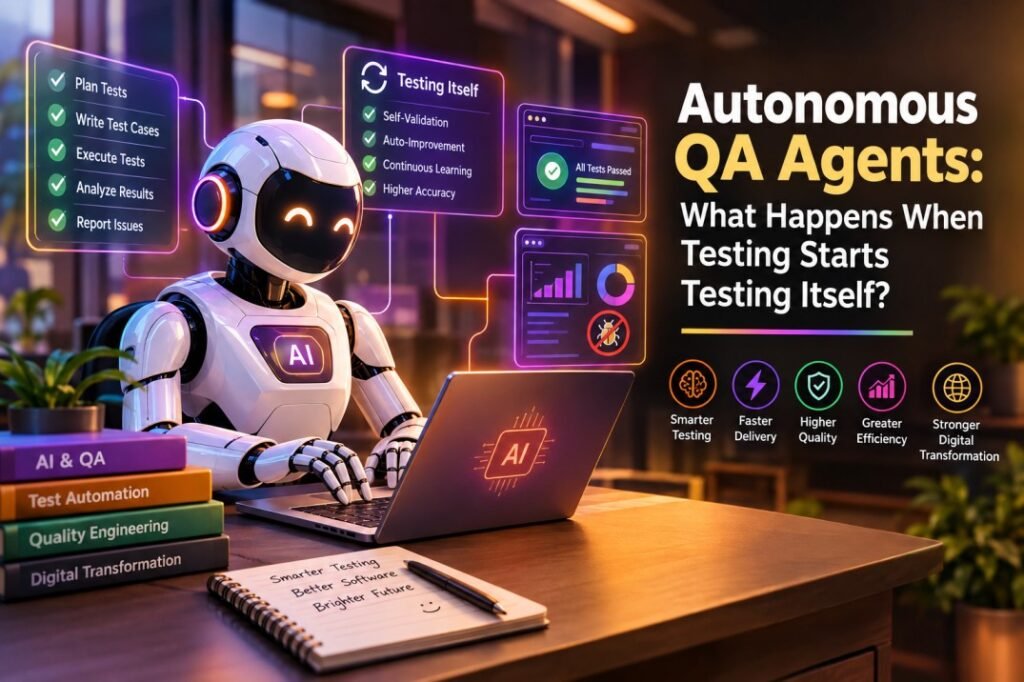
Software testing is entering a new phase.
For years, QA teams have progressively moved from manual testing to automation, continuous testing, AI-assisted test generation, and intelligent quality engineering. Now, another shift is emerging: AI systems that can plan testing activities, execute them, analyze results, adapt their approach, and decide what to test next.
This raises a fascinating question:
What happens when testing starts testing itself?
The answer lies in the emergence of Autonomous QA Agents—AI-driven systems designed to perform multi-step quality engineering activities with limited human intervention.
Unlike traditional automation, which generally follows predefined scripts, autonomous testing systems can reason about a testing objective, select appropriate actions, inspect application behavior, identify anomalies, and potentially improve their testing strategy over time.
This could significantly change how software teams approach quality, automation, release engineering, and digital transformation.
But autonomy also introduces a new responsibility: Who validates the tester when the tester itself is powered by AI?
Table of Contents
What Are Autonomous QA Agents?
Autonomous QA Agents are AI-powered software agents designed to perform testing and quality engineering tasks with a degree of independent decision-making.
A traditional automated test might follow this sequence:
- Open an application.
- Log in.
- Navigate to a specific page.
- Enter predefined data.
- Click a button.
- Verify the expected result.
- Report pass or fail.
An autonomous QA system can work at a higher level.
For example, a QA engineer could provide an objective such as:
“Validate whether the checkout process remains reliable when users apply discounts, change quantities, and use different payment methods.”
The AI agent could potentially:
- Understand the testing objective.
- Explore the application.
- Identify relevant workflows.
- Generate test scenarios.
- Execute tests.
- Analyze failures.
- Collect logs and evidence.
- Identify patterns.
- Create additional scenarios.
- Re-run relevant tests.
- Produce a quality report.
The important difference is that the agent is not simply executing a fixed script. It is participating in the testing decision process.
How Are Autonomous QA Agents Different From Test Automation?
Autonomous QA Agents Traditional test automation and autonomous testing are related, but they are not the same.
Traditional Test Automation
Traditional automation depends heavily on predefined logic.
For example:
Test Case → Automation Script → Execution → Result
If the application’s behavior changes significantly, the automation framework may require maintenance.
Autonomous Testing
An autonomous approach introduces an adaptive loop:
Goal → Plan → Explore → Test → Analyze → Adapt → Retest
The system can potentially determine what should happen next based on the information it has gathered.
This creates a fundamental change in the role of automation.
Instead of simply asking:
“How can we automate this test?”
QA teams can increasingly ask:
“How can an intelligent system continuously discover, validate, and improve testing?”
How Does an Autonomous QA Agent Work?
Autonomous QA Agents A sophisticated autonomous testing architecture can contain several specialized capabilities.
1. Requirement Understanding
The system first interprets requirements, user stories, acceptance criteria, API specifications, documentation, or other available project information.
For example:
“Customers should receive an email confirmation after successfully purchasing an insurance policy.”
An intelligent testing system can identify potential validation areas such as:
- Policy creation.
- Payment completion.
- Confirmation generation.
- Email delivery.
- Policy status.
- Error handling.
- Duplicate transactions.
2. Test Planning
The agent can transform a high-level requirement into a collection of testing objectives.
For an insurance application, it might identify:
- Positive scenarios.
- Negative scenarios.
- Boundary conditions.
- Business-rule validation.
- API validation.
- Database validation.
- Integration testing.
- Regression scenarios.
This is particularly valuable in complex enterprise systems where a single requirement can affect multiple services and databases.
3. Autonomous Test Generation
AI can generate candidate test cases based on requirements, application behavior, historical defects, API contracts, and existing test repositories.
For example, a requirement concerning an insurance claim could result in scenarios covering:
- Valid claim submission.
- Missing information.
- Invalid policy number.
- Duplicate claim.
- Claim exceeding policy limits.
- Incorrect date range.
- Unsupported claim type.
The QA engineer can then review, modify, approve, or reject those generated scenarios.
4. Test Execution
The agent can interact with different layers of an application ecosystem.
Depending on its architecture and available tools, this could include:
- Web applications.
- Mobile applications.
- APIs.
- Databases.
- Cloud services.
- Microservices.
- Event-driven systems.
- Test environments.
- CI/CD pipelines.
This creates the possibility of testing an application from multiple perspectives rather than relying exclusively on UI automation.
5. Failure Investigation
One of the most interesting capabilities is autonomous failure analysis.
Traditional automation may produce:
Test Failed – Expected 200, received 500.
An intelligent testing agent could investigate further by examining:
- API responses.
- Application logs.
- Database records.
- Network calls.
- Recent deployments.
- Related test failures.
- Error messages.
- Service dependencies.
It could then produce a more meaningful hypothesis:
“The API failure appears correlated with a database timeout occurring after the latest service deployment.”
This does not necessarily mean the AI diagnosis is correct. Human validation remains important, particularly for critical systems.
When Testing Starts Testing Itself
The most important concept behind autonomous testing is the feedback loop.
Imagine an AI agent executes 1,000 tests.
Instead of stopping after producing the results, it can analyze those results and ask:
- Which areas failed?
- Which tests are unstable?
- Which workflows were not sufficiently explored?
- Which failures appear related?
- Are new test scenarios necessary?
- Should certain tests be prioritized?
- Did application behavior change?
- Which regression tests should run next?
This creates a continuous quality cycle:
Test → Observe → Learn → Adapt → Test Again
That is where autonomous testing becomes fundamentally different from static automation.
Example: Autonomous Testing in an Insurance Application
Consider a Property & Casualty insurance platform.
A policy workflow might include:
Quote → Rating → Underwriting → Bind → Issue → Billing → Endorsement → Renewal → Claim
A conventional automation suite may contain hundreds or thousands of predefined tests.
An autonomous testing system could analyze changes to the application and identify impacted areas.
For example, suppose developers modify the rating engine.
The system could determine that the change potentially affects:
- Quote calculations.
- Premium values.
- Taxes.
- Discounts.
- Policy issuance.
- Billing.
- APIs.
- Database transactions.
It could then prioritize relevant tests instead of blindly executing the entire regression suite.
The result could be a more intelligent approach to regression testing.
The Role of AI in Self-Improving Testing
Autonomous QA Agents The future of QA is unlikely to be about eliminating test automation. Instead, automation is likely to become more intelligent.
AI can potentially help systems understand patterns across historical testing information.
For example:
Historical Information
- Previous production defects.
- Failed regression tests.
- Frequently changed modules.
- Flaky tests.
- API failures.
- Performance issues.
- Security findings.
Current Information
- Code changes.
- New requirements.
- Deployment changes.
- Infrastructure modifications.
- New API versions.
Potential AI Decision
The system can use this information to determine which areas deserve additional testing attention.
This moves QA toward risk-based autonomous testing.
Benefits of Autonomous QA Agents
Autonomous QA Agents The adoption of autonomous testing can create several opportunities.
Faster Test Execution
AI-driven systems can execute large numbers of scenarios continuously.
This can support faster development and release cycles.
Better Test Coverage
An intelligent agent can explore scenarios that may not have been explicitly included in the original test suite.
Reduced Test Maintenance
Traditional scripts can become fragile when interfaces change.
AI-assisted systems may adapt more effectively to certain application changes, potentially reducing maintenance effort.
Continuous Regression Testing
Instead of running regression only at the end of a sprint, intelligent testing can become part of continuous delivery.
Faster Defect Investigation
AI can correlate logs, test failures, API responses, and other evidence to accelerate root-cause analysis.
Improved QA Productivity
QA engineers can spend less time performing repetitive execution and more time on:
- Risk analysis.
- Test strategy.
- Exploratory testing.
- Architecture.
- Quality governance.
- Business validation.
Challenges of Autonomous QA Agents
Autonomous QA Agents Autonomy does not automatically mean accuracy.
There are significant challenges that organizations need to address.
1. AI Hallucination
An AI system can produce incorrect assumptions.
It may generate a test that appears logical but does not represent the actual business requirement.
Human review therefore remains essential.
2. False Positives
An intelligent agent might report a problem that is actually expected behavior.
Too many false positives can reduce trust in the system.
3. False Negatives
Even more concerning is the possibility of missing genuine defects.
An autonomous system should therefore be evaluated against measurable quality criteria rather than assumed to be reliable.
4. Test Data Complexity
Enterprise applications often require sophisticated test data.
Insurance, banking, healthcare, and other regulated domains may involve complex relationships between:
- Customers.
- Policies.
- Transactions.
- Claims.
- Payments.
- Documents.
- External services.
Creating meaningful test data autonomously can be difficult.
5. Security and Access Control
An autonomous agent may need access to applications, APIs, databases, logs, and testing environments.
Organizations must carefully control:
- Credentials.
- Permissions.
- Data access.
- Secrets.
- Production environments.
- Audit trails.
Who Tests the AI Tester?
This may become one of the biggest questions in modern Quality Engineering.
If an AI system generates test cases, who validates those test cases?
If it decides that an application is safe to release, who validates that decision?
If it changes its testing strategy, who controls that change?
This introduces a new discipline:
Testing the Testing System
QA teams will increasingly need to validate the AI systems responsible for quality activities.
Testing may include:
- Accuracy testing.
- Consistency testing.
- Bias detection.
- Decision validation.
- Prompt robustness.
- Security testing.
- Agent behavior testing.
- Failure recovery.
- Explainability.
- Auditability.
The quality organization therefore becomes responsible for both software quality and AI quality.
Impact on QA Engineers
Autonomous testing is likely to change the skill profile of QA professionals.
The future QA engineer may need a combination of traditional testing expertise and AI engineering knowledge.
Important skills could include:
- Test automation.
- API testing.
- SQL.
- Programming.
- AI fundamentals.
- LLM concepts.
- Agentic AI.
- Prompt engineering.
- AI evaluation.
- Data analysis.
- CI/CD.
- Cloud platforms.
- Observability.
- Security testing.
For experienced QA professionals, this represents an opportunity to move from execution-focused roles toward broader Quality Engineering responsibilities.
Autonomous Testing and Digital Transformation
The impact of autonomous testing extends beyond individual QA teams.
Organizations undergoing digital transformation increasingly depend on complex technology ecosystems.
Applications are becoming:
- Cloud-native.
- API-driven.
- Distributed.
- Event-based.
- AI-powered.
- Microservice-oriented.
- Continuously deployed.
Traditional testing models can struggle to keep pace with this complexity.
Autonomous quality engineering could become one component of a larger digital transformation strategy by connecting requirements, development, testing, deployment, monitoring, and feedback.
Instead of quality being a final checkpoint, it can become a continuous intelligence layer throughout the software lifecycle.
Future Trends in Autonomous Testing
The future of autonomous QA could evolve in several directions.
Multi-Agent Quality Engineering
Instead of one general-purpose AI agent, organizations could use multiple specialized agents.
For example:
- Test Planning Agent.
- API Testing Agent.
- UI Testing Agent.
- Database Validation Agent.
- Security Testing Agent.
- Performance Testing Agent.
- Defect Analysis Agent.
- Release Risk Agent.
These agents could collaborate through controlled workflows.
Self-Healing Test Automation
Applications change constantly.
Future systems may automatically identify broken locators, changed workflows, or modified APIs and adapt test implementations accordingly.
However, self-healing should not mean uncontrolled changes. Significant modifications should remain observable and governed.
Autonomous Exploratory Testing
Exploratory testing traditionally depends heavily on human creativity and domain knowledge.
AI agents could increasingly explore applications dynamically by following different paths based on application state and previous observations.
This could reveal unexpected edge cases.
AI-Driven Risk-Based Testing
Future systems may continuously calculate testing priorities based on:
- Code changes.
- Historical defects.
- Business criticality.
- Production incidents.
- User behavior.
- Dependency changes.
- Test history.
This could help teams focus testing effort where the potential business impact is greatest.
Continuous Production Feedback
The boundary between testing and production monitoring may become increasingly blurred.
Production telemetry could identify unusual behavior and automatically generate new candidate regression scenarios.
A simplified cycle could look like:
Production Observation → Risk Detection → Test Generation → Validation → Regression → Deployment Feedback
This represents a more continuous quality model.
Opportunities for Organizations
Organizations adopting autonomous quality engineering can explore opportunities such as:
Faster Releases
Automated analysis can shorten feedback cycles.
Scalable Testing
AI systems can potentially manage larger test workloads without increasing manual effort at the same rate.
Better Risk Visibility
Quality dashboards can combine testing, defect, deployment, and operational information.
Smarter Regression
Instead of treating every regression test equally, organizations can prioritize tests based on risk and change impact.
Quality at Scale
Large enterprises can apply consistent testing practices across multiple products, teams, and environments.
How QA Teams Can Prepare
Organizations do not need to replace their existing automation framework overnight.
A practical transition can happen incrementally.
Step 1: Strengthen Existing Automation
Build reliable foundations around:
- API automation.
- UI automation.
- Database testing.
- CI/CD.
- Test reporting.
- Test data management.
Step 2: Introduce AI Assistance
Use AI for:
- Test case generation.
- Test data generation.
- Failure summarization.
- Requirement analysis.
- Defect classification.
Step 3: Add Agentic Workflows
Allow AI systems to execute controlled multi-step testing activities.
Step 4: Establish Governance
Define:
- Human approval points.
- Access controls.
- Audit requirements.
- Quality metrics.
- AI evaluation criteria.
Step 5: Measure the Results
Track measurable outcomes such as:
- Defect detection rate.
- Regression execution time.
- Test maintenance effort.
- False-positive rate.
- Escaped defects.
- Automation stability.
- Release confidence.
What Happens Next?
The most interesting aspect of Autonomous QA Agents is not simply that machines can execute tests.
The larger transformation is that software testing can become an adaptive system.
Instead of a fixed sequence of scripts, the testing process can potentially observe application behavior, interpret evidence, make decisions, and continuously refine its strategy.
That does not remove the need for QA engineers.
It changes what QA engineers do.
The future quality engineer may become less focused on manually creating every test and more focused on designing quality systems, validating AI decisions, defining risk boundaries, and ensuring that autonomous systems behave responsibly.
Final Thoughts
Autonomous QA Agents represent an important direction in the evolution of software quality engineering.
The technology has the potential to make testing more adaptive, scalable, continuous, and intelligent. At the same time, autonomy introduces new risks around accuracy, security, governance, explainability, and trust.
The key question is therefore not:
“Will AI replace QA?”
A more useful question is:
“How can QA engineers build, govern, and validate intelligent systems that improve software quality?”
As organizations accelerate digital transformation, quality engineering will need to evolve alongside development and operations.
Testing may no longer be something that simply executes after software is built.
It may become an intelligent, continuously adapting system that observes software, challenges it, learns from failures, and helps teams make better quality decisions.
And when testing starts testing itself, the QA engineer’s role becomes even more important: not merely executing tests, but defining what trustworthy testing should look like.