
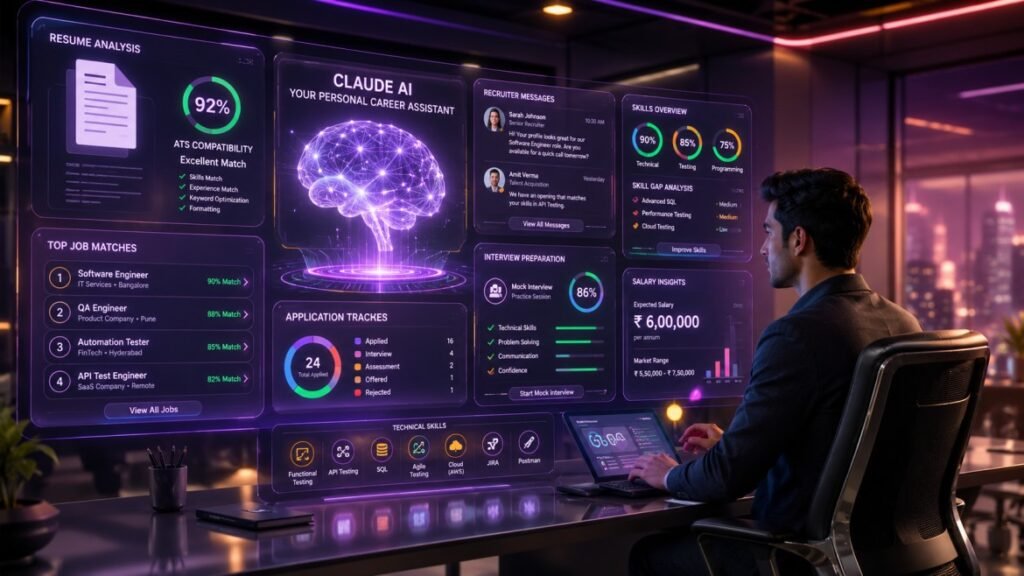
Finding a job in 2026 is no longer just about submitting hundreds of resumes. Recruiters increasingly use applicant tracking systems (ATS), skills-based screening, automated workflows, and AI-assisted recruitment tools to identify suitable candidates. For job seekers, this means a smarter and more personalized approach is needed.
One practical approach is to use Claude AI as a personal assistant throughout the job-search process. Instead of using AI only to write a resume, you can use it to analyze your experience, identify suitable roles, customize applications, prepare for interviews, and track your progress.
The important point is that AI should assist your job search—not replace your judgment or honesty. Your actual experience, skills, achievements, and qualifications should remain the foundation of every application.
Why Use Claude AI for Your Job Search?
A typical job search involves several repetitive activities:
- Searching for relevant vacancies
- Reading job descriptions
- Comparing jobs with your skills
- Updating resumes
- Writing cover letters
- Contacting recruiters
- Preparing for interviews
- Tracking applications
- Following up with companies
Claude can help organize many of these activities into one structured workflow.
This is part of the broader digital transformation of recruitment. Candidates who know how to work effectively with AI can potentially spend less time on repetitive tasks and more time improving their professional skills and building relationships.
Table of Contents
Step 1: Tell Claude About Your Current Situation
Start by giving Claude a realistic overview of your career situation.
For example:
I am currently unemployed and looking for a job. I previously worked with a local IT company as a software engineer. My main skills include Functional Testing, Insurance, API Testing, and SQL. I also have basic knowledge of AI tools. I am looking for a full-time Software Engineer role and expect around INR 60,000 per month. I have applied to 5 jobs so far.
This gives Claude enough context to understand your starting point.
Why This Matters
Generic AI advice can be too broad. When you provide your experience, skills, target role, salary expectations, and application history, the AI can provide more relevant suggestions.
You should update this information whenever your circumstances change.
Step 2: Upload Your Resume and Ask for an Honest Analysis
Your next step is to provide your current resume.
Ask Claude to:
- Analyze your strengths
- Identify weaknesses
- Find missing skills
- Evaluate your experience
- Identify realistic job opportunities
- Point out unclear or weak resume sections
- Determine whether your target role matches your background
Example Prompt
Honestly analyze my resume. Identify my strongest skills, weaknesses, missing skills, career gaps, and the jobs I am realistically qualified for. Do not exaggerate my experience or invent qualifications.
The phrase “do not invent anything” is particularly important.
AI should help you present your real experience more effectively—not manufacture experience you do not have.
Step 3: Identify Your Best-Fit Job Roles
Instead of applying randomly, ask Claude to identify three to five roles that match your existing background.
Example
Based only on my actual experience and skills, identify the 3–5 job roles that are the best fit for me. Explain why each role matches my background and what skills I may need to strengthen.
For someone with experience in software engineering, Functional Testing, insurance, APIs, and SQL, potential role categories could include:
- Software Engineer
- QA Engineer
- Functional Tester
- API Tester
- Software Test Engineer
- Insurance Technology QA roles
The exact recommendations should depend on the individual’s actual resume.
Step 4: Create a Stronger Resume
Once the target roles are clear, ask Claude to improve the resume.
Example Prompt
Improve my existing resume for these target roles. Highlight my actual relevant experience, technical skills, responsibilities, and achievements. Do not invent projects, technologies, certifications, job titles, or accomplishments.
A good AI-assisted resume should be:
- ATS-friendly
- Easy to scan
- Relevant to the target role
- Achievement-oriented where genuine achievements exist
- Free from unnecessary information
- Focused on measurable results when available
The goal is not to create a completely different professional identity. The goal is to communicate your real value more clearly.
Step 5: Compare Your Resume With Every Job Description
Once you find a promising vacancy, provide the job description to Claude.
If a job-posting link cannot be accessed, copy and paste the complete job description instead.
Ask:
Compare this job description with my resume and give me a match score out of 100. Explain the score based on skills, experience, responsibilities, and qualifications.
This can help you prioritize applications.
Go Beyond the Match Score
A score alone is not enough.
Ask:
Explain exactly why I am or am not a good fit for this specific job.
Then ask:
Identify the missing keywords or skills in my resume that are genuinely relevant to this job description. Separate critical requirements from nice-to-have requirements.
This distinction is important because job descriptions often contain a long list of preferred qualifications.
You should not add a keyword to your resume simply because an AI says it is missing. Only include skills you genuinely possess.
Step 6: Customize Your Resume for High-Priority Jobs
After analyzing the job description, ask Claude to create a customized resume version.
Example Prompt
Create a customized version of my resume for this job. Prioritize the experience and skills that genuinely match the job description. Keep all information truthful and do not invent anything.
You do not necessarily need a completely different resume for every application.
Instead, maintain a strong master resume and create targeted versions for high-priority opportunities.
Step 7: Research the Company Before Applying
A resume is only one part of an application.
Before applying, research:
- Company business model
- Products and services
- Industry
- Technology environment
- Company culture
- Recent developments
- Role responsibilities
- Relevant company initiatives
Then ask Claude to use the information to help create a personalized cover letter or application message.
Example Prompt
Based on my resume and this company’s information, create a concise personalized application message explaining why my actual experience is relevant to this position. Do not make unsupported claims.
This can make your application more relevant than a generic message.
Step 8: Contact the Right Recruiter or Hiring Manager
Networking can significantly improve a job search.
For a suitable vacancy, you can ask Claude to help identify the appropriate recruiter or hiring manager using publicly available professional information.
Then ask:
Draft a short, professional Naukri.com or email message to the recruiter for this role. Mention my relevant experience and interest in the position. Keep it personalized and avoid sounding like mass recruitment spam.
Always verify the person’s identity, company, role, and contact information before sending a message.
Never share confidential personal information with an AI tool unnecessarily.
Step 9: Apply Yourself and Personalize Every Application
AI can help prepare an application, but you should review and submit it yourself.
Do not blindly send the same resume to 100 companies.
For every important application:
- Read the job description.
- Check whether you genuinely qualify.
- Compare the requirements with your experience.
- Customize your resume if necessary.
- Personalize your application message.
- Verify every AI-generated claim.
- Submit the application yourself.
- Record the application in your tracker.
Quality and relevance are more valuable than simply increasing application volume.
Step 10: Create an AI-Powered Job Application Tracker
Your job search becomes much easier to manage when every application is recorded.
Create a spreadsheet containing:
| Field | Example |
|---|---|
| Company | ABC Technologies |
| Job Role | Software Engineer |
| Location | Gurgaon |
| Date Applied | August 12, 2026 |
| Job Source | Naukri |
| Recruiter | Recruiter Name |
| Resume Version | Software Engineer V2 |
| Status | Applied |
| Follow-Up Date | August 19, 2026 |
| Response | Pending |
| Interview | No |
| Notes | API + SQL match |
You can then ask Claude to analyze your application data.
For example:
Analyze my job application tracker. Identify which roles generate the most responses, which companies have responded, where I have the strongest match, and what I should change in my job-search strategy.
Step 11: Use Claude for Follow-Ups
If an application has received no response, ask Claude to create a short personalized follow-up.
For example:
Write a concise follow-up message for this application. Mention the position, application date, my relevant experience, and continued interest. Keep the tone professional and avoid sounding pushy.
Different situations require different follow-up messages, so avoid sending the exact same text to every recruiter.
Step 12: Prepare for Interviews With Claude
Getting an interview changes the job-search strategy.
Provide Claude with:
- Your resume
- Job description
- Company information
- Interview format
- Job requirements
Then ask:
Create a personalized interview preparation plan based on this job description, company information, and my resume. Identify the technical, behavioral, domain, and role-specific questions I should prepare for.
For a software testing or engineering position, preparation could include:
Technical Questions
- Functional testing
- API testing
- SQL
- Test case design
- Defect management
- Regression testing
- Integration testing
- Agile/Scrum
- Domain-specific scenarios
Behavioral Questions
- Tell me about yourself.
- Describe a difficult defect you identified.
- How do you prioritize testing?
- How do you handle disagreements with developers?
- Describe a challenging project.
Domain Questions
If the position involves insurance technology, prepare for questions involving insurance workflows, policy processes, claims, billing, or other requirements mentioned in the job description.
Step 13: Conduct a Realistic Mock Interview
Claude can also act as an interviewer.
Example Prompt
Conduct a realistic mock interview for this exact job. Ask one question at a time. Wait for my answer before continuing. After the interview, evaluate my answers and identify weaknesses, unclear explanations, technical gaps, and areas for improvement.
You can repeat the mock interview several times.
The objective is not to memorize AI-generated answers. Instead, use the feedback to improve your ability to communicate your own experience clearly.
Measure Whether AI Actually Improved Your Job Search
One of the most valuable parts of this approach is measuring results.
After one week, compare:
- Applications submitted
- Relevant applications submitted
- Recruiter responses
- Recruiter messages
- Interviews received
- Rejections
- Follow-ups completed
- Resume versions used
- Interviews progressing toward offers
Then ask Claude:
Compare my job-search results from this week with my previous results. Did AI improve my application quality, response rate, interview rate, or overall progress? Identify what worked and what I should change next week.
This turns job hunting into a measurable process instead of guesswork.
The Benefits of Claude AI as a Personal Assistant
Using Claude AI as a personal assistant can provide several practical advantages.
1. Better Organization
Your job search can become a structured workflow rather than a collection of random applications.
2. Faster Resume Customization
AI can help identify which parts of your experience are most relevant to individual positions.
3. More Personalized Applications
Instead of using one generic resume and cover letter, you can tailor important applications to the employer.
4. Interview Preparation
You can practice questions based on the actual role instead of preparing only generic interview answers.
5. Data-Driven Decisions
A job tracker can reveal which roles, industries, companies, and application strategies produce better results.
Challenges and Limitations
AI is powerful, but it is not a guaranteed job-search solution.
AI Can Make Mistakes
AI-generated information can be incorrect or outdated. Always verify company information, recruiter details, job requirements, and application instructions.
Avoid Resume Inflation
Never allow AI to add technologies, certifications, achievements, projects, or responsibilities you do not actually have.
Privacy Matters
Be careful when uploading personal information. Avoid unnecessarily sharing:
- Government identification numbers
- Bank information
- Passwords
- Confidential employer information
- Private client data
- Sensitive personal documents
Match Scores Are Estimates
A “90/100 match” is not an actual hiring probability. Treat it as a decision-support signal, not a guarantee of an interview.
AI Does Not Replace Networking
Recruiters, referrals, professional relationships, interviews, and demonstrated skills remain important.
Future Trends: AI and Job Searching in 2026 and Beyond
The future of technology is likely to make AI-assisted career management increasingly common.
Future job-search assistants may become more capable of:
- Monitoring relevant vacancies
- Comparing opportunities automatically
- Recommending skill-development plans
- Simulating company-specific interviews
- Analyzing application performance
- Identifying skill gaps
- Generating personalized learning paths
- Helping candidates manage multiple application pipelines
This could make the job search more like a personal career-management system.
The broader digital transformation of recruitment may also result in employers and candidates using AI simultaneously. Companies will use AI to find candidates, while candidates will use AI to understand vacancies and present their experience more effectively.
Opportunities for Job Seekers
AI creates an important opportunity for candidates who are willing to learn.
Instead of asking only, “How can AI write my resume?” candidates can ask:
“How can AI help me become a better candidate?”
That shift is significant.
A candidate can use AI to identify missing skills, practice technical questions, improve communication, understand unfamiliar technologies, and develop a more disciplined application strategy.
However, the strongest candidates will combine AI with real-world expertise.