
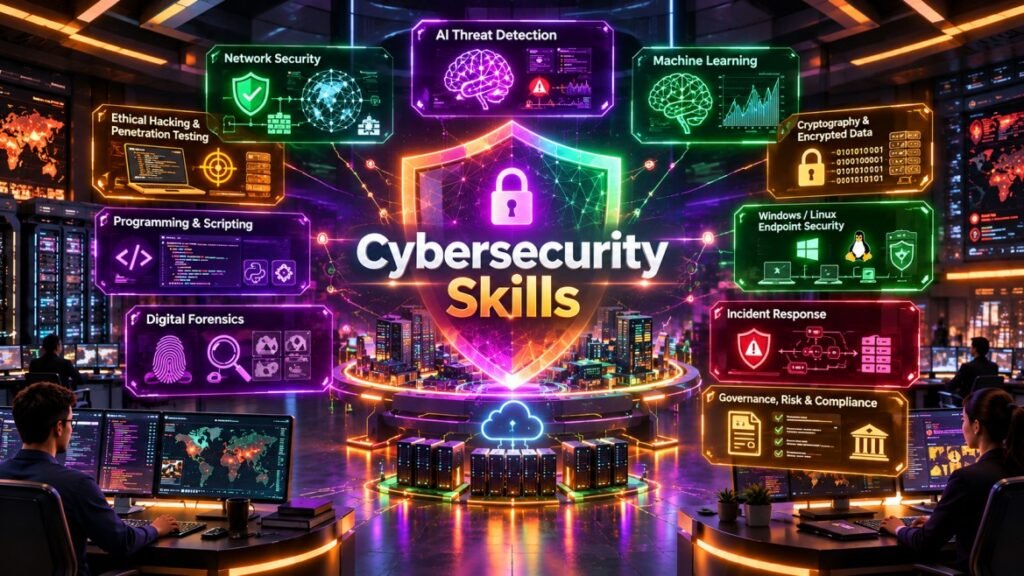
Cybersecurity Skills Cyber threats are becoming more sophisticated, automated, and difficult to predict. As businesses accelerate cloud adoption, AI implementation, remote work, connected devices, and digital transformation of IT, cybersecurity has moved from being an isolated technical function to a critical business requirement.
For professionals planning a career in cybersecurity in 2026 and beyond, simply understanding antivirus software or basic networking is no longer enough. Modern security teams need professionals who can analyze threats, investigate incidents, automate repetitive tasks, understand business risks, and communicate security issues clearly.
The Cybersecurity Skills landscape is therefore changing rapidly. Technical expertise remains essential, but organizations increasingly value professionals who combine security knowledge with analytical thinking, adaptability, communication, and continuous learning.
Whether you are a student, IT professional, software tester, system administrator, developer, or someone planning a career transition, developing the right cybersecurity capabilities can open opportunities across industries.
Table of Contents
Why Cybersecurity Is a High-Demand Career in 2026
Cybersecurity Skills Almost every organization now depends on digital infrastructure. Customer information, financial transactions, applications, intellectual property, employee data, and business operations are increasingly managed through connected systems.
This expansion creates a larger attack surface for cybercriminals.
The future of IT will involve increasingly autonomous systems, AI-powered applications, cloud platforms, APIs, connected devices, and data-driven business processes. Each of these technologies introduces new security considerations.
Some of the major reasons cybersecurity professionals are in demand include:
- Increasing ransomware and phishing attacks
- Expansion of cloud computing
- Growth of remote and hybrid work
- AI-generated cyber threats
- Increasing API and application security requirements
- Regulatory and compliance requirements
- Expansion of IoT and connected infrastructure
- Increasing dependence on digital customer platforms
- Greater protection requirements for sensitive data
This means cybersecurity is no longer only about preventing attacks. It is also about identifying risks, minimizing damage, recovering quickly, and continuously improving organizational resilience.
10 Technical Cybersecurity Skills to Learn in 2026
1. Network Security
Network security remains one of the fundamental areas of information security.
A security professional should understand how networks operate and how malicious activity can be detected or blocked.
Important areas include:
- Firewalls
- VPNs
- Network segmentation
- Intrusion Detection Systems (IDS)
- Intrusion Prevention Systems (IPS)
- TCP/IP
- DNS
- HTTP/HTTPS
- Network monitoring
- Secure network architecture
Example
Suppose an organization suddenly receives thousands of connection requests from unusual geographic locations. A network security professional should be able to analyze the traffic, identify suspicious patterns, investigate the source, and determine whether the activity represents an attack.
2. Incident Response and Risk Management
No organization can assume that it will never experience a security incident.
Instead, organizations need a structured incident response capability.
Professionals should understand:
- Incident identification
- Containment
- Eradication
- Recovery
- Incident documentation
- Risk assessment
- Business impact analysis
- Disaster recovery
- Security drills
- Post-incident reviews
Why It Matters
A fast and coordinated response can significantly reduce financial losses, downtime, data exposure, and reputational damage.
Security professionals should therefore learn how to create and execute incident response procedures rather than simply reacting when an attack occurs.
3. Advanced Threat Analysis
Cyberattacks are becoming increasingly sophisticated.
Attackers can use automation, artificial intelligence, social engineering, malware, stolen credentials, and advanced evasion techniques to bypass conventional defenses.
Threat analysis involves studying:
- Indicators of compromise
- Malware behavior
- Attack patterns
- Threat intelligence
- Network anomalies
- Suspicious processes
- Authentication events
- Attacker techniques and tactics
Security professionals should learn to distinguish normal system behavior from potentially malicious activity.
AI-assisted attacks make this capability particularly important in 2026.
4. Ethical Hacking and Penetration Testing
Ethical hacking allows organizations to discover vulnerabilities before attackers exploit them.
Penetration testers simulate realistic attacks against authorized systems to identify weaknesses.
Important areas include:
- Vulnerability assessment
- Web application testing
- API security testing
- Network penetration testing
- Authentication testing
- Authorization testing
- Security configuration testing
- OWASP security concepts
- Vulnerability reporting
Example
A penetration tester might discover that an application allows unauthorized users to access another customer’s information by modifying an API parameter.
The tester documents the vulnerability and provides remediation guidance so the development team can fix it before a real attacker discovers it.
5. Artificial Intelligence and Machine Learning
Artificial intelligence is becoming an important component of modern cybersecurity.
Security teams can use AI and machine learning to identify unusual behavior and prioritize potential threats.
Applications include:
- Anomaly detection
- Behavioral analysis
- Malware classification
- Threat prediction
- Automated alert analysis
- Security log analysis
- Fraud detection
- Phishing detection
However, cybersecurity professionals also need to understand the security risks created by AI itself.
AI systems can be attacked through techniques such as prompt manipulation, data poisoning, model abuse, and adversarial inputs.
Understanding both AI for security and security for AI will become increasingly valuable.
6. Programming and Scripting
You do not necessarily need to become a professional software developer to work in cybersecurity.
However, programming and scripting can dramatically increase your effectiveness.
Useful technologies include:
- Python
- JavaScript
- Bash
- PowerShell
- SQL
- Regular expressions
- REST APIs
Programming can help security professionals automate repetitive activities.
Example
Instead of manually analyzing thousands of log entries, a Python script can filter suspicious IP addresses, identify repeated authentication failures, and generate a preliminary security report.
Automation saves time and allows security teams to concentrate on higher-value investigations.
7. Cryptography
Cryptography provides the foundation for protecting sensitive information.
Professionals should understand the concepts behind:
- Encryption
- Decryption
- Hashing
- Digital signatures
- Public-key cryptography
- Symmetric encryption
- Certificates
- Key management
- TLS/SSL
The objective is not necessarily to become a cryptographic mathematician. Instead, cybersecurity professionals should understand when and why different cryptographic mechanisms are used.
For example, passwords should not be stored as plain text. Secure password storage uses appropriate hashing and security mechanisms to reduce the consequences of credential theft.
8. Digital Forensics
Digital forensics focuses on investigating security incidents and analyzing digital evidence.
A forensic investigator may examine:
- System logs
- Network records
- Disk images
- Browser artifacts
- File metadata
- Authentication records
- Memory
- Suspicious files
- Endpoint activity
The objective is to reconstruct what happened.
A forensic investigation can answer questions such as:
How did the attacker enter the environment?
Which systems were accessed?
What information was potentially compromised?
How long did the attacker remain undetected?
Digital forensics is particularly important after major security incidents.
9. Operating System Security
Cybersecurity professionals should have practical knowledge of major operating systems.
At minimum, learn the security architecture and administration concepts of:
- Windows
- Linux
- macOS
For Windows, learn areas such as Active Directory, permissions, authentication, event logs, PowerShell, and endpoint security.
For Linux, understand:
- File permissions
- Processes
- Services
- Shell commands
- Users and groups
- System logs
- SSH
- Network configuration
Operating-system knowledge helps security professionals understand how attackers exploit endpoints and how defenders can harden them.
10. Governance, Risk and Compliance
Cybersecurity is not only a technical discipline.
Organizations must also comply with laws, regulations, contractual requirements, industry standards, and internal security policies.
GRC professionals work with areas such as:
- Risk assessment
- Security policies
- Compliance
- Auditing
- Security controls
- Vendor risk
- Data protection
- Regulatory requirements
- Security frameworks
A technically strong professional who cannot understand organizational risk may struggle to communicate the business importance of security.
This is why GRC knowledge is becoming increasingly valuable alongside technical security expertise.
Essential Soft Skills for Cybersecurity Professionals
Technical capabilities alone are not enough.
Modern security teams operate across development, infrastructure, legal, compliance, management, customer support, and business teams.
Communication Skills
Cybersecurity professionals must explain complicated technical problems in language that business stakeholders can understand.
For example, instead of saying:
“The endpoint has indicators associated with credential dumping.”
A security professional may explain:
“There is evidence that an attacker may have attempted to steal employee login credentials from the affected computer.”
Clear communication improves decision-making.
Adaptability
The threat landscape changes continuously.
New vulnerabilities, attack techniques, cloud technologies, AI capabilities, regulations, and security tools emerge regularly.
Professionals must be comfortable learning unfamiliar technologies and adapting their security strategies.
Being able to learn quickly can be more valuable than knowing one specific security tool extremely well.
Critical Thinking
Security investigations rarely provide a complete answer immediately.
Professionals must connect different pieces of evidence and determine what is actually happening.
Critical thinking helps with:
- Evaluating suspicious activity
- Prioritizing security alerts
- Identifying false positives
- Connecting attack indicators
- Assessing business risk
- Choosing appropriate remediation
Problem Solving
Cybersecurity frequently involves working under pressure.
A security professional may need to determine why an application is vulnerable, why an account was compromised, or how malware entered an environment.
Effective problem solving requires:
- Defining the problem
- Gathering evidence
- Identifying the root cause
- Evaluating possible solutions
- Implementing remediation
- Validating the result
Continuous Learning
Perhaps the most important professional capability is the willingness to keep learning.
Cybersecurity does not have a fixed endpoint.
Professionals should regularly follow:
- New vulnerabilities
- Security research
- Emerging attack techniques
- Cloud security developments
- AI security
- Security frameworks
- New testing tools
- Industry regulations
The ability to continuously update your knowledge can determine whether your career remains relevant as technology changes.
How to Build Cybersecurity Skills in 2026
You do not need to learn everything simultaneously.
A structured approach is more effective.
Step 1: Build Networking Fundamentals
Start with:
- TCP/IP
- DNS
- HTTP/HTTPS
- Ports
- Firewalls
- VPNs
- Routing
- Network monitoring
Step 2: Learn Linux and Windows
Practice system administration, permissions, processes, services, logs, authentication, and security configuration.
Step 3: Learn Security Fundamentals
Study:
- Threats
- Vulnerabilities
- Authentication
- Authorization
- Encryption
- Malware
- Social engineering
- Security controls
Step 4: Learn Python or Another Scripting Language
Use programming to automate security tasks and process security data.
Step 5: Practice Ethical Hacking
Build knowledge of vulnerability assessment, penetration testing, web security, APIs, and common attack techniques.
Always practice against systems you own or are explicitly authorized to test.
Step 6: Learn Incident Response
Understand how security teams detect, investigate, contain, eradicate, and recover from incidents.
Step 7: Explore AI Security
Learn how AI can support threat detection while understanding the security risks introduced by AI systems.
Step 8: Develop Communication Skills
Practice writing clear security reports and explaining technical risks to non-technical audiences.
Certifications That Can Support a Cybersecurity Career
Certifications are not a substitute for practical experience, but they can help demonstrate structured knowledge.
Depending on your career stage, you can explore certifications covering:
- Cybersecurity fundamentals
- Network security
- Ethical hacking
- Security operations
- Cloud security
- Risk and compliance
- Penetration testing
The right certification depends on whether your goal is security operations, penetration testing, cloud security, GRC, application security, digital forensics, or security architecture.
Practical labs and demonstrable projects should accompany certification preparation.
Future Cybersecurity Trends to Watch
The next stage of cybersecurity will be strongly influenced by automation and artificial intelligence.
AI-Powered Cyber Defense
AI will increasingly assist security teams with alert correlation, anomaly detection, threat intelligence, investigation, and response.
At the same time, attackers will use AI to automate reconnaissance, phishing, social engineering, and other activities.
This creates an ongoing AI-versus-AI security environment.
Security Automation
Security Operations Centers will increasingly automate repetitive investigation and response tasks.
Professionals who understand scripting, APIs, automation platforms, and security workflows will have an advantage.
Cloud and API Security
As businesses migrate applications and services to cloud environments, cloud configuration and API security will remain major areas of focus.
Zero Trust Security
Organizations will increasingly adopt security models based on continuous verification rather than automatically trusting users or devices simply because they are inside a corporate network.
Identity Security
Compromised credentials remain a major security concern.
Identity, privileged access management, authentication, and authorization will therefore remain critical security domains.
Challenges Facing Cybersecurity Professionals
Despite strong career opportunities, cybersecurity is demanding.
Rapid Technology Changes
Security professionals must continually update their knowledge.
Alert Fatigue
Security teams can receive enormous numbers of alerts, making prioritization essential.
Increasingly Sophisticated Attacks
Attackers can combine automation, AI, social engineering, and technical exploitation.
Skills Shortage
Organizations often struggle to find professionals with both deep technical knowledge and practical experience.
High Responsibility
Security decisions can affect customer data, finances, business operations, and organizational reputation.
These challenges also create opportunities for professionals who can develop strong technical and analytical capabilities.
Career Opportunities in Cybersecurity
Developing the right capabilities can lead to numerous career paths.
Potential roles include:
- Cybersecurity Analyst
- Security Operations Center (SOC) Analyst
- Security Engineer
- Penetration Tester
- Ethical Hacker
- Incident Response Analyst
- Digital Forensics Investigator
- Threat Intelligence Analyst
- Application Security Engineer
- Cloud Security Engineer
- Security Automation Engineer
- GRC Analyst
- Security Consultant
- Security Architect
Professionals with backgrounds in software testing, development, networking, database administration, or system administration can also transition into specialized security roles.
For example, an experienced software tester can build on existing knowledge of functional testing, API testing, SQL, application behavior, and defect analysis to move toward application security or security testing.
Cybersecurity and the Future of IT
The future of IT will be increasingly connected to cybersecurity.
AI applications, cloud platforms, APIs, automation, connected devices, and digital services will continue expanding the technology ecosystem. Consequently, security cannot remain a final checkpoint performed after software is developed.
Security will increasingly become part of:
- Software development
- Cloud architecture
- Data management
- DevOps
- AI development
- Product engineering
- Business risk management
The digital transformation of IT therefore creates both new security challenges and new career opportunities.
The impact of IT on modern businesses is already significant, and cybersecurity will be essential for ensuring that this digital growth remains trustworthy and resilient.
Final Thoughts
Cybersecurity in 2026 requires much more than memorizing security concepts or learning a collection of tools.
The strongest professionals will combine technical knowledge with analytical thinking, communication, adaptability, automation, and continuous learning.
The most valuable Cybersecurity Skills are therefore not limited to one technology. They represent a combination of networking, ethical hacking, incident response, threat analysis, programming, cryptography, digital forensics, operating-system security, GRC, and strong human skills.
If you are starting today, do not try to master everything at once. Build strong fundamentals, practice regularly, create security projects, learn from real-world incidents, and gradually specialize in an area that matches your interests.
Cybersecurity will continue evolving alongside AI and digital transformation. Professionals who learn continuously and understand both technology and risk will be well positioned for the opportunities ahead.