
Introduction
Data is becoming one of the most valuable resources for modern organizations. From predicting customer behavior to detecting financial fraud and improving healthcare outcomes, businesses increasingly depend on data-driven decisions. As digital transformation continues across industries, professionals who can convert raw data into useful insights are becoming increasingly important.
If you are planning a career in technology, 2026 is an interesting time to explore data science. However, becoming a Data Scientist requires much more than learning a few machine learning algorithms. You need a combination of programming, mathematics, statistics, databases, data visualization, machine learning, communication, and business understanding.
This Data Science Roadmap provides a structured path for beginners and professionals who want to understand what to learn, in what order, and how these skills connect to real-world data science projects.
Table of Contents
What Is Data Science?
Data Science is an interdisciplinary field that combines statistics, mathematics, programming, machine learning, data analysis, and visualization to extract meaningful information from data.
Data can be:
- Structured, such as SQL tables and spreadsheets
- Unstructured, such as images, videos, documents, and text
- Semi-structured, such as JSON and XML
- Real-time, such as application logs and IoT data
A Data Scientist uses different techniques to transform this raw information into insights, predictions, or automated decisions.
A Simple Example
Imagine an e-commerce company has millions of customer transactions.
A Data Scientist could analyze this information to:
- Identify purchasing patterns.
- Predict which customers may stop purchasing.
- Recommend products.
- Forecast future sales.
- Detect unusual transactions.
- Help management make better business decisions.
This demonstrates the impact of data science on modern businesses.
Why Choose Data Science in 2026?
Data science has expanded beyond traditional technology companies. Organizations in almost every major industry now use data to improve products, operations, customer experiences, and strategic decisions.
Industries Using Data Science
- Healthcare
- Banking and financial services
- Insurance
- E-commerce
- Manufacturing
- Telecommunications
- Retail
- Logistics
- Automotive
- Cybersecurity
- Entertainment
- Marketing
- Government and public services
The growth of AI, cloud computing, automation, and digital transformation is also increasing the amount and complexity of data organizations need to manage.
Why Data Science Is Attractive
A career in data science can provide opportunities to:
- Work on complex business problems.
- Build predictive models.
- Develop AI-powered applications.
- Analyze large datasets.
- Work across different industries.
- Participate in digital transformation initiatives.
- Progress toward specialized AI and machine learning roles.
However, the field is competitive. Learning tools without understanding their underlying concepts is unlikely to be enough for long-term career growth.
What Does a Data Scientist Do?
A Data Scientist can be involved in almost every stage of the data lifecycle.
The responsibilities may include:
1. Data Collection
Data may come from:
- Databases
- APIs
- Websites
- Cloud platforms
- Business applications
- Sensors and IoT devices
- Customer interactions
2. Data Cleaning
Real-world data is rarely perfect.
A Data Scientist may need to:
- Handle missing values.
- Remove duplicates.
- Correct inconsistent formats.
- Identify outliers.
- Transform variables.
- Validate data quality.
3. Exploratory Data Analysis
Exploratory Data Analysis, or EDA, helps identify patterns, relationships, anomalies, and trends within datasets.
4. Model Development
Data Scientists build statistical and machine learning models for tasks such as:
- Classification
- Regression
- Clustering
- Forecasting
- Recommendation
- Anomaly detection
5. Model Deployment and Monitoring
A model is not useful simply because it performs well in a notebook.
It may need to be:
- Deployed into an application.
- Integrated with APIs.
- Monitored in production.
- Retrained when data changes.
- Evaluated for performance and reliability.
6. Communication
A major responsibility is explaining technical findings to business stakeholders.
A successful Data Scientist must be able to answer:
What does the data tell us, and what should the business do with that information?
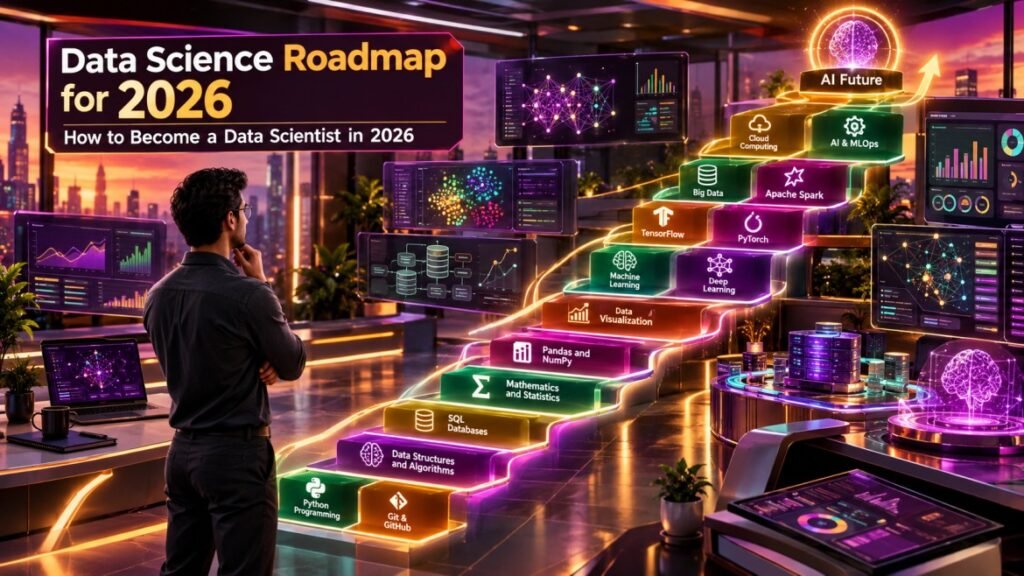
Data Science Roadmap for 2026
The following progression provides a practical learning path.
Programming → Git → DSA → SQL → Mathematics & Statistics → Data Analysis → Visualization → Machine Learning → Deep Learning → Big Data → Deployment & MLOps
You do not have to master everything simultaneously. Build the fundamentals first and progressively move toward advanced concepts.
Step 1: Learn Programming Fundamentals
Python should be one of your first priorities.
Python is widely used for:
- Data analysis
- Machine learning
- Automation
- Data engineering
- AI development
- APIs
- Scientific computing
Python Topics to Learn
Start with:
- Variables
- Data types
- Operators
- Conditional statements
- Loops
- Functions
- Lists
- Tuples
- Dictionaries
- Sets
- File handling
- Exception handling
- Object-oriented programming
- Modules and packages
After learning the fundamentals, start using Python libraries relevant to data science.
What About R?
R is particularly useful for statistical analysis, visualization, and research-oriented workflows. While Python is often the more versatile starting point, learning R can be valuable depending on your career direction.
Step 2: Learn Git and GitHub
Version control is an essential professional skill.
Git allows developers and Data Scientists to track changes in their code and collaborate with other team members.
Learn These Git Concepts
- Repository
- Commit
- Branch
- Merge
- Pull request
- Clone
- Push
- Pull
- Conflict resolution
.gitignore
Use GitHub to create a public portfolio containing your projects.
For example, your repository could include:
customer-churn-prediction/
├── data/
├── notebooks/
├── src/
├── README.md
├── requirements.txt
└── model/
A well-organized GitHub profile can demonstrate practical skills to recruiters.
Step 3: Understand Data Structures and Algorithms
Data Structures and Algorithms are particularly important for technical interviews and writing efficient programs.
Important Data Structures
Learn:
- Arrays
- Lists
- Stacks
- Queues
- Hash tables
- Trees
- Graphs
- Heaps
Important Algorithms
Understand:
- Searching
- Sorting
- Recursion
- Traversal
- Hashing
- Dynamic programming
- Graph algorithms
- Complexity analysis
You do not necessarily need competitive-programming expertise to begin data science, but you should understand how to write efficient and maintainable code.
Step 4: Master SQL and Database Management
SQL is one of the most important practical skills in the Data Science Roadmap.
Many business datasets live inside relational databases. Therefore, knowing Python but not SQL can significantly limit your ability to work with real organizational data.
SQL Topics to Learn
Start with:
- SELECT
- WHERE
- ORDER BY
- GROUP BY
- HAVING
- JOIN
- CASE
- Subqueries
- Common Table Expressions
- Window functions
- Aggregations
- Indexes
- Basic database design
Example
Suppose you want to identify customers generating the highest revenue. SQL can help you aggregate transaction data before sending the results into a Python-based analysis workflow.
This combination of SQL + Python is highly useful for practical data work.
Step 5: Build Your Mathematics and Statistics Foundation
You do not need to become a mathematician, but you should understand the mathematics behind data science algorithms.
Linear Algebra
Focus on:
- Vectors
- Matrices
- Matrix operations
- Dot products
- Eigenvalues
- Eigenvectors
Linear algebra becomes especially important when studying machine learning and neural networks.
Calculus
Learn the fundamentals of:
- Functions
- Derivatives
- Partial derivatives
- Gradients
- Optimization
These concepts help explain how many machine learning models are optimized.
Probability
Study:
- Probability distributions
- Conditional probability
- Bayes’ theorem
- Random variables
- Expected value
- Variance
Statistics
Important topics include:
- Mean
- Median
- Standard deviation
- Correlation
- Sampling
- Hypothesis testing
- Confidence intervals
- Regression
- Statistical significance
A strong statistical foundation helps you interpret models rather than simply running them.
Step 6: Learn Data Handling with NumPy and Pandas
Once your Python fundamentals are comfortable, start working with real datasets.
NumPy
NumPy provides tools for numerical computing and array-based operations.
Learn:
- Arrays
- Indexing
- Broadcasting
- Vectorization
- Mathematical operations
- Matrix operations
Pandas
Pandas is widely used for data manipulation and analysis.
Learn how to:
- Load datasets.
- Filter records.
- Merge datasets.
- Group data.
- Handle missing values.
- Transform columns.
- Work with dates.
- Detect duplicates.
- Create analytical summaries.
Practice With Real Datasets
Instead of only following tutorials, download datasets and attempt to answer questions independently.
For example:
Dataset: Online retail transactions
Questions:
- Which products sell the most?
- Which months generate the highest revenue?
- Which customers purchase repeatedly?
- Are there unusual transactions?
- Can future sales be predicted?
This converts theoretical knowledge into practical experience.
Step 7: Master Data Visualization
Data visualization allows you to communicate patterns that may not be obvious from raw numbers.
Python Visualization Tools
Learn:
- Matplotlib
- Seaborn
- Plotly
You should understand how to select an appropriate chart for a particular analytical question.
Business Intelligence Tools
Also consider learning:
- Tableau
- Power BI
For example, a Data Scientist might use Python for statistical analysis and machine learning while using Power BI to communicate business KPIs to executives.
Step 8: Learn Exploratory Data Analysis
EDA connects data handling with machine learning.
During EDA, investigate:
- Distribution of variables
- Missing values
- Outliers
- Correlations
- Trends
- Relationships between variables
- Potential data leakage
- Feature quality
Example
Suppose you are building a customer churn model.
You might investigate whether churn differs according to:
- Customer tenure
- Subscription type
- Monthly spending
- Support interactions
- Payment method
EDA helps determine which variables deserve further investigation.
Step 9: Learn Machine Learning
Machine learning is a major component of the Data Science Roadmap.
Start with supervised and unsupervised learning.
Supervised Learning
The model learns from labeled data.
Common algorithms include:
- Linear Regression
- Logistic Regression
- Decision Trees
- Random Forest
- Gradient Boosting
- Support Vector Machines
- K-Nearest Neighbors
Typical applications include:
- Fraud detection
- Customer churn prediction
- Sales forecasting
- Classification
- Risk assessment
Unsupervised Learning
The data does not have predefined labels.
Learn:
- K-Means clustering
- Hierarchical clustering
- Dimensionality reduction
- Principal Component Analysis
These methods can be useful for segmentation and pattern discovery.
Step 10: Learn Model Evaluation
Building a model is only part of the process.
You need to determine whether it performs reliably.
Important Concepts
- Training data
- Validation data
- Test data
- Cross-validation
- Overfitting
- Underfitting
- Bias
- Variance
- Feature selection
- Hyperparameter tuning
Evaluation Metrics
Depending on the problem, learn:
Classification:
- Accuracy
- Precision
- Recall
- F1-score
- ROC-AUC
- Confusion matrix
Regression:
- MAE
- MSE
- RMSE
- R²
The appropriate metric depends on the business problem.
Step 11: Explore Deep Learning and AI
After establishing machine learning fundamentals, move toward deep learning.
Popular frameworks include:
- TensorFlow
- PyTorch
Deep Learning Topics
Learn:
- Neural networks
- Activation functions
- Forward propagation
- Backpropagation
- Optimization
- CNNs
- RNNs
- Transformers
In 2026, understanding AI concepts can complement traditional data science skills.
You can also explore:
- Generative AI
- Large Language Models
- Embeddings
- Vector databases
- Retrieval-Augmented Generation
- AI agents
- Multimodal AI
The objective should not be to learn every new AI tool. Instead, understand the underlying concepts and how they solve practical problems.
Step 12: Learn Big Data Technologies
Traditional tools may struggle when datasets become extremely large or arrive continuously.
This is where big data technologies become relevant.
Technologies to Explore
- Hadoop
- Apache Spark
- Spark SQL
- Distributed computing
- Data pipelines
- Cloud data platforms
Apache Spark is particularly useful for distributed data processing and can work with large datasets across clusters.
You should understand why distributed computing is necessary rather than simply memorizing Spark commands.
Step 13: Learn Cloud and MLOps Fundamentals
Modern data science increasingly involves cloud infrastructure and production systems.
Consider learning at least one major cloud ecosystem, such as:
- AWS
- Microsoft Azure
- Google Cloud
MLOps Concepts
Learn the basics of:
- Model deployment
- Model versioning
- CI/CD
- Monitoring
- Data pipelines
- Experiment tracking
- Containerization
- Model retraining
Tools such as Docker and MLflow can be explored as your projects become more advanced.
Step 14: Build Real-World Data Science Projects
Projects are where your knowledge comes together.
Instead of creating ten simple projects based on tutorials, create a smaller number of well-designed projects that demonstrate an end-to-end workflow.
Beginner Projects
- House price prediction
- Sales analysis
- Customer segmentation
- Movie recommendation
- Retail dashboard
Intermediate Projects
- Customer churn prediction
- Fraud detection
- Demand forecasting
- Credit risk analysis
- Marketing campaign analysis
Advanced Projects
- End-to-end ML API
- Real-time recommendation system
- NLP classification system
- RAG-based analytics assistant
- Large-scale Spark pipeline
- Production ML monitoring system
Each project should explain the problem, data, methodology, results, limitations, and business impact.
How Long Does It Take to Become a Data Scientist?
The timeline depends heavily on your existing background and the amount of time you can dedicate to learning.
A possible progression is:
| Stage | Main Focus |
|---|---|
| Months 1–2 | Python, Git and programming |
| Months 3–4 | SQL, databases, statistics |
| Months 5–6 | Pandas, NumPy, EDA and visualization |
| Months 7–9 | Machine learning |
| Months 10–11 | Deep learning and AI |
| Month 12+ | Big data, cloud, MLOps and portfolio |
This is a learning framework rather than a guaranteed career timeline. Someone with software engineering or analytics experience may progress faster through the fundamentals.
Skills to Develop for Data Science Jobs in 2026
A competitive Data Scientist profile can combine several skill categories.
Technical Skills
- Python
- SQL
- Git
- Statistics
- Mathematics
- Pandas
- NumPy
- Machine Learning
- Deep Learning
- Data Visualization
- Big Data
- Cloud
- MLOps
Business Skills
- Problem-solving
- Business understanding
- Analytical thinking
- Domain knowledge
- Decision-making
Communication Skills
- Data storytelling
- Presentation
- Technical documentation
- Stakeholder communication
The combination is important because Data Scientists are often expected to translate technical analysis into business outcomes.
Data Science and Digital Transformation
The impact of data science on digital transformation is significant.
Organizations increasingly use data to redesign how they operate rather than simply creating reports.
For example:
Traditional approach:
Sales declined last quarter.
Data-driven approach:
Sales declined among a particular customer segment, with specific behavioral patterns indicating a higher probability of churn.
The second approach can support more targeted action.
Data science can contribute to digital transformation through:
- Predictive analytics
- Intelligent automation
- Personalized customer experiences
- Fraud detection
- Demand forecasting
- Risk modeling
- Recommendation engines
- Operational optimization
Future Trends in Data Science for 2026 and Beyond
The future of data science is likely to involve increasing convergence between analytics, AI, software engineering, and business intelligence.
1. Generative AI and Data Science
Data Scientists can use generative AI for:
- Code assistance
- Data exploration
- Documentation
- Query generation
- Natural-language analytics
- Model development support
However, generated outputs still require validation.
2. Automated Machine Learning
AutoML can automate portions of:
- Feature engineering
- Model selection
- Hyperparameter optimization
- Evaluation
This may reduce repetitive work while increasing the importance of problem formulation and model governance.
3. Real-Time Analytics
Organizations increasingly need insights immediately rather than days after an event.
Applications include:
- Fraud detection
- Recommendation systems
- Financial monitoring
- IoT analytics
- Operational monitoring
4. Responsible AI
As AI systems become more influential, organizations will pay greater attention to:
- Bias
- Privacy
- Explainability
- Security
- Data governance
- Model accountability
5. AI-Assisted Analytics
Natural-language interfaces may allow business users to ask questions about datasets without writing complex queries.
This means Data Scientists may increasingly focus on designing reliable analytical systems rather than simply producing individual reports.
Challenges in Becoming a Data Scientist
The career has significant opportunities, but there are also challenges.
1. Large Learning Curve
The field combines several disciplines. Learning Python alone does not make someone a Data Scientist.
2. Rapid Technology Changes
AI frameworks and tools evolve quickly.
You need continuous learning without constantly abandoning fundamentals for every new technology.
3. Competition for Entry-Level Roles
Many candidates now complete online courses and boot camps. Practical projects and demonstrable problem-solving skills can help differentiate your profile.
4. Data Quality Problems
Real-world datasets are often incomplete, inconsistent, biased, or poorly documented.
5. Business Communication
A technically accurate model can still have limited value if stakeholders cannot understand its implications.
Career Opportunities in Data Science
The skills in this Data Science Roadmap can lead to several related career paths.
Possible roles include:
- Data Scientist
- Junior Data Scientist
- Machine Learning Engineer
- Data Analyst
- Business Intelligence Analyst
- Data Engineer
- AI Engineer
- Applied Scientist
- ML Operations Engineer
- Product Data Scientist
- Decision Scientist
The exact requirements differ between companies, so job descriptions should be used to identify which skills are most relevant to your target role.
How to Build a Strong Data Science Portfolio
Your portfolio should demonstrate your ability to solve problems, not simply your ability to follow tutorials.
For every project, include:
- Problem statement
- Business context
- Dataset description
- Data-cleaning process
- Exploratory analysis
- Feature engineering
- Model selection
- Evaluation metrics
- Results
- Limitations
- Business interpretation
- Future improvements
A GitHub repository with clear documentation can make your work easier for recruiters and hiring managers to evaluate.
Common Mistakes Beginners Should Avoid
Mistake 1: Learning Too Many Tools
Do not try to learn every AI and data science framework simultaneously.
Mistake 2: Ignoring Statistics
Machine learning without statistical understanding can make model results difficult to interpret.
Mistake 3: Avoiding SQL
Real business data frequently exists in databases.
Mistake 4: Building Only Tutorial Projects
A copied project does not demonstrate independent problem-solving.
Mistake 5: Focusing Only on Models
Data preparation, validation, deployment, communication, and monitoring are also important.
Mistake 6: Ignoring Business Context
A model should ultimately solve a meaningful problem.
A Practical 2026 Learning Strategy
If you are starting from zero, follow this sequence:
Phase 1 — Foundation
Python → Git → Programming → SQL
Phase 2 — Analytical Foundation
Statistics → Probability → Mathematics → Pandas → NumPy
Phase 3 — Data Analysis
EDA → Data Cleaning → Visualization → Tableau/Power BI
Phase 4 — Machine Learning
Supervised Learning → Unsupervised Learning → Feature Engineering → Model Evaluation
Phase 5 — Advanced AI
Deep Learning → Transformers → Generative AI → LLM applications
Phase 6 — Production
APIs → Cloud → Docker → MLOps → Model Monitoring
Phase 7 — Portfolio
Build → Deploy → Document → Publish → Apply
This sequence provides a more sustainable approach than trying to master every technology at once.
Final Thoughts
Learning data science in 2026 requires a combination of strong fundamentals and awareness of emerging technologies. Python, SQL, mathematics, statistics, data analysis, visualization, and machine learning remain important foundations, while AI, deep learning, cloud computing, big data, and MLOps can expand your capabilities.
The most important lesson from this Data Science Roadmap is that becoming a Data Scientist is not about collecting certificates or memorizing algorithms. It is about learning how to transform messy data into reliable insights and useful solutions.
As organizations continue their digital transformation, professionals who can connect data, AI, technology, and business problems will have opportunities across many industries. Build your fundamentals, work with real datasets, create meaningful projects, learn continuously, and develop the ability to communicate your findings clearly.