
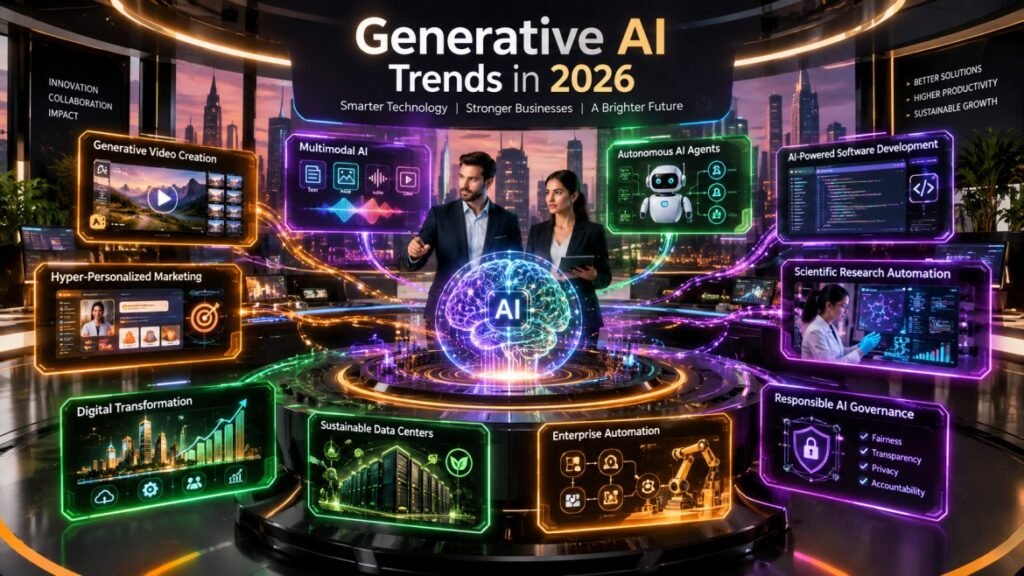
Generative AI Trends – Generative artificial intelligence has evolved from an emerging innovation into a core business capability. Over the last few years, organizations have experimented with AI-generated content, automated workflows, and intelligent assistants. In 2026, the technology is expected to move beyond experimentation and become deeply integrated into everyday operations, creative processes, and strategic decision-making.
The most significant Generative AI Trends in 2026 will focus on practical business value, advanced automation, multimodal intelligence, and responsible governance. Organizations are increasingly seeking measurable outcomes rather than chasing hype, leading to a more mature and sustainable AI ecosystem.
This article explores the most important Generative AI Trends expected to shape 2026 and examines their impact on businesses, professionals, and the future of technology.
Table of Contents
Why Generative AI Matters in 2026
Generative AI is no longer limited to creating text, images, or simple chat responses. Modern systems can analyze multiple forms of data, automate business processes, assist researchers, and support enterprise-scale decision-making.
Several factors are accelerating adoption:
- Growing demand for productivity and efficiency
- Increased availability of enterprise AI platforms
- Rising investment in automation
- Expansion of AI-powered business applications
- Need for personalized customer experiences
- Competitive pressure across industries
As digital transformation continues across industries, Generative AI is becoming a strategic necessity rather than a technological luxury.
Top 10 Generative AI Trends in 2026
1. Mainstream Generative Video
Generative video technology is expected to become one of the most disruptive innovations of 2026.
AI-powered video creation tools are dramatically reducing production costs and development timelines. Marketing teams, media companies, educators, and content creators can generate high-quality video content without traditional production limitations.
Key Applications
- Marketing campaigns
- Product demonstrations
- Employee training
- Educational content
- Entertainment production
- Personalized advertising
Example
A global e-commerce company can automatically generate hundreds of product videos tailored to different customer segments, languages, and regions within hours instead of weeks.
Business Impact
- Faster content production
- Lower operational costs
- Increased scalability
- Enhanced customer engagement
2. Multimodal and Agentic AI
One of the most important Generative AI Trends in 2026 is the rise of multimodal and agentic systems.
Instead of processing only text, these systems can simultaneously understand:
- Text
- Audio
- Images
- Video
- Structured business data
At the same time, AI agents are becoming increasingly autonomous and capable of executing complex workflows with minimal human supervision.
Example
An AI assistant can analyze customer emails, listen to support calls, review uploaded documents, generate reports, and schedule follow-up actions automatically.
Benefits
- Improved decision-making
- Better contextual understanding
- End-to-end workflow automation
- Higher operational efficiency
3. Domain-Specific AI Models
The era of one-size-fits-all AI models is gradually fading.
Organizations increasingly require specialized systems trained on industry-specific knowledge, regulations, and workflows.
Industries Leading Adoption
Healthcare
- Clinical documentation
- Medical research support
- Diagnostic assistance
Finance
- Risk analysis
- Fraud detection
- Regulatory compliance
Engineering
- Design optimization
- Simulation support
- Technical documentation
Why It Matters
Domain-specific models provide:
- Greater accuracy
- Better compliance
- Reduced hallucinations
- Industry-specific expertise
4. Large-Scale AI Automation
Digital assistants are rapidly evolving into AI co-workers.
By 2026, AI systems will autonomously manage numerous operational activities that currently require manual effort.
Tasks AI Can Handle
- Contract drafting
- Procurement management
- Supply chain optimization
- Scheduling
- Customer support
- Data analysis
Example
A manufacturing company can deploy AI agents to monitor inventory, predict shortages, negotiate supplier recommendations, and generate purchasing reports.
Business Benefits
- Reduced operational costs
- Faster execution
- Increased productivity
- Improved business agility
5. Hyper-Personalized Content at Scale
Customer expectations continue to rise.
Consumers increasingly expect brands to deliver relevant experiences based on their preferences, behavior, and interests.
Generative AI enables organizations to create personalized content for millions of customers simultaneously.
Examples
- Personalized email campaigns
- Customized product recommendations
- Dynamic website experiences
- AI-generated social media content
- Individualized learning materials
Marketing Impact
Businesses can significantly improve:
- Customer engagement
- Conversion rates
- Brand loyalty
- Marketing ROI
6. AI-Powered Research and Innovation
Generative AI is becoming a powerful research partner.
Scientists, engineers, and researchers are using AI to accelerate innovation by generating hypotheses, designing experiments, and analyzing complex datasets.
Potential Applications
- Drug discovery
- Materials science
- Climate modeling
- Engineering simulations
- Academic research
Example
Researchers can use AI to identify potential molecular structures and simulate outcomes before conducting physical laboratory tests.
Result
- Faster discoveries
- Reduced research costs
- Improved experimentation
- Enhanced innovation capacity
7. Responsible AI Governance
As AI becomes more influential, governance is becoming a business priority.
Organizations are implementing frameworks that promote:
- Transparency
- Fairness
- Accountability
- Security
- Privacy protection
Key Governance Areas
Ethical AI
Ensuring responsible use of AI-generated outputs.
Compliance
Meeting regulatory requirements across industries.
Risk Management
Monitoring potential bias, inaccuracies, and security vulnerabilities.
Why Governance Matters
Trust is becoming one of the most valuable assets in the AI economy.
Organizations that prioritize responsible AI will gain stronger customer confidence and long-term sustainability.
8. AI-Native Software Development
Software engineering is entering a new era.
Generative AI is increasingly capable of:
- Writing code
- Debugging applications
- Generating documentation
- Performing quality testing
- Monitoring infrastructure
Developer Role Evolution
Developers will spend less time on repetitive coding tasks and more time on:
- System architecture
- Product strategy
- Security planning
- Innovation
Example
A development team can use AI to automatically generate application components while focusing on business requirements and user experience.
9. Pragmatic ROI Over AI Hype
Organizations are becoming more selective with AI investments.
Rather than adopting AI because it is trendy, businesses are focusing on measurable outcomes.
Questions Companies Are Asking
- Does AI reduce costs?
- Does it increase revenue?
- Does it improve customer satisfaction?
- Does it enhance productivity?
Success Metrics
- Revenue growth
- Efficiency improvements
- Customer retention
- Time savings
- Operational optimization
This shift toward practical value represents one of the most important Generative AI Trends for enterprise adoption.
10. Sustainable AI Infrastructure
As AI usage grows, energy consumption is becoming a major concern.
Data centers supporting large AI models require significant computational resources.
Industry Focus Areas
- Energy-efficient AI models
- Green data centers
- Renewable energy integration
- Resource optimization
- Carbon footprint reduction
Why It Matters
Sustainable AI development ensures long-term scalability while minimizing environmental impact.
The future of technology depends not only on innovation but also on responsible resource management.
Opportunities Created by Generative AI in 2026
Businesses embracing AI strategically can unlock significant advantages.
Major Opportunities
Increased Productivity
AI automates repetitive tasks and accelerates workflows.
Enhanced Customer Experiences
Personalized interactions improve engagement and satisfaction.
Faster Innovation
Research and product development cycles become shorter.
New Revenue Streams
AI-powered services create additional business opportunities.
Improved Decision-Making
Organizations gain deeper insights through advanced analytics.
Challenges Businesses Must Address
Despite its potential, Generative AI presents several challenges.
Data Privacy
Organizations must protect sensitive customer and business information.
Regulatory Compliance
Governments worldwide are introducing AI regulations that require ongoing compliance efforts.
Skill Gaps
Businesses need professionals capable of managing and optimizing AI systems.
Model Reliability
AI-generated outputs still require human oversight and validation.
Infrastructure Costs
Large-scale AI implementation can require significant investment.
The Future of Technology Beyond 2026
The next phase of AI development will likely focus on deeper collaboration between humans and intelligent systems.
Future innovations may include:
- Fully autonomous business operations
- Advanced scientific discovery platforms
- Real-time multimodal assistants
- Personalized education ecosystems
- Intelligent enterprise decision-making networks
As Generative AI continues to evolve, its role will expand from automation tool to collaborative partner capable of augmenting human creativity, productivity, and innovation.
Conclusion
The Generative AI Trends in 2026 signal a major shift in how businesses operate, innovate, and compete. From mainstream generative video and multimodal AI to specialized industry models and sustainable infrastructure, organizations are entering a new era of intelligent automation.
Companies that focus on practical implementation, measurable outcomes, and responsible governance will be best positioned to capitalize on the opportunities ahead. As digital transformation accelerates across every sector, Generative AI is becoming a foundational technology that will shape the future of technology, redefine business operations, and unlock entirely new possibilities for innovation.
The organizations that successfully integrate AI into their strategies today will be the leaders of tomorrow’s intelligent economy.