
Artificial Intelligence is rapidly transforming the way businesses operate, automate workflows, and interact with customers. As organizations embrace the future of technology, AI agents are emerging as one of the most impactful innovations. These intelligent systems can reason, make decisions, access external tools, and perform tasks with minimal human intervention.
One of the most powerful frameworks enabling this revolution is LangChain. Designed as an open-source framework for building generative AI applications and autonomous AI agents, LangChain simplifies the process of connecting large language models (LLMs) with tools, databases, APIs, and external systems.
In this comprehensive guide, we’ll explore How LangChain Works to Create AI Agents, the key components involved, real-world use cases, challenges, and the growing impact of it on modern digital transformation initiatives.
Table of Contents
What Is LangChain?
LangChain is an open-source development framework that helps developers build applications powered by large language models. Instead of relying solely on an LLM to generate responses, LangChain enables models to interact with external resources, perform actions, retrieve information, and solve complex tasks.
The framework acts as a bridge between AI models and real-world systems, making AI applications more practical, reliable, and intelligent.
Some of the supported models include:
- GPT-4
- Claude
- Gemini
- Llama
- Mistral
- Open-source LLMs
By combining these models with tools and workflows, LangChain enables the creation of sophisticated AI agents.
Understanding AI Agents
An AI agent is an intelligent system that can:
- Analyze user requests
- Reason through problems
- Select appropriate actions
- Use external tools
- Generate meaningful outputs
- Learn from context
Unlike traditional chatbots that simply answer questions, AI agents can actively perform tasks.
Example
A user asks:
“Find the latest market trends for electric vehicles and summarize them.”
A simple chatbot might rely only on its training data.
A LangChain-powered AI agent can:
- Search the web for recent information.
- Gather relevant articles.
- Analyze findings.
- Summarize trends.
- Present actionable insights.
This ability to think and act makes AI agents significantly more powerful.
How LangChain Works to Create AI Agents
Understanding How LangChain Works to Create AI Agents requires examining the framework’s core architecture.
At a high level, LangChain combines:
- Large Language Models
- Prompts
- Tools
- Parsers
- Memory
- Chains
- Agent Logic
These components work together to create autonomous systems capable of solving complex tasks.
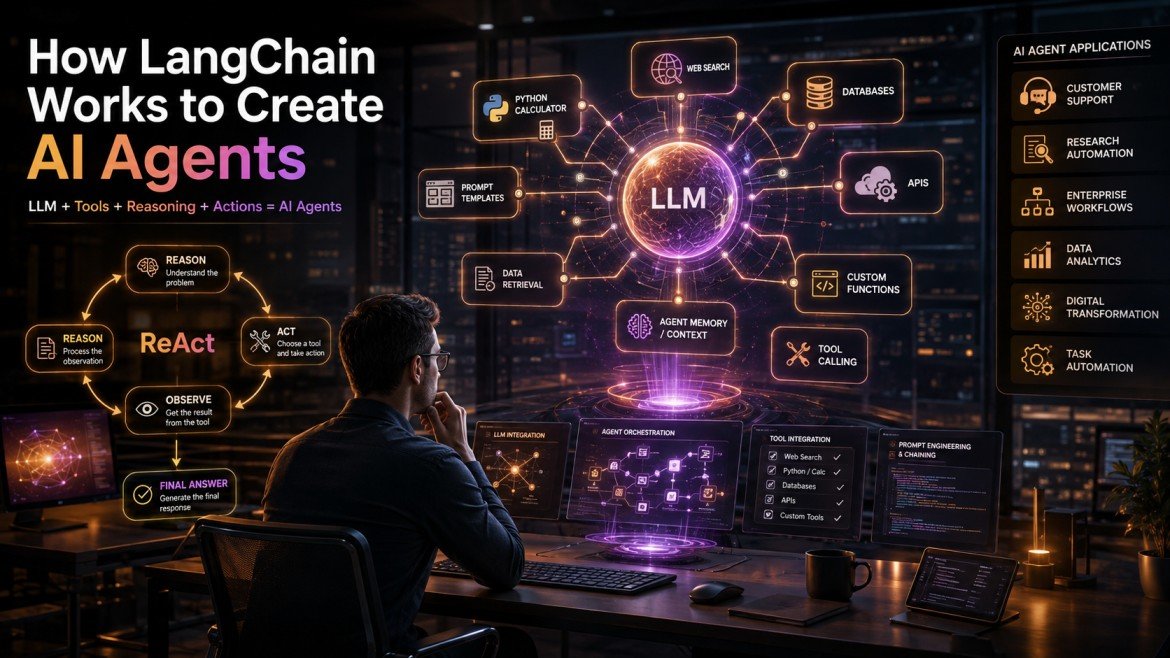
The ReAct Framework: Reason + Act
One of the most important concepts behind LangChain agents is the ReAct framework.
ReAct stands for:
Reason
The model analyzes the problem and determines the best approach.
Act
The model executes actions using external tools.
Observe
The model reviews the results.
Continue
The model decides whether additional actions are needed.
This cycle continues until the task is completed.
Example Workflow
User Query:
“Calculate the average stock price of Company X over the last week.”
Agent Process:
- Reason about what information is needed.
- Access stock market data.
- Retrieve prices.
- Use a calculator tool.
- Compute the average.
- Return the result.
This combination of reasoning and action forms the foundation of intelligent AI agents.
The Role of Parsing in AI Agents
Before an AI model can act, it must understand the user’s request.
This is where parsing becomes essential.
Parsing converts natural language into formats that the model can process effectively.
The parser helps:
- Break text into tokens
- Create embeddings
- Identify user intent
- Detect tool requirements
- Structure prompts
Example
Input:
“What is the weather in New York today and convert 75°F to Celsius?”
The parser identifies:
- Weather information request
- Temperature conversion request
- Required external tools
The agent can then execute the appropriate actions.
Without efficient parsing, agent performance would be significantly reduced.
Tool Integration: The Power Behind AI Agents
One of LangChain’s biggest strengths is tool integration.
Tools extend the capabilities of language models beyond text generation.
Common Tools Used in LangChain
Web Search APIs
Examples:
- DuckDuckGo
- Google Search
- Bing Search
These tools provide real-time information.
Python Calculators
Used for:
- Mathematical calculations
- Data analysis
- Statistical processing
Databases
Agents can query:
- SQL databases
- Vector databases
- Knowledge bases
Custom APIs
Businesses can connect:
- CRM systems
- ERP software
- Customer support platforms
- Internal business applications
Example: AI Research Assistant
A LangChain agent can:
- Search the web.
- Read articles.
- Compare sources.
- Summarize findings.
- Generate reports.
This creates a powerful automated research workflow.
Key Components of LangChain
1. Large Language Models (LLMs)
The LLM acts as the brain of the agent.
Supported models include:
- GPT-4
- Claude
- Gemini
- Llama
- Mistral
The model handles:
- Understanding language
- Reasoning
- Decision-making
- Response generation
2. Prompt Engineering
Prompts guide the behavior of the model.
Static Prompts
Fixed instructions used repeatedly.
Prompt Templates
Dynamic prompts with variables.
Example:
Summarize the following article:
{article_text}
Few-Shot Prompting
Provides examples to improve output quality.
This helps agents perform tasks more consistently.
3. Chaining
Chains connect multiple operations together.
Simple Chains
Single-step workflows.
Example:
Input → LLM → Output
Complex Chains
Multi-step workflows involving:
- Multiple tools
- Conditional logic
- External data sources
Example:
Search → Analyze → Summarize → Report
Chaining enables sophisticated automation scenarios.
4. Memory Management
Memory allows agents to remember previous interactions.
Benefits include:
- Personalized conversations
- Better context retention
- Improved customer experiences
- Long-term task tracking
This capability is especially important for conversational AI systems.
Types of AI Agents in LangChain
Zero-Shot Agents
These agents receive no prior examples.
They rely entirely on:
- Model knowledge
- Prompt instructions
- Reasoning capabilities
Advantages:
- Fast deployment
- Flexible usage
- Reduced setup effort
Conversational Agents
These agents maintain conversation history.
Capabilities include:
- Multi-turn interactions
- Context retention
- Personalized responses
Examples:
- Customer support assistants
- Virtual consultants
- AI coaches
Conversational agents create more natural user experiences.
Real-World Applications of LangChain AI Agents
The practical impact of LangChain extends across multiple industries.
AI Customer Assistants
Businesses use AI agents to:
- Answer customer questions
- Resolve support issues
- Provide recommendations
- Handle ticket routing
Benefits include:
- Faster response times
- Reduced support costs
- Improved satisfaction
Healthcare Workflows
Healthcare organizations use AI agents for:
- Patient scheduling
- Medical documentation
- Research assistance
- Clinical workflow automation
Human oversight remains critical, but AI can significantly improve efficiency.
CRM Automation
Sales teams leverage agents to:
- Update records
- Qualify leads
- Generate reports
- Schedule follow-ups
This enhances productivity and reduces manual work.
Research and Knowledge Management
Researchers can automate:
- Literature reviews
- Data collection
- Content summarization
- Competitive analysis
The result is faster decision-making and improved productivity.
Benefits of LangChain for Digital Transformation
Organizations pursuing digital transformation increasingly rely on AI-driven automation.
Key benefits include:
Increased Efficiency
Routine tasks can be automated.
Better Decision-Making
Agents provide data-driven insights.
Scalability
Systems can support thousands of interactions simultaneously.
Cost Reduction
Automation reduces operational expenses.
Enhanced User Experiences
Personalized and intelligent interactions improve customer satisfaction.
The growing impact of it on enterprise innovation continues to accelerate.
Challenges of Building AI Agents
Despite the advantages, several challenges remain.
Tool Reliability
External APIs may fail or provide inaccurate data.
Hallucinations
LLMs can occasionally generate incorrect information.
Security Risks
Agents interacting with external systems require strong safeguards.
Context Limitations
Large workflows can exceed context window constraints.
Cost Management
Complex agents may require significant computational resources.
Organizations must address these challenges through testing, monitoring, and governance.
Future Trends in AI Agents
The future of technology is closely tied to advancements in AI agents.
Several trends are shaping the next generation of intelligent systems.
Multi-Agent Systems
Multiple agents will collaborate to solve complex tasks.
Example:
- Research Agent
- Analysis Agent
- Reporting Agent
Working together as a coordinated team.
Autonomous Enterprise Operations
Businesses will deploy agents capable of:
- Managing workflows
- Monitoring performance
- Optimizing processes
With minimal human intervention.
Advanced Reasoning Models
Future models will deliver:
- Better planning
- Improved logic
- More accurate decisions
Enhancing agent reliability.
AI-Powered Personal Assistants
Next-generation assistants will:
- Understand context deeply
- Manage schedules
- Execute business tasks
- Coordinate across platforms
Creating seamless productivity experiences.
Industry-Specific AI Agents
Specialized agents will emerge for:
- Healthcare
- Finance
- Legal services
- Manufacturing
- Education
Offering domain-specific expertise and automation.
Why LangChain Is Becoming Essential for AI Development
As businesses continue embracing digital transformation, the need for intelligent systems that can reason, act, and automate tasks is growing rapidly.
This is precisely where LangChain excels.
By combining:
- Powerful LLMs
- Tool integrations
- Prompt engineering
- Chaining workflows
- Agent architectures
LangChain enables developers to create practical AI applications that go far beyond traditional chatbots.
Understanding How LangChain Works to Create AI Agents provides valuable insight into the future direction of enterprise AI and automation.
Conclusion
LangChain has become one of the most influential frameworks for building intelligent AI agents. Through its integration of large language models, tool calling, parsing, prompting, and chaining, it enables systems that can reason, take actions, and solve real-world problems.
As the future of technology continues to evolve, AI agents will play a central role in business automation, customer engagement, healthcare innovation, research, and digital transformation. Organizations that understand and adopt these technologies today will be better positioned to capitalize on the growing impact of it in tomorrow’s AI-driven economy.
Whether you’re a developer, business leader, or technology enthusiast, learning How LangChain Works to Create AI Agents is an important step toward understanding the next generation of intelligent automation.