
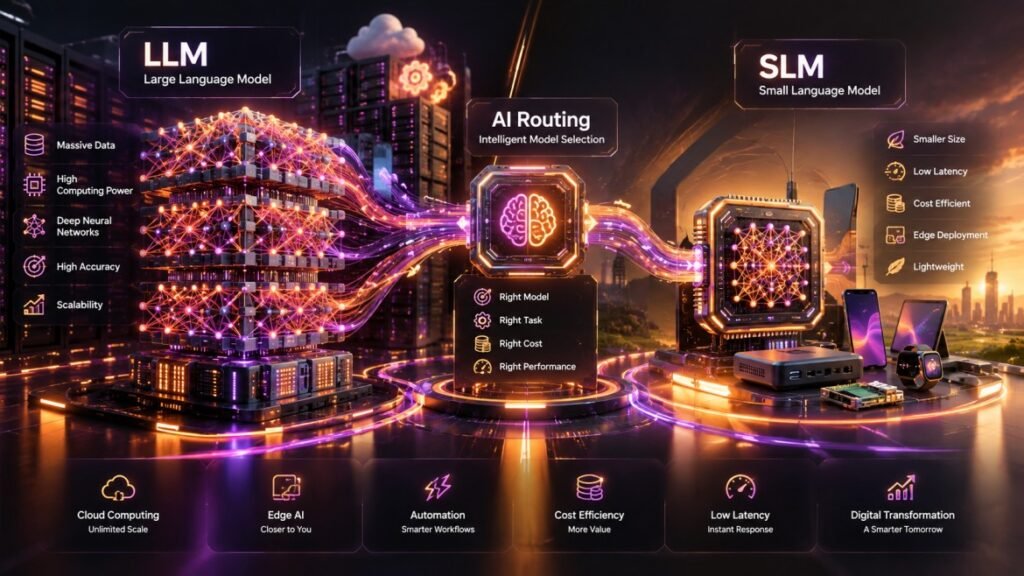
LLM vs SLM Artificial Intelligence is rapidly becoming an essential part of modern digital transformation. From intelligent search and customer support to software development, data analysis, automation, and content creation, AI models are changing how organizations build and deliver digital products.
Among the most important developments in generative AI are Large Language Models (LLMs) and Small Language Models (SLMs). Both can understand and generate human-like language, but they are designed for different requirements.
The debate around LLM vs SLM is therefore not simply about which model is more powerful. It is about choosing the right balance between intelligence, speed, cost, scalability, privacy, and deployment requirements.
An LLM may be the better choice for a complex reasoning or content-generation platform, while an SLM can be more practical for a focused application that needs fast responses and lower computing costs.
This article explains the key differences between LLMs and SLMs, their applications, challenges, opportunities, and why a hybrid AI strategy could shape the future of enterprise technology.
Table of Contents
What Is an LLM?
LLM vs SLM – A Large Language Model (LLM) is an AI model trained on enormous amounts of text and other data. LLMs typically contain billions or, in some cases, hundreds of billions of parameters.
These parameters help the model identify patterns, understand context, generate text, answer questions, summarize information, write code, and perform complex language-related tasks.
Popular LLM-based systems have demonstrated capabilities across areas such as:
- Content generation
- Software development
- Document analysis
- Research assistance
- Customer support
- Language translation
- Data interpretation
- Complex reasoning
The major advantage of an LLM is its broad capability. It can handle many different types of tasks without being specifically designed for just one narrow workflow.
Advantages of LLMs
- Strong performance on complex tasks
- Better understanding of context
- Advanced language generation
- Suitable for creative applications
- Useful for complex research and analysis
- Can support multiple business workflows
However, this capability generally comes with higher infrastructure requirements and operational costs.
What Is an SLM?
A Small Language Model (SLM) is a comparatively compact language model designed to perform efficiently with fewer parameters and lower computational requirements.
Instead of attempting to solve every possible language problem, an SLM can be optimized for specific tasks, industries, devices, or workflows.
This makes SLMs particularly attractive for applications where speed, efficiency, privacy, and lower deployment costs are more important than maximum general-purpose capability.
Examples include:
- Lightweight virtual assistants
- Classification systems
- Internal enterprise automation
- Simple document processing
- Edge AI applications
- Fast customer-service responses
- Device-based AI features
SLMs can potentially operate in environments where deploying a very large model would be impractical.
LLM vs SLM: Key Differences
LLM vs SLM Understanding the difference between the two models requires examining more than parameter count.
1. Model Size and Complexity
The most obvious difference is model size.
LLMs generally contain significantly more parameters and require substantial computational resources for training and inference. Their large architecture allows them to represent complex relationships in data.
SLMs use fewer parameters and are designed to deliver useful results with considerably lower resource requirements.
Example: A company developing a sophisticated research assistant may prefer an LLM, while a mobile application that only needs text classification could use an SLM.
2. Performance and Quality
LLMs generally perform better when a task requires:
- Complex reasoning
- Long-context understanding
- Nuanced writing
- Multiple-step problem solving
- Broad knowledge
- Creative generation
SLMs can perform extremely well when the task is clearly defined and the model has been appropriately optimized or fine-tuned.
For a narrow business workflow, an SLM may deliver sufficiently high accuracy without requiring the resources of a much larger model.
3. Speed and Latency
LLM vs SLM Model size directly affects computational requirements.
A large model may require more processing, potentially increasing response latency. This can become important in applications where users expect immediate responses.
SLMs are designed with efficiency in mind. Their smaller architecture can make them suitable for:
- Real-time applications
- Mobile AI
- Edge computing
- Fast automation
- Interactive systems
For applications where milliseconds or seconds matter, an SLM can provide an important performance advantage.
4. Cost and Infrastructure
LLM vs SLM Running an advanced LLM at scale can require expensive cloud infrastructure, powerful GPUs, memory, networking, and ongoing model-serving resources.
SLMs generally require fewer resources. This can reduce:
- Infrastructure costs
- Inference costs
- Energy consumption
- Deployment complexity
- Hardware requirements
For startups and smaller organizations, this difference can significantly influence an AI implementation strategy.
5. Deployment Flexibility
LLM vs SLM LLMs are often deployed through powerful cloud infrastructure because their resource requirements can be substantial.
SLMs offer more deployment flexibility. Depending on the model and application, they may be suitable for local systems, edge devices, private infrastructure, or environments with limited connectivity.
This can be particularly valuable when organizations need greater control over data processing.
6. Privacy and Data Control
LLM vs SLM Data privacy is becoming increasingly important as organizations integrate AI into business processes.
An SLM deployed locally or within a controlled environment can potentially reduce the need to send sensitive information to an external AI service.
This can be useful in sectors such as:
- Financial services
- Healthcare
- Insurance
- Manufacturing
- Government
- Enterprise operations
However, privacy depends on the complete architecture and deployment model, not simply whether an AI system is classified as an SLM.
LLM vs SLM Comparison Table
| Feature | LLM | SLM |
|---|---|---|
| Model size | Very large | Comparatively small |
| Parameters | Usually billions or more | Fewer parameters |
| Computing requirements | High | Lower |
| Response speed | Can have higher latency | Generally faster |
| Operating cost | Higher | Lower |
| Complex reasoning | Excellent | More limited |
| Creative generation | Excellent | Suitable for focused tasks |
| Real-time applications | Possible but resource-intensive | Highly suitable |
| Edge deployment | More difficult | More practical |
| Customization | Broad capabilities | Often easier to optimize for specific tasks |
| Best suited for | Complex, general-purpose AI | Focused, efficient AI |
When Should You Choose an LLM?
An LLM is generally a strong choice when your application needs broad intelligence and sophisticated language capabilities.
LLM Use Cases
1. Creative Content Generation
Marketing platforms, writing assistants, and content-generation applications can benefit from an LLM’s ability to produce diverse and context-aware content.
2. Advanced Customer Service
Complex customer-service systems may need to understand customer history, policies, product information, and nuanced questions.
An LLM can provide broader conversational capabilities for these scenarios.
3. Deep Data and Document Analysis
Organizations dealing with large collections of reports, documents, research papers, or business information can use LLM-based systems for summarization, extraction, comparison, and analysis.
4. Software Development
LLMs can assist developers with:
- Code generation
- Code explanation
- Debugging
- Test creation
- Documentation
- Refactoring suggestions
5. Research and Knowledge Applications
Applications that require information synthesis across multiple subjects can benefit from the broader capabilities of an LLM.
When Should You Choose an SLM?
An SLM can be a better choice when the AI task is narrowly defined and performance requirements emphasize efficiency.
SLM Use Cases
1. Lightweight Virtual Assistants
A company may need an assistant that answers a limited set of frequently asked questions. Deploying a large model may be unnecessary for such a workflow.
2. Simple Business Automation
SLMs can support focused tasks such as:
- Email classification
- Ticket categorization
- Intent detection
- Text classification
- Basic information extraction
3. Edge AI
Devices such as smartphones, industrial equipment, vehicles, and IoT systems can benefit from models that require fewer computational resources.
4. Real-Time Applications
Applications requiring rapid responses can use smaller models to reduce latency and improve user experience.
The Hybrid AI Approach
The future of AI may not be a competition where one model completely replaces the other.
Instead, businesses are increasingly likely to use multiple models for different workloads.
A hybrid architecture could route simple tasks to an SLM while sending complex requests to an LLM.
For example:
User request → AI Router → Simple task → SLM
User request → AI Router → Complex task → LLM
This architecture can provide a practical balance between intelligence and efficiency.
Example of a Hybrid System
Imagine an insurance company’s AI platform.
An SLM could handle:
- Claim classification
- Basic policy questions
- Document categorization
- Routine status requests
An LLM could handle:
- Complex claim analysis
- Long-document summarization
- Detailed customer conversations
- Complex policy interpretation
The result could be a more scalable AI ecosystem than relying exclusively on a single model.
How LLMs and SLMs Are Transforming Businesses
AI is becoming a core component of digital transformation rather than an experimental technology used by a small number of teams.
LLMs can help organizations redesign knowledge-intensive processes, while SLMs can make AI more accessible across everyday workflows and devices.
The impact can be seen in several areas.
Increased Automation
AI can automate repetitive language-based activities, allowing employees to focus on higher-value work.
Faster Decision Support
AI systems can summarize information and identify relevant patterns, helping teams access insights more quickly.
Lower AI Deployment Barriers
SLMs can make AI deployment more practical for organizations that cannot justify the infrastructure requirements of very large models.
Personalized Digital Experiences
Both model types can contribute to more intelligent applications, including personalized recommendations, virtual assistants, and automated customer interactions.
Future Trends in LLM and SLM Technology
The future of AI development is likely to involve improvements across both large and small models.
1. Smaller Models Will Become More Capable
Advances in model architecture, training techniques, quantization, distillation, and optimization can allow smaller models to perform increasingly sophisticated tasks.
The gap between large and small models may therefore become less important for specialized workloads.
2. AI Will Move Closer to the Edge
More AI processing is expected to occur directly on devices.
This could improve:
- Response times
- Offline functionality
- Data control
- Application reliability
- Operational efficiency
SLMs are particularly well positioned for this trend.
3. Model Routing Will Become More Important
Future AI platforms may dynamically select the most appropriate model based on task complexity.
A simple question might be processed by a low-cost model, while a difficult request is automatically routed to a more capable LLM.
4. Industry-Specific AI Models
Organizations are increasingly interested in AI models optimized for particular domains.
Industry-focused SLMs could become valuable for sectors with specialized terminology, workflows, and compliance requirements.
5. Greater Focus on AI Efficiency
As AI adoption grows, organizations will pay greater attention to inference cost, energy consumption, latency, and infrastructure efficiency.
This will increase interest in smaller and optimized models.
Challenges of LLMs and SLMs
Neither model type is perfect.
LLM Challenges
LLMs can face:
- High infrastructure costs
- Greater energy consumption
- Potential latency
- Complex deployment requirements
- Data privacy considerations
- Hallucinations and inaccurate outputs
- Difficulty controlling broad model behavior
SLM Challenges
SLMs can face:
- Lower performance on highly complex tasks
- Smaller knowledge capacity
- More limited reasoning ability
- Potentially weaker generalization
- Greater dependence on task-specific optimization
Therefore, model selection should be based on the application’s requirements rather than model size alone.
Opportunities for Businesses
The evolution of LLMs and SLMs creates significant opportunities for organizations.
Startups
Startups can use SLMs to build affordable AI-powered products without requiring extremely large infrastructure investments.
Enterprises
Large companies can combine LLMs and SLMs across different departments and workflows.
Developers
Developers can select models based on workload requirements rather than using the same model for every application.
AI Infrastructure Providers
The growing demand for efficient inference creates opportunities around:
- Model optimization
- AI chips
- Edge computing
- Model routing
- AI observability
- Private AI infrastructure
LLM vs SLM: Which One Is Better?
There is no universal winner.
The right choice depends on the business problem.
Choose an LLM when you need:
- Advanced reasoning
- Broad knowledge
- Complex content generation
- Sophisticated conversations
- Deep analysis
Choose an SLM when you prioritize:
- Low latency
- Lower cost
- Focused functionality
- Edge deployment
- Data control
- Operational efficiency
For many enterprise applications, the best strategy may be to use both.
Conclusion
The LLM vs SLM discussion represents a broader shift in AI engineering: organizations are moving from asking “Which AI model is the most powerful?” to asking “Which model is most appropriate for this workload?”
LLMs remain highly valuable for complex, knowledge-intensive, and creative applications. SLMs, meanwhile, provide an efficient alternative for focused tasks where speed, cost, privacy, and deployment flexibility matter.
The future of AI is likely to be increasingly heterogeneous. Instead of relying on one enormous model for every problem, organizations may build intelligent systems that combine LLMs, SLMs, specialized models, AI agents, and intelligent routing.
This approach can make digital transformation more scalable, efficient, and practical.
Ultimately, the strongest AI strategy is not necessarily the model with the largest parameter count. It is the architecture that delivers the right level of intelligence at the right cost, speed, and scale.