
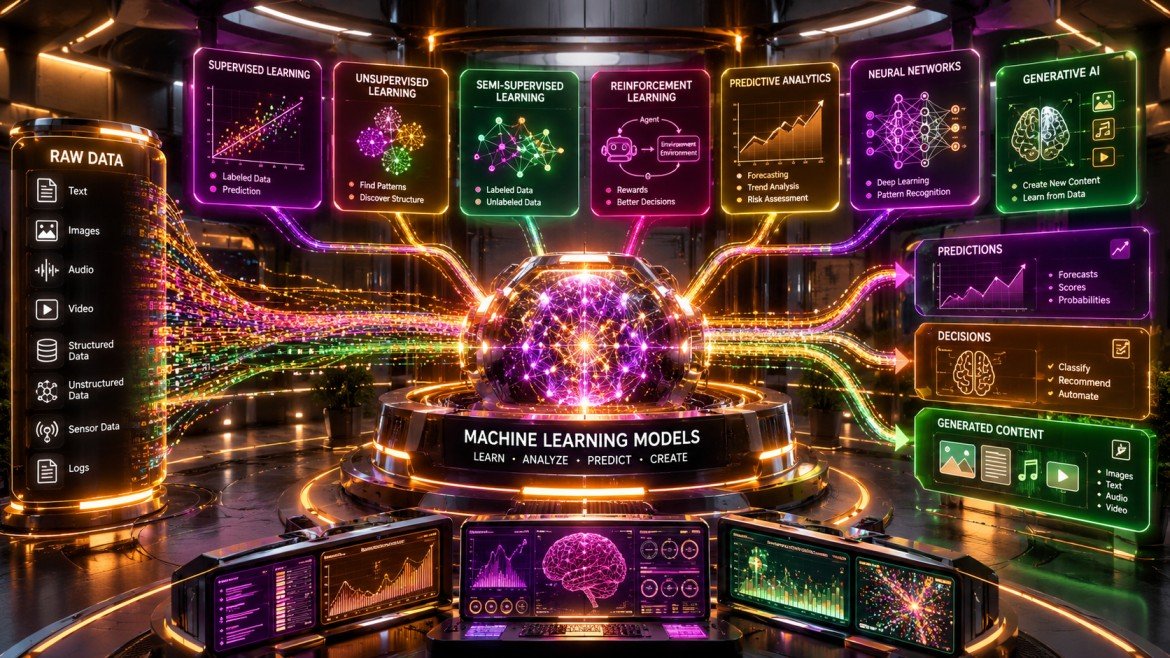
Machine learning has moved from being a specialized technology used by researchers to becoming one of the most important technologies behind modern digital products. From recommendation engines and fraud detection to autonomous systems and Generative AI, machine learning is changing how businesses analyze information, automate processes, and make decisions.
But how do Machine Learning Models actually work?
At a basic level, machine learning allows computers to identify patterns in data and use those patterns to make predictions, classifications, recommendations, or decisions without being explicitly programmed for every possible situation.
Understanding the different types of machine learning is important for anyone interested in Artificial Intelligence, data science, software development, automation, or digital transformation.
This article explains how machine learning models work, the four major learning approaches, their real-world applications, challenges, and what the future could look like.
Table of Contents
What Is Machine Learning?
Machine Learning is a branch of Artificial Intelligence that enables computers to learn patterns from data and improve their performance without relying entirely on manually written rules.
Traditional software generally follows a simple structure:
Input → Programmed Rules → Output
Machine learning changes this approach:
Data + Learning Algorithm → Trained Model → Prediction or Decision
For example, instead of manually programming thousands of rules to identify spam emails, a machine learning system can analyze large numbers of previously identified spam and legitimate emails.
The model learns patterns associated with spam and uses those patterns to classify new messages.
A Simple Example
Suppose a company wants to predict whether a customer is likely to purchase a product.
The system could use information such as:
- Customer age
- Previous purchases
- Website activity
- Product searches
- Location
- Purchase frequency
- Interaction with marketing campaigns
The model analyzes historical data and learns relationships between these variables and purchasing behavior.
When a new customer interacts with the website, the trained model can estimate the probability that the customer will make a purchase.
How Do Machine Learning Models REALLY Work?
Although machine learning can appear complicated, the underlying process can be understood through several important stages.
1. Data Collection
Every machine learning project begins with data.
Data may come from:
- Databases
- Websites
- Mobile applications
- Sensors
- Customer transactions
- Images
- Videos
- Documents
- APIs
- Business systems
The quality and quantity of data can significantly affect the final model.
2. Data Preparation
Raw data is rarely ready for immediate use.
It may contain:
- Missing values
- Duplicate records
- Incorrect information
- Outliers
- Inconsistent formats
- Irrelevant variables
Data preparation involves cleaning and transforming the information into a suitable format.
3. Feature Selection and Engineering
Features are variables that help the model understand a problem.
For example, when predicting house prices, useful features could include:
- Property size
- Number of bedrooms
- Location
- Property age
- Distance from public transport
Selecting meaningful features can improve model performance.
4. Model Training
The algorithm processes training data and identifies relationships or patterns.
During training, the model adjusts internal parameters to reduce errors between its predictions and the expected results.
This is where the system essentially “learns” from data.
5. Model Evaluation
A model should not simply perform well on the data it has already seen.
It must also perform effectively on new, unseen data.
Common evaluation approaches include:
- Accuracy
- Precision
- Recall
- F1-score
- Mean Absolute Error
- Mean Squared Error
- ROC-AUC
The appropriate metric depends on the problem.
6. Deployment
Once the model achieves acceptable performance, it can be deployed into a real application.
For example, a deployed model might:
- Detect fraudulent transactions
- Recommend products
- Predict equipment failures
- Identify objects in images
- Forecast demand
- Analyze customer behavior
7. Monitoring and Retraining
Machine learning does not necessarily end after deployment.
Real-world data changes over time. Customer behavior, economic conditions, technology, and business processes can all evolve.
As a result, organizations may need to monitor model performance and retrain models using newer data.
Four Main Types of Machine Learning
The major learning approaches can be divided into four categories:
- Supervised Learning
- Unsupervised Learning
- Semi-Supervised Learning
- Reinforcement Learning
Each approach solves different types of problems.
1. Supervised Learning
Supervised learning uses labeled data.
This means the training data contains both inputs and expected outputs.
For example:
Email → Spam
House characteristics → House price
The model learns the relationship between the input variables and known outcomes.
Common Supervised Learning Applications
Supervised learning is widely used for:
- Spam detection
- Credit risk assessment
- Fraud detection
- Medical diagnosis
- Sales forecasting
- Customer churn prediction
- House price prediction
- Image classification
Classification
Classification predicts a category.
For example:
- Spam / Not Spam
- Fraud / Not Fraud
- Approved / Rejected
- Positive / Negative
Regression
Regression predicts a numerical value.
For example:
- House price
- Product demand
- Revenue
- Temperature
- Delivery time
Popular supervised learning algorithms include:
- Linear Regression
- Logistic Regression
- Decision Trees
- Random Forest
- Support Vector Machines
- Gradient Boosting
- Neural Networks
2. Unsupervised Learning
Unsupervised learning works with unlabeled data.
There is no predefined answer provided to the model. Instead, the algorithm attempts to discover hidden structures, relationships, or patterns within the data.
Example: Customer Segmentation
Imagine an online retailer has millions of customers but does not have predefined customer categories.
An unsupervised learning algorithm could analyze:
- Purchase history
- Spending behavior
- Product preferences
- Website activity
- Purchase frequency
It may identify groups such as:
- High-value customers
- Occasional buyers
- Discount-focused customers
- New customers
- Inactive customers
Businesses can then use these groups for targeted marketing strategies.
Common Unsupervised Learning Techniques
Examples include:
- K-Means Clustering
- Hierarchical Clustering
- Principal Component Analysis
- Association Rule Learning
- Autoencoders
Unsupervised learning is particularly useful when organizations have large datasets but limited labeled information.
3. Semi-Supervised Learning
Semi-supervised learning combines a small amount of labeled data with a much larger amount of unlabeled data.
This approach is useful because labeling data can be expensive, time-consuming, or require specialized experts.
For example, imagine a healthcare organization has thousands of medical images but only a small number have been labeled by medical professionals.
A semi-supervised approach can use:
Small labeled dataset + Large unlabeled dataset → Improved learning
Applications
Semi-supervised learning can be useful in:
- Medical image analysis
- Speech recognition
- Document classification
- Image recognition
- Fraud detection
- Web content classification
The approach can reduce the amount of manually labeled data required while still helping models learn meaningful patterns.
4. Reinforcement Learning
Reinforcement learning works differently from supervised and unsupervised learning.
Instead of learning directly from labeled examples, an agent interacts with an environment.
The agent performs an action and receives feedback in the form of a reward or penalty.
The general process is:
State → Action → Reward → New State
Over time, the agent learns which actions are more likely to produce desirable outcomes.
Real-World Applications
Reinforcement learning can be used in:
- Robotics
- Game-playing systems
- Autonomous systems
- Resource optimization
- Industrial automation
- Traffic management
- Recommendation strategies
For example, a robot could receive a positive reward when it successfully completes a task and a negative reward when it makes an undesirable move.
Through repeated interactions, the system can improve its strategy.
Machine Learning Models and Generative AI
One of the biggest developments in Artificial Intelligence is Generative AI.
Traditional machine learning often focuses on predicting an outcome, identifying a category, or discovering patterns.
Generative models go a step further by producing new content.
They can generate:
- Text
- Images
- Audio
- Video
- Computer code
- Synthetic data
Large language models, diffusion models, and other generative architectures demonstrate how machine learning can move beyond conventional prediction.
How Generative Models Differ
Consider a traditional image classification model.
It might receive an image and predict:
“This image contains a dog.”
A generative model can instead create an entirely new image based on a prompt such as:
“A futuristic robot walking through a rainforest.”
This represents a major shift in how AI systems interact with information.
Machine Learning in Digital Transformation
Machine learning has become an important component of digital transformation across industries.
Organizations can use intelligent systems to automate repetitive work, improve forecasting, personalize customer experiences, and support decision-making.
Business Applications
Banking and Finance
Machine learning can help with:
- Fraud detection
- Credit scoring
- Risk assessment
- Transaction monitoring
- Financial forecasting
Healthcare
Potential applications include:
- Medical image analysis
- Patient risk prediction
- Drug discovery
- Clinical decision support
- Personalized treatment research
Insurance
Insurance organizations can use machine learning for:
- Claims analysis
- Fraud detection
- Risk assessment
- Customer segmentation
- Pricing analysis
- Document processing
Retail
Retail companies can use machine learning to:
- Recommend products
- Forecast demand
- Optimize inventory
- Analyze customer behavior
- Personalize marketing
Manufacturing
Manufacturers can apply machine learning to:
- Predict equipment failures
- Improve quality control
- Optimize production
- Detect anomalies
- Reduce operational downtime
How to Choose the Right Machine Learning Model
There is no universal model that is perfect for every problem.
Selecting the right approach depends on several factors.
1. Define the Problem
First determine what you actually want the system to accomplish.
Is the goal to:
- Predict a number?
- Classify something?
- Discover groups?
- Generate content?
- Optimize decisions?
The problem definition determines the appropriate learning approach.
2. Examine Your Data
Consider:
- How much data is available?
- Is the data labeled?
- Is it structured or unstructured?
- How reliable is the data?
- Are there missing values?
Data availability can strongly influence model selection.
3. Consider Accuracy Requirements
Some applications require extremely high accuracy.
For example, safety-critical applications may have very different requirements from a recommendation engine.
4. Consider Explainability
In industries such as healthcare, banking, and insurance, organizations may need to understand why a model made a particular prediction.
Simpler models can sometimes offer greater interpretability than highly complex neural networks.
5. Consider Computing Requirements
Advanced models may require significant:
- Processing power
- Memory
- Storage
- Training time
- Infrastructure
Organizations need to balance model performance against operational costs.
Common Challenges of Machine Learning
Despite its enormous potential, machine learning has several challenges.
Data Quality
Poor-quality data can produce poor-quality predictions.
A model cannot reliably learn useful patterns from inaccurate or heavily biased data.
Bias
If historical training data contains biases, the resulting model may reproduce or amplify those biases.
Organizations therefore need responsible data practices and appropriate testing.
Overfitting
Overfitting occurs when a model learns the training data too closely and performs poorly on unseen data.
A strong machine learning system should generalize beyond its training examples.
Model Interpretability
Some advanced models are difficult to explain.
This creates challenges in situations where users need to understand why a particular decision was made.
Security and Privacy
Organizations must protect sensitive data used for training and inference.
Security considerations become particularly important when machine learning systems process financial, personal, or confidential business information.
Future of Machine Learning Models
The future of machine learning is likely to involve increasingly capable, efficient, and specialized systems.
Several developments are particularly important.
Smaller and More Efficient AI Models
AI development is not only about creating larger models.
There is increasing interest in models that can operate efficiently on:
- Smartphones
- Laptops
- Edge devices
- Industrial equipment
- IoT systems
This could make AI more accessible and reduce dependence on centralized infrastructure.
Multimodal AI
Future systems will increasingly work across multiple types of information simultaneously.
A single system could understand:
- Text
- Images
- Audio
- Video
- Structured data
This will create more natural AI applications.
AI Agents
Machine learning systems are increasingly being integrated into AI agents capable of planning, reasoning, using tools, and completing multi-step tasks.
This could significantly change how businesses automate workflows.
Automated Machine Learning
AutoML technologies can automate parts of the machine learning lifecycle, including:
- Feature selection
- Model selection
- Hyperparameter optimization
- Model evaluation
This can make machine learning more accessible to organizations with limited specialist resources.
Responsible AI
As AI adoption increases, organizations will place greater emphasis on:
- Fairness
- Transparency
- Privacy
- Security
- Accountability
- Governance
Responsible AI is likely to become an essential part of enterprise AI strategies.
Opportunities Created by Machine Learning
The growth of machine learning is creating opportunities for professionals and businesses.
Career Opportunities
People can build careers in areas such as:
- Machine Learning Engineering
- Data Science
- AI Engineering
- Data Engineering
- MLOps
- AI Product Management
- AI Testing
- Model Validation
- Responsible AI
- AI Security
Professionals with knowledge of software development, databases, cloud computing, testing, and AI can potentially benefit from the growing demand for intelligent technology.
Business Opportunities
Companies can use machine learning to:
- Automate manual processes
- Reduce operational costs
- Improve customer experience
- Identify new revenue opportunities
- Improve forecasting
- Make data-driven decisions
- Develop intelligent products
The biggest opportunity is not simply using AI because it is popular. The real value comes from solving meaningful business problems.
Machine Learning vs Traditional Programming
Traditional programming generally depends on explicit rules.
For example:
Input + Rules → Output
Machine learning instead uses examples to learn relationships:
Input + Expected Outcomes → Learning Process → Model
After training:
New Input → Trained Model → Prediction
This difference allows machine learning to address problems where writing every rule manually would be impractical.
Why Machine Learning Matters
Machine learning is no longer limited to research laboratories.
It is becoming part of everyday digital experiences.
When a platform recommends a movie, detects suspicious activity, translates a sentence, recognizes an image, or generates content, machine learning may be operating behind the scenes.
Its impact on digital transformation is therefore substantial.
However, successful adoption requires more than selecting an advanced algorithm. Organizations need high-quality data, appropriate infrastructure, skilled professionals, responsible governance, continuous testing, and clearly defined business objectives.
Final Thoughts
Machine Learning Models provide the foundation for many modern Artificial Intelligence applications.
Supervised learning helps systems learn from labeled examples. Unsupervised learning discovers hidden patterns. Semi-supervised learning combines labeled and unlabeled information, while reinforcement learning allows agents to improve through interaction and feedback.
Generative AI is expanding the possibilities even further by enabling systems to create new text, images, audio, video, and code.
The future of machine learning will likely be defined not only by increasingly powerful models but also by efficiency, multimodal capabilities, AI agents, responsible AI, and deeper integration into business processes.
For organizations undergoing digital transformation, the key question is no longer simply “Can we use machine learning?”
The more important question is:
“Which machine learning approach can solve our specific problem, using the data, resources, and risk controls available to us?”
That shift—from experimenting with AI to applying it strategically—is where the real impact of machine learning begins.