
Artificial intelligence is rapidly moving beyond systems that understand only text. Today, AI can interpret pictures, listen to audio, analyze video, understand language, and connect information from several formats at the same time. This evolution is known as Multimodal AI.
Imagine showing an AI system a photograph, asking a question about it, providing a voice instruction, and then asking it to analyze a video. Instead of treating each input independently, a multimodal system can combine these signals to develop a more comprehensive understanding of the situation.
This capability is becoming an important part of the future of technology, influencing healthcare, transportation, education, customer service, content creation, and the broader digital transformation of businesses.
Table of Contents
What Is Multimodal AI?
Multimodal AI refers to artificial intelligence that can process, understand, and connect multiple types of information, including:
- Text
- Images
- Audio
- Video
- Speech
- Sensor information
- Other structured or unstructured data
Traditional AI models were often designed around a single type of input. A language model might process text, while a computer-vision system could analyze images.
A multimodal system attempts to connect these different forms of information. This allows an AI application to reason about relationships between words, visual objects, sounds, and events.
A Simple Example
Suppose you upload a picture of a damaged machine and ask:
“What appears to be wrong with this equipment?”
An AI system with vision capabilities can inspect the image and combine its visual interpretation with your written question. If audio or video is also available, additional evidence can potentially be incorporated into the analysis.
This is fundamentally different from simply running separate AI models for text and images.
How Does Multimodal AI Work?
The underlying architecture can be complex, but the basic workflow can be understood in several stages.
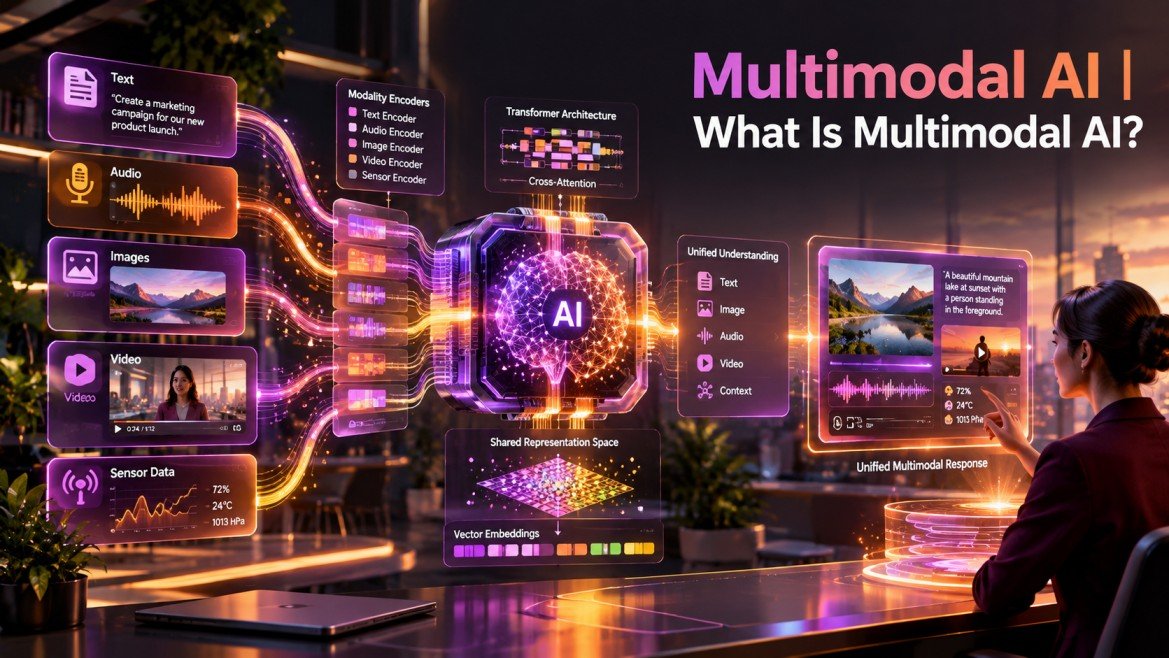
1. Multiple Inputs Are Collected
The system receives information from different modalities.
For example:
Text: “Describe what is happening.”
Image: A photograph of a vehicle.
Audio: A recording of an engine.
Video: Footage showing the vehicle operating.
Each modality contains different forms of information.
2. Data Is Converted Into Representations
AI models convert raw inputs into mathematical representations called vectors or embeddings.
Text can be represented through numerical tokens and embeddings. Images can be converted into visual representations, while audio can be represented through learned features associated with sound.
These representations allow the system to process different types of information computationally.
3. Information Moves Into a Shared Representation Space
One of the major goals is to align information from different modalities.
For example, the words “red car” and an image containing a red car should have representations that allow the system to understand their relationship.
This alignment enables the model to connect concepts across modalities.
4. Cross-Modal Reasoning
Modern architectures can use transformer-based mechanisms, including attention and cross-attention, to determine relationships between different inputs.
The system may connect:
- Words with objects
- Speech with text
- Images with descriptions
- Video frames with spoken instructions
- Sounds with visual events
This cross-modal reasoning is what makes these systems particularly powerful.
5. Generating the Output
After processing the available information, the AI generates a response.
Depending on the application, the output could be:
- Text
- Speech
- An image
- A summary
- A classification
- A recommendation
- An automated action
Major Multimodal AI Models
Several influential systems and research projects have contributed to the development of multimodal intelligence.
CLIP
OpenAI’s CLIP demonstrated how images and natural-language descriptions could be connected through large-scale contrastive learning.
It helped establish important techniques for aligning visual and textual representations.
BLIP-2
BLIP-2 connected vision components with large language models, demonstrating how visual information could be incorporated into language-based reasoning.
Flamingo
DeepMind’s Flamingo research explored few-shot learning across images, videos, and text, demonstrating the potential for models to work across multiple modalities.
PaLM-E
Google’s PaLM-E explored multimodal learning for embodied applications by combining language with visual and sensor information.
Gemini
Google’s Gemini family was designed around multimodal capabilities, allowing different forms of information to be processed within a unified model family.
GPT-4o
OpenAI’s GPT-4o introduced highly integrated text, vision, and audio interaction, demonstrating how multimodal interfaces can make AI interactions more natural.
Real-World Applications
The practical impact of Multimodal AI is becoming increasingly visible across industries.
Healthcare
Medical professionals can potentially combine:
- Medical images
- Patient information
- Clinical notes
- Laboratory data
- Audio or speech information
AI systems can assist with identifying patterns and organizing information, although clinical decisions still require appropriate professional oversight and validation.
Autonomous Vehicles
Self-driving systems need to understand much more than text.
They can combine information from:
- Cameras
- Radar
- LiDAR
- GPS
- Maps
- Sensors
The combination of these signals helps autonomous systems interpret their surroundings and make decisions.
Visual Search
Tools such as Google Lens demonstrate how AI can connect visual information with language-based search.
A user can point a camera at an object and receive information related to what the system identifies.
Customer Service
Future customer-service platforms can combine voice, text, images, and documents.
For example, a customer could photograph a damaged product, explain the problem verbally, and receive assistance without manually describing every visual detail.
Education
AI tutors can potentially analyze written answers, diagrams, spoken responses, and educational videos.
This could enable more interactive and personalized learning experiences.
Content Creation
Creators can use multimodal systems to work across:
- Scripts
- Images
- Voice
- Video
- Music
- Captions
This can reduce the time required to move from an initial concept to a finished piece of content.
How Multimodal AI Is Trained
Training these systems is considerably more complicated than training an AI model on a single data type.
Large and Diverse Datasets
Models require enormous quantities of relevant data.
Training examples may include:
- Image-text pairs
- Video-text pairs
- Audio-text pairs
- Speech transcripts
- Visual descriptions
- Sensor information
The quality and diversity of these datasets have a major influence on model performance.
Contrastive Learning
Contrastive learning can teach models which pieces of information belong together.
For example, an image of a dog paired with the description “a dog running in a park” should be represented more closely than an unrelated description.
Massive Computing Requirements
Training advanced multimodal systems can require significant computational resources, including GPUs and specialized AI accelerators.
This makes large-scale development expensive and limits access to organizations with substantial computing infrastructure.
Challenges of Multimodal AI
Despite its potential, several technical and social challenges remain.
Data Mismatch
Images, text, speech, and video have fundamentally different structures.
Aligning them accurately is a difficult engineering and research problem.
Data Quality
Poorly labeled, incomplete, biased, or duplicated datasets can negatively affect model performance.
Bias and Fairness
AI systems can inherit biases from their training data.
Because multimodal systems process information from many sources, identifying and reducing these biases can become particularly complicated.
High Computational Costs
Large multimodal models can require considerable processing power, memory, storage, and energy.
Evaluation Complexity
It is difficult to determine whether an AI system truly understands relationships across modalities or is simply recognizing statistical patterns.
Evaluation therefore needs to test more than individual image, audio, or language capabilities.
Privacy and Security
Multimodal systems may process highly sensitive information such as photographs, voices, videos, documents, and environmental data.
Strong privacy, security, and governance practices are therefore essential.
Multimodal AI and Digital Transformation
The connection between AI and digital transformation is becoming increasingly important.
Businesses traditionally maintained separate systems for documents, images, customer conversations, videos, and operational data. Multimodal systems can potentially provide a common AI interface for interacting with these different information sources.
For example, an employee could ask an AI assistant to analyze a presentation, inspect an accompanying chart, summarize an audio meeting, and compare the findings with a business document.
This could reduce information silos and make organizational knowledge easier to access.
Future Trends
The next phase of AI development is likely to make multimodal interaction more natural and useful.
Real-Time AI Interaction
AI assistants are increasingly moving toward real-time conversations involving speech, vision, and contextual information.
AI Agents With Multiple Senses
Future AI agents could combine text, visual inputs, audio, documents, and external tools to complete complex tasks.
Personalized AI
Multimodal systems could create richer user experiences by understanding individual preferences, environments, and interaction styles while respecting privacy requirements.
AI in Robotics
Combining vision, language, sound, and sensor data could accelerate progress in intelligent robots capable of operating in dynamic environments.
More Efficient Models
Research is likely to focus on reducing the computational requirements of multimodal systems so that more capable models can operate on consumer devices and edge hardware.
Opportunities Created by Multimodal AI
The technology creates opportunities for both organizations and professionals.
Businesses can use multimodal systems to improve customer experiences, automate repetitive workflows, analyze complex information, and develop new digital products.
Professionals can benefit by learning how to work with AI across different media rather than relying exclusively on traditional text-based prompting.
Emerging opportunities include:
- AI product development
- Multimodal application engineering
- AI-assisted content production
- Computer vision
- Conversational AI
- Robotics
- AI evaluation
- AI governance
- Data engineering
- Human-AI interaction design
What Is the Future of Multimodal AI?
The long-term goal is not simply to create AI that can process more data types. The larger objective is to develop systems capable of connecting information in ways that resemble more natural human interaction.
Humans rarely experience the world through a single modality. We see objects, hear sounds, read words, observe movement, and use context simultaneously.
The future of technology may therefore depend on AI systems that can similarly integrate different information streams.
As models become more capable, multimodal interfaces could become a standard layer between people and digital systems.
Conclusion
Multimodal AI represents an important evolution in artificial intelligence because it brings different forms of information together within a single reasoning process.
From healthcare and autonomous transportation to education, customer service, robotics, and content creation, its applications are expanding rapidly.
At the same time, significant challenges remain, including data alignment, bias, privacy, computational costs, and reliable cross-modal evaluation.
The impact of Multimodal AI will ultimately depend on how effectively organizations combine technological capability with responsible development. As digital transformation continues and the future of technology becomes increasingly AI-driven, multimodal systems could become one of the key technologies shaping how humans interact with computers.