
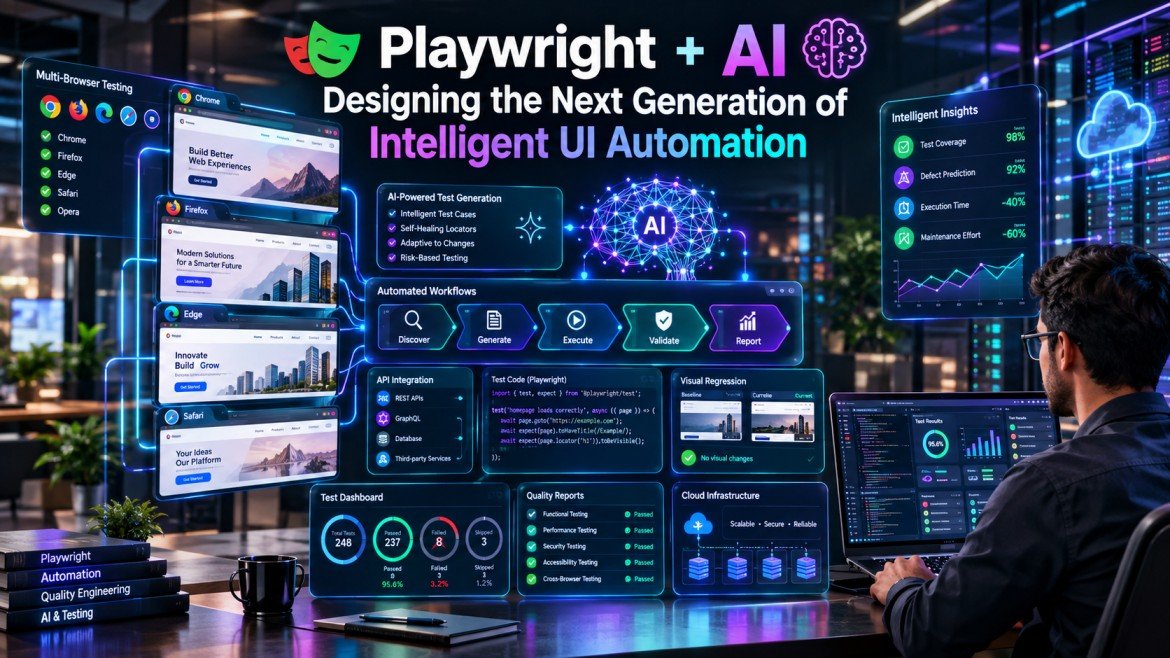
Introduction
Web applications are becoming more dynamic, personalized, and complex. Modern products rely on JavaScript-heavy interfaces, asynchronous workflows, APIs, microservices, third-party integrations, and continuously changing user experiences. Traditional UI automation can struggle when applications evolve faster than their test suites.
This is where the combination of Playwright and artificial intelligence becomes increasingly interesting.
Playwright already provides a powerful foundation for browser automation across Chromium, Firefox, and WebKit. AI can add another layer of intelligence by helping teams understand application behavior, generate test scenarios, identify patterns, analyze failures, and maintain automation when interfaces change.
The emerging concept of Playwright AI is therefore not simply about asking an AI model to generate Playwright scripts. It represents a broader approach in which AI assists throughout the UI testing lifecycle—from discovering test scenarios to analyzing failures and improving regression coverage.
For Quality Engineers, SDETs, and automation specialists, this shift could transform UI automation from a collection of scripted browser actions into a more adaptive quality engineering system.
Table of Contents
What Is Playwright?
Playwright is an open-source browser automation framework originally developed by Microsoft. It enables developers and testers to automate modern web applications across multiple browser engines.
Its capabilities include:
- Chromium, Firefox, and WebKit automation
- End-to-end testing
- Cross-browser testing
- API testing
- Mobile browser emulation
- Network interception
- Screenshots and video recording
- Parallel test execution
- Trace-based debugging
- Automatic waiting for many browser conditions
A conventional Playwright test might follow a deterministic sequence:
Open application → Login → Navigate → Enter data → Submit → Validate result
This approach is highly effective when the application behavior and expected workflow are known.
However, modern applications introduce another challenge: change.
A button may move, a component may be redesigned, a workflow may gain additional steps, or an AI-powered feature may produce different outputs. Maintaining thousands of deterministic tests can become expensive.
What Is Playwright AI?
Playwright AI can be understood as the integration of AI capabilities with Playwright-based browser automation to make testing more intelligent, adaptive, and productive.
Rather than replacing Playwright, AI can operate as an intelligence layer around the automation framework.
For example, an AI-assisted testing system could help:
- Understand application requirements.
- Identify potential test scenarios.
- Generate Playwright test structures.
- Suggest locators and assertions.
- Execute automated workflows.
- Analyze failed tests.
- Identify whether a failure is caused by the application or the test.
- Detect UI changes.
- Recommend test maintenance.
- Discover additional regression scenarios.
The important distinction is that Playwright remains the automation engine while AI can provide reasoning, generation, analysis, and decision-support capabilities.
Why Combine Playwright With AI?
Traditional automation generally follows predefined instructions.
AI-assisted automation can potentially work with higher-level goals.
Consider a requirement:
“Verify that customers can purchase an insurance policy online using a valid payment method.”
A traditional automation approach requires engineers to manually convert this requirement into:
- Login steps
- Navigation steps
- Form interactions
- Test data
- Assertions
- Error handling
- Cleanup procedures
An AI-assisted approach could analyze the requirement and suggest a broader test model containing:
- Successful purchase
- Invalid customer information
- Missing mandatory fields
- Invalid payment details
- Session timeout
- Duplicate submission
- Network interruption
- Browser compatibility
- Confirmation email validation
The engineer still needs to review and approve these scenarios, but AI can reduce the amount of repetitive analysis required.
How Intelligent UI Automation Could Work
A next-generation automation architecture can be divided into several layers.
1. Requirement Understanding
AI can analyze:
- User stories
- Acceptance criteria
- Product documentation
- API specifications
- Existing test cases
- Defect reports
It can then identify potential functional and negative scenarios.
Example
Requirement:
Users must be able to reset their password using a registered email address.
Potential AI-generated scenarios could include:
- Valid registered email
- Unregistered email
- Empty email field
- Invalid email format
- Expired reset link
- Reused reset link
- Multiple reset requests
- Password policy validation
The output can become an initial test design that a QA engineer reviews.
2. Test Generation
Once scenarios are identified, AI can generate Playwright test structures.
For example, a generated test might contain:
test('successful password reset', async ({ page }) => {
  await page.goto('/forgot-password');

  await page.getByLabel('Email').fill('user@example.com');
  await page.getByRole('button', { name: 'Reset Password' }).click();

  await expect(
    page.getByText('Password reset instructions sent')
  ).toBeVisible();
});
The value of AI is not simply producing code.
The larger opportunity is connecting requirements, test intent, application behavior, and executable automation.
Intelligent Locator Generation
Locators are one of the most important parts of UI automation.
Traditional automation can become fragile when developers modify:
- CSS classes
- DOM structures
- element positions
- HTML attributes
- component implementations
AI-assisted locator strategies could analyze the page structure and identify alternative ways to locate an element.
For example, instead of relying heavily on:
page.locator('.btn-primary-8472')
a system may prioritize more meaningful signals such as:
page.getByRole('button', { name: 'Submit' })
or:
page.getByLabel('Customer Name')
The goal is not to let AI randomly change locators. Instead, AI can identify locator candidates and recommend changes when existing selectors become unreliable.
Self-Healing UI Tests
One of the most discussed possibilities around Playwright AI is self-healing automation.
Imagine that an application’s login button changes from:
Login
to:
Sign In
A conventional test may fail because its expected locator or assertion no longer matches.
An AI-assisted system could analyze:
- DOM structure
- Accessibility attributes
- Nearby text
- Element relationships
- Previous test execution
- Screenshot information
- Application semantics
It could then identify that the new element is probably the intended target.
Instead of immediately modifying the test, a mature implementation should ideally:
- Detect the mismatch.
- Identify a possible replacement.
- Validate the replacement.
- Report the proposed change.
- Allow controlled approval.
- Record the change for auditability.
This distinction is important because automatic self-healing without validation can hide real application defects.
AI-Powered Failure Analysis
A failed UI test does not necessarily mean that the application is broken.
The failure may originate from:
- Application defects
- Locator changes
- Timing issues
- Environment instability
- Network problems
- Test-data problems
- Authentication failures
- Third-party services
- Browser differences
AI can analyze Playwright artifacts such as:
- Trace files
- Screenshots
- Videos
- Console logs
- Network activity
- Error messages
- Test execution history
It can then classify the failure and provide a probable explanation.
Example
A test fails because an element is not found.
AI might correlate the failure with a recent UI deployment and identify that the button’s accessible name changed.
Another failure may occur because an API request returned HTTP 503.
In that case, the likely problem is environmental or service-related rather than a UI defect.
This type of intelligent triage can significantly reduce the time engineers spend manually investigating repetitive failures.
Visual Intelligence in Playwright Testing
DOM-based testing is powerful, but visual information provides another dimension.
AI-powered visual analysis can potentially identify:
- Unexpected layout changes
- Missing components
- Overlapping elements
- Incorrect labels
- Broken responsive layouts
- Visual regressions
- Unexpected popups
- Misaligned controls
For example, a test may technically pass because an element exists in the DOM, while the element is actually hidden behind another component.
Visual analysis can provide an additional validation layer.
This creates a broader testing model:
DOM validation + functional validation + API validation + visual validation + AI-assisted analysis
Natural Language to Playwright Automation
Another major opportunity is natural-language-driven test creation.
A tester could describe:
“Open the customer portal, log in with a valid account, navigate to policies, search for an active policy, open it, and verify that the policy status is Active.”
An AI system could convert that intent into a Playwright test workflow.
The workflow could include:
- Page navigation
- Authentication
- Element discovery
- Data entry
- Assertions
- Error handling
- Reporting
This does not eliminate the need for engineering knowledge.
Instead, it can reduce the distance between test intent and executable automation.
AI and Test Data Generation
Good UI automation requires realistic test data.
AI can assist with generating structured datasets for scenarios such as:
- Customer registration
- Insurance policies
- Claims
- Orders
- Payments
- User profiles
- Addresses
- Product catalogs
For example, a testing system could generate combinations of:
- Valid data
- Boundary values
- Missing values
- Invalid formats
- Duplicate values
- Special characters
- Large input values
However, sensitive production data should not simply be sent to an AI system. Organizations need appropriate data-masking, privacy, access-control, and governance mechanisms.
AI-Driven Regression Testing
Large applications may contain thousands of automated tests.
Running every test after every small change can be expensive.
AI could help prioritize regression tests based on:
- Changed application components
- Historical failures
- Code dependencies
- Defect history
- Business criticality
- User journeys
- Recent production incidents
For example, if a payment component changes, an intelligent system could prioritize tests covering:
- Payment processing
- Checkout
- Order confirmation
- Refunds
- Payment failures
- Transaction history
This creates the possibility of risk-based intelligent regression testing.
Playwright AI in CI/CD Pipelines
The combination can become especially valuable when integrated into CI/CD.
A modern pipeline could look like:
Code Commit → Build → AI Test Selection → Playwright Execution → Failure Analysis → Risk Assessment → Report
For example:
Stage 1: Code Change
A developer commits a change affecting the checkout module.
Stage 2: Change Analysis
AI identifies potentially impacted workflows.
Stage 3: Test Selection
Relevant Playwright tests are prioritized.
Stage 4: Execution
Tests execute in parallel across supported browser engines.
Stage 5: Failure Analysis
AI examines traces, logs, screenshots, and network failures.
Stage 6: Reporting
The system produces an explanation and identifies tests that may require maintenance.
This can make CI/CD feedback more actionable for developers and QA engineers.
Example: AI-Assisted E-Commerce Testing
Consider an e-commerce application.
A traditional regression suite may contain tests for:
- Login
- Product search
- Product details
- Cart
- Checkout
- Payment
- Order history
An intelligent automation system could additionally analyze recent changes and determine that a modification to product pricing potentially affects:
- Search results
- Product pages
- Cart totals
- Discount calculations
- Checkout
- Order confirmation
- Invoices
The system could recommend additional scenarios before the regression run.
This demonstrates the larger role of Playwright AI: not merely generating browser scripts, but connecting application change with testing decisions.
Challenges of Playwright + AI
The combination is promising, but it introduces significant challenges.
1. AI Hallucinations
AI-generated tests can contain incorrect assumptions.
A generated locator may not exist. An assertion may misunderstand the requirement. A generated workflow may skip an important business rule.
Human validation therefore remains essential.
2. False Self-Healing
A self-healing mechanism can become dangerous if it automatically modifies tests whenever something changes.
A genuine application defect could accidentally be interpreted as a locator problem.
The system must distinguish between:
Test maintenance problem
and
Product defect
before making changes.
3. Security and Privacy
Enterprise testing frequently involves sensitive information.
Potentially sensitive data includes:
- Customer information
- Financial information
- Authentication tokens
- Insurance records
- Healthcare information
- Production logs
AI systems must be integrated with appropriate security controls, data masking, retention policies, and access management.
4. Cost and Infrastructure
AI-powered testing can require additional:
- Model usage
- Compute resources
- Storage
- Observability infrastructure
- Engineering effort
- Governance
Organizations need to measure whether the productivity gains justify these costs.
5. Explainability
QA teams need to understand why an AI system generated a test or changed a locator.
An enterprise-ready solution should provide traceability such as:
Requirement → Generated Scenario → Test → Execution → Failure → AI Analysis → Recommended Action
Without traceability, debugging AI-generated decisions becomes difficult.
Human QA Engineers Still Matter
AI does not remove the need for experienced testers.
In fact, intelligent automation can make human expertise more important.
AI can assist with:
- Test generation
- Data generation
- Failure analysis
- Pattern detection
- Regression prioritization
- Documentation
Human engineers remain responsible for:
- Business-risk analysis
- Test strategy
- Exploratory testing
- Requirement interpretation
- Security considerations
- Accessibility validation
- Quality decisions
- Governance
The future is therefore more likely to involve AI-augmented Quality Engineering rather than completely autonomous testing.
Future Trends in Intelligent UI Automation
1. Autonomous Test Agents
Future systems may use specialized agents capable of:
- Exploring applications
- Discovering workflows
- Creating tests
- Executing tests
- Investigating failures
- Updating test documentation
These agents could operate within controlled environments with human approval.
2. Requirement-to-Test Automation
The testing lifecycle could increasingly move toward:
Requirement → Test Scenario → Playwright Test → Execution → Analysis → Report
This could reduce repetitive translation between business requirements and technical automation.
3. Intelligent Test Maintenance
AI may continuously monitor test failures and application changes to identify automation that needs maintenance.
Instead of discovering broken tests during a release, teams could receive maintenance recommendations earlier.
4. Predictive Quality Engineering
Historical data could help identify areas that have higher probabilities of defects or test failures.
Potential inputs include:
- Code changes
- Defect history
- Test failures
- Deployment frequency
- Component complexity
- Production incidents
This can support more targeted testing strategies.
5. Multimodal Testing
Future automation systems are likely to combine multiple forms of information:
- DOM
- Screenshots
- Videos
- Logs
- APIs
- Documentation
- Code
- User stories
This multimodal context can provide a more complete understanding of application behavior.
Opportunities for QA Engineers
The emergence of intelligent automation creates new opportunities for testers who combine traditional QA skills with AI knowledge.
Important skills include:
Technical Skills
- Playwright
- JavaScript or TypeScript
- API testing
- SQL
- Git
- CI/CD
- Cloud testing
- Test architecture
AI Skills
- Generative AI
- Prompt engineering
- AI-assisted coding
- LLM fundamentals
- AI evaluation
- Agentic workflows
- AI testing concepts
Quality Engineering Skills
- Risk-based testing
- Exploratory testing
- Test strategy
- Quality metrics
- Observability
- Root-cause analysis
The strongest professionals will understand both the automation framework and the quality risks behind the application.
Best Practices for Implementing Playwright AI
Playwright AI is Organizations considering AI-assisted Playwright automation should start with controlled use cases.
Recommended approach
- Begin with test-case generation.
- Keep human review in the workflow.
- Use AI for failure summarization.
- Experiment with locator recommendations.
- Introduce risk-based test selection.
- Establish security and privacy controls.
- Track AI-generated changes.
- Measure false positives and false negatives.
- Avoid uncontrolled self-healing.
- Gradually expand automation autonomy.
The goal should not be “maximum AI.”
The goal should be better quality with measurable engineering value.
Playwright + AI: A New Quality Engineering Model
The traditional automation model is:
Tester → Script → Browser → Result
The emerging intelligent model is closer to:
Requirement → AI Analysis → Test Design → Playwright Automation → Execution → Evidence → AI Analysis → Human Decision
This represents a fundamental shift.
Automation becomes more than a mechanism for replaying predefined actions. It becomes part of an intelligent quality engineering ecosystem.
Conclusion
The combination of Playwright and AI has the potential to reshape how modern teams approach UI automation.
Playwright provides the reliable browser automation foundation, while AI can add capabilities around test generation, application understanding, failure analysis, locator recommendations, regression prioritization, visual analysis, and intelligent test maintenance.
However, successful implementation requires more than connecting an AI model to a browser automation framework.
Teams need strong test architecture, quality engineering practices, security controls, human oversight, measurable outcomes, and clear governance.
The most valuable future may not be completely autonomous testing. Instead, it may be a collaborative model where AI handles repetitive analysis and automation work while experienced Quality Engineers focus on risk, strategy, and product quality.
As web applications become increasingly intelligent, UI automation will need to become intelligent as well. Playwright AI represents one possible path toward that next generation of adaptive, scalable, and context-aware software testing.