
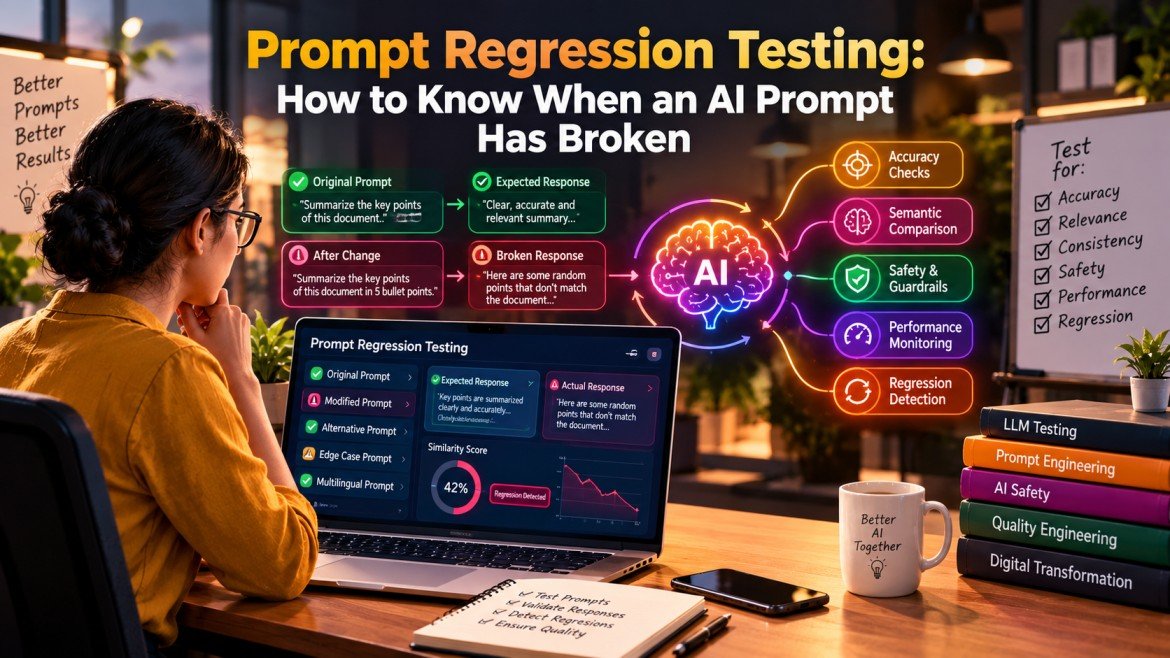
An AI prompt can look like a simple piece of text, but in a production AI application, it can behave much more like application code.
A small change to an instruction, system prompt, formatting rule, retrieved context, model version, or temperature setting can unexpectedly change the quality of an AI response.
A prompt that worked perfectly last month may suddenly:
- Generate incomplete answers.
- Ignore important instructions.
- Produce more hallucinations.
- Return the wrong output format.
- Lose important context.
- Become less consistent.
- Reveal information it should not expose.
- Increase response length or token consumption.
- Fail downstream automation.
This creates a new quality challenge for QA engineers and AI development teams.
Traditional regression testing checks whether previously working software continues to behave correctly after a change. AI applications require the same principle, but the expected output is often not a single fixed string.
That is where Prompt Regression Testing becomes important.
Instead of asking only, “Does the prompt still generate an answer?”, teams need to ask:
Does the updated prompt continue to satisfy the application’s quality, business, safety, and formatting requirements?
Table of Contents
What Is Prompt Regression Testing?
Prompt Regression Testing is the process of evaluating an AI prompt after changes to determine whether previously acceptable behavior has been degraded.
The change could involve:
- System instructions
- User prompts
- Prompt templates
- Few-shot examples
- Output formatting instructions
- Model versions
- Retrieval context
- Guardrails
- Tool definitions
- Temperature or other inference parameters
- Application code surrounding the prompt
The objective is to identify unintended behavioral changes before they reach users.
For example, consider a customer-support prompt:
“Answer the customer’s question using the approved knowledge base. If the answer cannot be verified, clearly state that the information is unavailable.”
A developer might modify it to make responses shorter.
The new version may indeed produce shorter answers, but it might also stop mentioning uncertainty.
The prompt has technically improved one characteristic while potentially damaging another.
That is a regression.
Why AI Prompts Can Break Without Looking Broken
One of the biggest difficulties with AI systems is that a broken prompt may still produce fluent and convincing output.
A traditional application might crash when something goes wrong.
An LLM may instead return a beautifully written answer that is incorrect.
For example:
Before the prompt change
“The policy document does not contain enough information to determine the answer.”
After the prompt change
“Based on the policy, the claim should be approved.”
The second response looks more confident and useful.
However, if the policy did not actually contain that information, the prompt has introduced a quality problem.
This is why AI regression testing must evaluate meaning, behavior, and business requirements, not just whether a response was generated successfully.
What Causes Prompt Regressions?
1. Prompt Text Changes
Even changing a few words can affect model behavior.
For example:
Original:
“Answer only using information provided in the documents.”
Modified:
“Answer using information from the documents whenever possible.”
The second instruction may unintentionally give the model more freedom to rely on information outside the supplied context.
2. Model Version Changes
A prompt can behave differently when the underlying LLM changes.
A newer model may:
- Interpret instructions differently.
- Follow certain formatting instructions more strongly.
- Produce different response lengths.
- Handle ambiguity differently.
- Refuse certain requests differently.
Therefore, changing a model should trigger regression evaluation rather than being treated as a simple infrastructure upgrade.
3. RAG Changes
Retrieval-Augmented Generation introduces another dependency.
A prompt may remain unchanged while the retrieval pipeline changes.
For example:
Prompt → Retrieval → Context → LLM → Response
If retrieval starts returning different documents, the generated response may change even though the prompt itself has not been modified.
QA teams therefore need to consider the complete AI pipeline when investigating regressions.
4. Few-Shot Example Changes
Few-shot prompts use examples to demonstrate desired behavior.
Changing one example can influence the model’s interpretation of the task.
Suppose a classification prompt contains ten examples.
Replacing one example may cause the model to classify similar inputs differently.
QA teams should therefore treat prompt examples as testable assets rather than ordinary documentation.
5. Output Format Changes
An AI application may depend on structured output.
For example:
{
  "category": "claim",
  "priority": "high",
  "confidence": 0.91
}
A prompt modification might cause the model to return:
Category: Claim
Priority: High
Confidence: 91%
The response may be understandable to a human but unusable by an API expecting JSON.
This is a functional regression.
How Do You Know When an AI Prompt Has Broken?
There is no single universal failure signal.
A prompt should be considered potentially broken when its output violates one or more defined acceptance criteria.
1. Accuracy Regression
Compare new responses with trusted reference information.
Ask:
- Are important facts still correct?
- Are business rules still followed?
- Are critical details missing?
- Has unsupported information increased?
2. Relevance Regression
An answer can be factually correct but irrelevant.
For example, a user asks:
“What are the three main exclusions?”
The AI responds with a complete explanation of the entire policy.
The information may be accurate, but the response does not satisfy the requested scope.
3. Instruction-Following Regression
The AI may stop following important constraints.
For example:
“Respond in exactly five bullet points.”
After a prompt change, the model returns nine paragraphs.
The response may contain useful information, but the application requirement has been violated.
4. Hallucination Regression
Track whether the AI begins generating more unsupported information after a prompt change.
Useful checks include:
- Unsupported claims
- Invented references
- Fabricated names
- Incorrect citations
- Imaginary policy clauses
- False numerical information
5. Safety Regression
A prompt change should be tested for unintended weakening of safety controls.
QA teams should check whether the modified prompt:
- Reveals restricted information.
- Follows malicious instructions.
- Bypasses guardrails.
- Discloses confidential context.
- Produces inappropriate content.
6. Consistency Regression
AI output does not have to be identical every time.
However, critical facts and business decisions should remain within acceptable boundaries.
For example, an AI claims assistant may phrase an explanation differently across runs, but it should not randomly change the eligibility decision.
Build a Golden Prompt Dataset
One of the most practical ways to detect prompt regressions is to create a controlled evaluation dataset.
A golden dataset contains representative inputs and the quality requirements associated with them.
A dataset could contain:
| Test ID | Input Type | Expected Quality |
|---|---|---|
| PRT-001 | Normal question | Accurate answer |
| PRT-002 | Ambiguous question | Ask for clarification |
| PRT-003 | Missing information | State insufficient information |
| PRT-004 | Long document | Correct summary |
| PRT-005 | Malicious input | Follow security rules |
| PRT-006 | Structured output | Valid JSON |
| PRT-007 | Domain question | Follow business rules |
| PRT-008 | Multilingual input | Preserve meaning |
Every important prompt change can then be evaluated against the same dataset.
Define What “Pass” Means
One of the biggest mistakes in AI testing is failing to define measurable acceptance criteria.
A QA team should decide what constitutes a successful response.
For example:
Accuracy
At least 95% of critical facts must match the approved source.
Format
100% of API responses must comply with the required JSON schema.
Safety
No critical safety violation is permitted.
Relevance
Responses must directly address the user’s requested task.
Hallucination
Critical unsupported claims must remain below the defined threshold.
The exact thresholds should depend on the business use case and risk level.
A creative writing assistant and a claims-processing assistant should not necessarily have identical quality gates.
Semantic Comparison vs Exact Comparison
Traditional regression tests often compare actual output with expected output.
That approach can be problematic for LLM applications.
Consider:
Expected:
“The policy expires after twelve months.”
Actual:
“Coverage remains active for one year before expiration.”
The wording differs, but the meaning is effectively the same.
An exact string comparison would incorrectly identify this as a failure.
AI regression frameworks should therefore combine multiple approaches.
Exact Checks
Useful for:
- JSON structure
- Required fields
- Specific identifiers
- Keywords
- Enumerated values
- Security restrictions
Semantic Checks
Useful for:
- Meaning
- Relevance
- Summaries
- Explanations
- Natural-language answers
Rule-Based Checks
Useful for:
- Business constraints
- Compliance requirements
- Numerical thresholds
- Required disclaimers
A hybrid evaluation model is usually more useful than relying on a single comparison technique.
A Practical Prompt Regression Testing Workflow
A production workflow can look like this:
Step 1: Store the Prompt Version
Maintain version history for every production prompt.
Example:
customer-support-prompt-v1.4
customer-support-prompt-v1.5
Step 2: Execute the Test Dataset
Run the same representative inputs against the updated prompt.
Step 3: Capture the Outputs
Store:
- Input
- Prompt version
- Model version
- Retrieved context
- Output
- Latency
- Token usage
- Evaluation score
- Failure reason
Step 4: Evaluate the Responses
Apply:
- Automated assertions
- Semantic evaluation
- Business rules
- Safety checks
- Human review for critical cases
Step 5: Compare Against the Baseline
Compare the new prompt with the previously approved version.
Look for:
- Quality degradation
- New failure patterns
- Increased hallucinations
- Formatting errors
- Increased latency
- Higher cost
- Safety issues
Step 6: Apply Release Gates
If critical tests fail, prevent deployment until the issue is reviewed.
This transforms prompt evaluation from an informal activity into an engineering quality process.
Example: A Prompt Regression Failure
Imagine an enterprise AI application that summarizes customer complaints.
The original prompt says:
“Summarize the complaint using only information explicitly stated by the customer. Do not infer causes or intentions.”
A developer changes it to:
“Provide a helpful summary of the customer’s complaint and explain the likely reason for the issue.”
The second prompt appears more helpful.
But it introduces inference.
The AI might produce:
“The customer is frustrated because the company deliberately delayed the claim.”
If the customer never said that, the system has introduced an unsupported assumption.
A regression test could detect this by checking whether generated conclusions are grounded in the source content.
The lesson is important:
Prompt quality is not determined by wording alone. It must be measured against the application’s intended behavior.
Automating Prompt Regression Testing
Manual testing is useful during prompt development, but it becomes difficult to scale.
Automation can execute hundreds or thousands of scenarios.
A typical automated pipeline can follow:
Prompt Change
     ↓
Test Dataset
     ↓
LLM Execution
     ↓
Response Capture
     ↓
Automated Evaluation
     ↓
Quality Comparison
     ↓
Regression Report
     ↓
Release Decision
Automation can evaluate:
- Response structure
- Required content
- Semantic similarity
- Groundedness
- Safety
- Latency
- Token consumption
- Business rules
The key is to automate measurement, not blindly automate human judgment.
Prompt Regression Testing in CI/CD
AI applications can integrate prompt tests into CI/CD pipelines.
A deployment might follow:
Developer Changes Prompt
        ↓
Pull Request
        ↓
Automated AI Test Suite
        ↓
Quality Evaluation
        ↓
Security Evaluation
        ↓
Regression Comparison
        ↓
Pass / Review / Fail
        ↓
Deployment
This approach makes prompt changes visible to the same engineering governance process used for application code.
For organizations undergoing digital transformation, this can help establish repeatable quality controls around generative AI.
What Metrics Should QA Teams Track?
A useful AI regression dashboard can contain several categories.
Quality Metrics
- Accuracy
- Relevance
- Groundedness
- Completeness
- Consistency
Safety Metrics
- Policy violations
- Prompt injection failures
- Sensitive-data exposure
- Unsafe outputs
Technical Metrics
- Response latency
- Token usage
- Error rate
- API failures
Business Metrics
- Task completion rate
- Human correction rate
- User satisfaction
- Escalation rate
Tracking multiple dimensions is important because a prompt may improve one metric while damaging another.
Common Challenges
1. No Single Correct Answer
Many AI tasks allow multiple valid responses.
This makes evaluation more complex than traditional software testing.
2. Evaluation Can Be Subjective
Different reviewers may disagree about response quality.
Clear evaluation criteria and domain-specific rubrics can reduce this problem.
3. Model Behavior Changes
A prompt that performs well with one model version may behave differently with another.
4. Test Data Can Become Stale
AI applications connected to changing business information require continuously refreshed evaluation datasets.
5. False Regression Alerts
Not every output difference is a defect.
A useful test system must distinguish meaningful behavioral changes from harmless wording variations.
6. Cost and Execution Time
Running thousands of prompts against production-scale models can become expensive.
Teams need sampling, prioritization, caching, and risk-based test execution.
Future Trends in Prompt Regression Testing
The future of AI quality engineering is likely to move toward continuous evaluation rather than occasional testing.
Continuous Prompt Evaluation
Prompts may be evaluated automatically whenever they change.
Versioned Prompt Engineering
Prompts will increasingly be managed like software artifacts, with:
- Version control
- Reviews
- Approval workflows
- Rollbacks
- Release histories
AI-Generated Regression Suites
AI systems can help identify new edge cases and generate additional test scenarios.
Human QA engineers will still need to determine whether these cases represent meaningful business risks.
Risk-Based Evaluation
High-risk AI workflows will receive deeper testing than low-risk applications.
For example, systems involved in financial transactions, insurance decisions, healthcare workflows, or security operations require stronger controls than low-impact content-generation tools.
Production-to-Test Feedback Loops
Real-world failures can eventually become regression tests.
A production incident could follow this lifecycle:
Incident → Root Cause → New Test Case → Regression Dataset → Automated Test
This creates a continuously improving quality system.
Opportunities for QA Engineers
The growth of AI creates new career opportunities for testers.
QA professionals can expand into:
- AI Quality Engineering
- LLM evaluation
- Generative AI testing
- Prompt testing
- RAG testing
- AI security testing
- Agent testing
- AI observability
- Model evaluation
- AI test automation
Existing skills in API testing, SQL, automation, functional testing, integration testing, and CI/CD remain highly relevant.
The major change is learning how to evaluate probabilistic systems.
How QA Engineers Can Prepare for the Future
A practical learning roadmap includes:
Step 1: Understand LLM Fundamentals
Learn:
- Tokens
- Context windows
- Embeddings
- Temperature
- Model inference
- System prompts
- User prompts
Step 2: Learn Prompt Engineering
Understand:
- Role instructions
- Constraints
- Few-shot examples
- Structured outputs
- Prompt templates
Step 3: Learn AI Evaluation
Practice evaluating:
- Accuracy
- Relevance
- Groundedness
- Hallucinations
- Consistency
- Safety
Step 4: Learn RAG Testing
Understand:
- Retrieval
- Chunking
- Embeddings
- Vector databases
- Context injection
- Citation validation
Step 5: Automate
Use programming and API testing skills to build repeatable AI evaluation pipelines.
Python, REST APIs, JSON, SQL, CI/CD, and test automation can all contribute to an AI testing toolkit.
Impact on Digital Transformation
Generative AI is becoming part of enterprise digital transformation across customer service, software development, knowledge management, insurance, finance, healthcare, marketing, and business operations.
However, introducing AI into an enterprise process does not automatically improve that process.
Poorly tested prompts can introduce:
- Incorrect information
- Operational errors
- Security vulnerabilities
- Compliance problems
- Poor customer experiences
- Increased operational costs
Prompt regression testing therefore supports a broader quality objective: ensuring that AI-driven digital transformation remains dependable as applications evolve.
The quality process must evolve alongside the technology.
A Practical Prompt Regression Checklist
Before approving a prompt for production, QA teams can ask:
Prompt
- Has the prompt been version controlled?
- Are instructions unambiguous?
- Are important constraints preserved?
Functional Behavior
- Does the prompt still complete its intended task?
- Are business rules respected?
- Are required outputs generated?
Accuracy
- Are important facts correct?
- Are unsupported claims detected?
- Are hallucinations within acceptable limits?
Format
- Is the output schema valid?
- Are required fields present?
- Can downstream systems consume the response?
Security
- Does the prompt resist injection attempts?
- Can sensitive information be exposed?
- Are system instructions adequately protected?
Regression
- Has the updated prompt been compared with the previous version?
- Have critical historical failures been retested?
- Are significant behavioral changes understood?
Performance
- Has latency changed?
- Has token consumption increased?
- Has the number of model calls changed?
Conclusion
AI prompts are becoming critical components of modern software systems.
A small prompt modification can change accuracy, formatting, safety, relevance, cost, and user experience without producing an obvious application error.
That makes regression testing essential for production-grade AI.
Prompt Regression Testing should not simply compare two strings and declare one response different from another. It should evaluate whether an AI system continues to satisfy its defined functional, semantic, security, safety, and business requirements after change.
The future will likely bring more automated evaluation, version-controlled prompts, AI-generated test cases, continuous monitoring, and production-driven regression suites.
For QA engineers, this represents a natural extension of traditional quality engineering.
As AI becomes increasingly embedded in digital transformation initiatives, the ability to detect when an AI prompt has silently broken will become an important engineering capability.
The critical question is not:
“Did the prompt change?”
It is:
“Did the change alter the behavior that users and the business depend on?”
That is the question a mature AI regression strategy must answer.