
Introduction
The software testing profession is changing faster than ever.
For years, the QA Engineer role was strongly associated with writing test cases, executing functional tests, reporting defects, performing regression testing, and validating whether an application met its documented requirements.
Those activities remain important. However, modern software development is changing the definition of quality.
Cloud-native applications, continuous delivery, APIs, microservices, artificial intelligence, autonomous agents, data-driven applications, and DevOps practices have moved quality activities much closer to development and production.
As a result, many organizations are moving toward a broader Quality Engineering (QE) mindset.
The transition from QA Engineer to Quality Engineer is not simply a change in job title. It represents a shift from primarily detecting defects to helping engineering teams prevent, predict, measure, and continuously improve quality across the entire software lifecycle.
In 2026, this transformation is becoming particularly important as organizations accelerate digital transformation and integrate AI into software development and business processes.
Table of Contents
QA Engineer vs Quality Engineer: What Is the Difference?
The distinction is not absolute. Companies use these titles differently, and many professionals continue to perform overlapping responsibilities.
However, there is a useful difference in mindset.
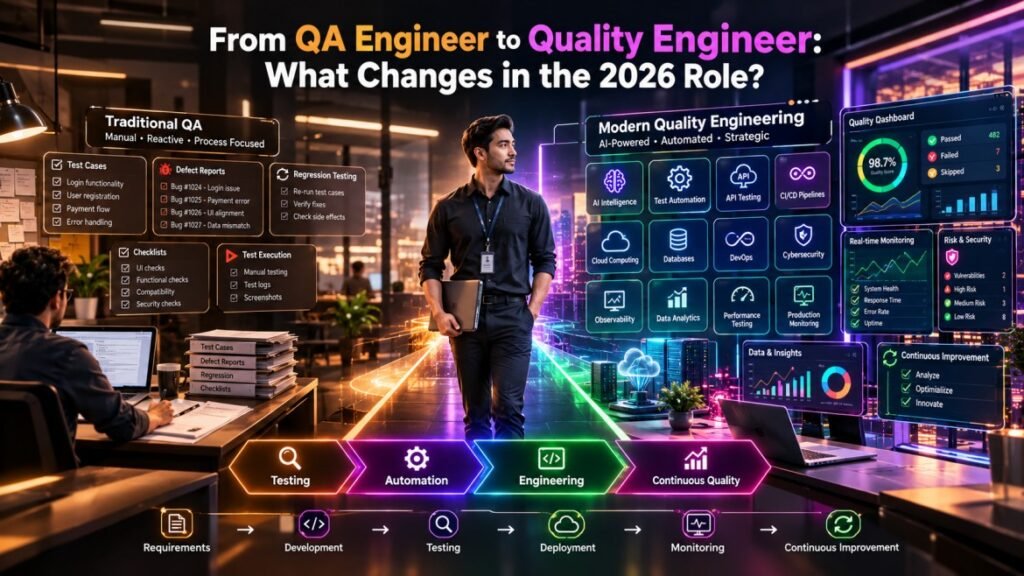
Traditional QA-oriented approach
A conventional QA Engineer may focus heavily on:
- Functional testing
- Test-case design
- Regression testing
- Defect reporting
- Requirement validation
- User acceptance testing
- Manual and automated test execution
Quality Engineering approach
A Quality Engineer typically takes broader ownership of:
- Quality throughout the SDLC
- Test automation strategy
- CI/CD quality gates
- API and service-level testing
- Performance and reliability
- Security considerations
- Data quality
- Observability
- Production quality
- Risk-based testing
- AI-assisted testing
- Continuous quality improvement
The fundamental change is from testing software to engineering quality into software delivery.
Why Is the QA Role Changing in 2026?
Several technology and organizational trends are driving this evolution.
1. Faster Software Delivery
Modern organizations increasingly release software continuously rather than through large periodic releases.
Continuous integration and continuous delivery require quality activities to happen continuously as well.
A testing process that begins only after development is complete can become a bottleneck.
Quality Engineering addresses this by integrating quality checks throughout the development pipeline.
2. AI Is Changing Software Development
AI coding assistants and generative AI tools can help developers create code, tests, documentation, queries, and automation scripts much faster.
However, faster code generation can also increase the volume of code that requires validation.
This creates new responsibilities for the QA Engineer, including evaluating:
- AI-generated code
- AI-generated test cases
- AI-generated requirements
- AI-generated documentation
- AI-powered application behavior
- AI model outputs
- AI agent workflows
The tester increasingly becomes a reviewer and quality investigator rather than simply a test executor.
3. Applications Are Becoming More Distributed
Modern systems frequently include:
- Microservices
- REST and GraphQL APIs
- Cloud infrastructure
- Event-driven systems
- Mobile applications
- Third-party services
- Databases
- Message queues
- AI services
A defect may therefore not exist inside a single application component.
It can emerge from an interaction between several services.
Quality Engineering requires broader system-level thinking.
4. Production Is Becoming Part of the Quality Lifecycle
Quality cannot always be fully determined before release.
Real-world usage can expose:
- Unexpected user behavior
- Performance bottlenecks
- Data anomalies
- Integration problems
- AI behavior variations
- Reliability issues
Modern quality practices therefore extend into production through:
- Monitoring
- Logging
- Observability
- Synthetic testing
- Production analytics
- Feature flags
- Controlled releases
- Incident analysis
The definition of testing is expanding beyond the test environment.
How the QA Engineer Role Is Evolving
The transition can be understood across several dimensions.
| Traditional Focus | Quality Engineering Focus |
|---|---|
| Test execution | Quality ownership |
| Defect detection | Defect prevention |
| Test cases | Risk-based scenarios |
| Functional validation | End-to-end quality |
| Regression testing | Continuous testing |
| Manual testing | Intelligent automation |
| Test environment | Entire delivery ecosystem |
| Pre-production | Pre-production + production |
| Requirements | Customer and business outcomes |
| Testing tools | Engineering platforms and pipelines |
This does not mean traditional testing becomes irrelevant.
Instead, it becomes one component of a larger quality strategy.
From Test Execution to Quality Engineering
Traditional Model
A traditional workflow often looks like:
Requirement → Development → Testing → Defects → Retesting → Release
The testing phase can become a separate stage.
Modern Quality Model
A Quality Engineering workflow is closer to:
Requirement → Risk Analysis → Design → Development → Automated Validation → CI/CD → Deployment → Observability → Feedback → Continuous Improvement
Quality becomes a continuous activity.
This is one of the most important changes professionals should understand in 2026.
The New Skill Set for Quality Engineers
The future role requires a broader technical foundation.
1. Strong Testing Fundamentals
Core testing knowledge remains essential.
A Quality Engineer should understand:
- Functional testing
- Integration testing
- System testing
- Regression testing
- Exploratory testing
- Risk-based testing
- Boundary-value analysis
- Negative testing
- Usability testing
Automation cannot replace sound testing fundamentals.
2. Automation Engineering
Automation is increasingly expected rather than considered a specialist add-on.
Useful technologies can include:
- Selenium
- Playwright
- Cypress
- Appium
- REST API automation
- Postman
- Java
- Python
- JavaScript or TypeScript
The specific tools vary by organization.
The important capability is designing maintainable automation that provides meaningful quality feedback.
3. API and Service Testing
Modern applications often depend more heavily on APIs than traditional user interfaces.
A Quality Engineer should understand:
- REST
- GraphQL
- HTTP
- Authentication
- Authorization
- JSON
- API contracts
- Status codes
- Service dependencies
- Mocking
- Contract testing
API-level testing can identify defects earlier and provide faster feedback than relying exclusively on UI testing.
4. Database and Data Validation
Data quality is increasingly important in AI-powered and distributed applications.
Quality Engineers may need to validate:
- SQL queries
- Data transformations
- ETL pipelines
- Data consistency
- Referential integrity
- API-to-database flows
- Data migration
- Analytics outputs
For AI systems, the quality of the underlying data can directly influence application behavior.
5. CI/CD and DevOps
A modern Quality Engineer should understand how testing fits into engineering pipelines.
Important concepts include:
- Git
- CI/CD
- Build pipelines
- Automated test execution
- Quality gates
- Deployment strategies
- Environment management
- Containers
- Cloud platforms
The objective is to make quality feedback available as early and as frequently as possible.
6. AI Testing Skills
AI is creating an entirely new testing layer.
Quality Engineers may increasingly test:
- LLM applications
- RAG systems
- AI agents
- Prompt behavior
- Hallucinations
- Retrieval accuracy
- AI safety
- Model responses
- Context handling
- Prompt injection
- AI-generated content
Unlike traditional applications, AI systems may not always have a single deterministic expected output.
Therefore, evaluation techniques become essential.
The Role of AI in the Future of QA
AI is not simply another automation tool.
It can change how quality teams work.
AI can assist with:
- Test-case generation
- Requirement analysis
- Test-data generation
- Code analysis
- Test maintenance
- Defect clustering
- Log analysis
- API test generation
- Exploratory test suggestions
- Regression prioritization
However, human validation remains critical.
AI-generated tests can contain:
- Incorrect assumptions
- Missing edge cases
- Redundant scenarios
- Invalid assertions
- Poor business logic
The future professional therefore needs the ability to evaluate AI-generated testing artifacts, not blindly accept them.
Shift From Test Cases to Quality Risks
One major mindset change is moving beyond test-case counts.
Consider two teams.
Team A
- 5,000 test cases
- 95% execution rate
- Large regression suite
Team B
- Smaller targeted test suite
- Strong risk analysis
- Extensive API coverage
- Critical-path automation
- Production observability
The number of test cases alone does not prove software quality.
Quality Engineering focuses more strongly on:
- Business risk
- Customer impact
- Failure probability
- Critical workflows
- System reliability
- Security
- Performance
- Data integrity
The question becomes:
“What could fail, how serious would the impact be, and how quickly can we detect it?”
Quality Engineering Across the SDLC
Requirements Stage
Quality starts before coding.
Quality Engineers can review requirements for:
- Ambiguity
- Missing acceptance criteria
- Contradictory rules
- Unclear business logic
- Edge cases
- Security considerations
- Data dependencies
This prevents defects from entering the implementation phase.
Development Stage
Quality activities can include:
- Code-level validation
- Unit test review
- API testing
- Static analysis
- Test automation
- Pairing with developers
- AI-generated code review
The objective is earlier defect detection.
Integration Stage
Quality Engineers validate:
- Service interactions
- APIs
- Databases
- External systems
- Message queues
- Authentication
- Data flows
This is particularly important for distributed applications.
Deployment Stage
Quality checks can become integrated into CI/CD.
For example:
Code Commit → Build → Unit Tests → API Tests → Security Checks → UI Tests → Quality Gate → Deployment
A failed quality gate can prevent an unsafe build from progressing.
Production Stage
Quality continues after deployment.
Teams can monitor:
- Error rates
- Response times
- Failed transactions
- User behavior
- Service availability
- Application logs
- AI response quality
Production data becomes an additional source of quality intelligence.
What Happens to Manual Testing?
Manual testing is not disappearing.
Instead, its purpose is changing.
Manual testing remains valuable for:
- Exploratory testing
- Usability testing
- Complex workflows
- New features
- Unexpected behavior
- User experience evaluation
- Risk investigation
- AI response assessment
The difference is that Quality Engineers increasingly automate repetitive, deterministic checks while using human judgment where it adds greater value.
Quality Engineering and Digital Transformation
The impact of digital transformation on testing is significant.
Organizations modernizing their technology ecosystems often adopt:
- Cloud platforms
- Mobile applications
- APIs
- Microservices
- AI
- Automation
- Data platforms
- DevOps
Each transformation introduces new quality risks.
For example, moving from a monolithic application to microservices can improve scalability but also introduce:
- Network failures
- Service dependencies
- Distributed transactions
- Version compatibility problems
- Increased observability requirements
Quality Engineering helps organizations manage these risks systematically.
Challenges in the 2026 Quality Engineering Role
1. Skill Expansion
Professionals may need knowledge across testing, automation, cloud, APIs, data, DevOps, security, and AI.
This can make the role technically demanding.
2. Tool Overload
The modern engineering ecosystem contains thousands of tools.
Knowing every tool is impossible.
The focus should be on understanding principles and selecting appropriate technologies.
3. Maintaining Automation
Poorly designed automation can create more maintenance work than value.
Automation should therefore be:
- Reliable
- Maintainable
- Fast
- Relevant
- Observable
4. AI Reliability
AI systems introduce probabilistic behavior, making conventional pass/fail testing insufficient for some scenarios.
5. Production Complexity
Distributed systems can make failures difficult to reproduce.
Strong observability becomes essential.
Opportunities for Quality Engineers in 2026
The role expansion creates significant career opportunities.
Professionals can specialize in areas such as:
AI Quality Engineer
Focuses on:
- LLM testing
- RAG testing
- AI evaluation
- AI safety
- Agent testing
SDET / Automation Engineer
Focuses on:
- Test architecture
- Automation frameworks
- CI/CD
- Programming
- API and UI automation
Quality Engineering Lead
Focuses on:
- Quality strategy
- Engineering practices
- Automation architecture
- Team enablement
- Quality metrics
Performance Quality Engineer
Focuses on:
- Load testing
- Stress testing
- Scalability
- Reliability
- Performance engineering
AI Test Engineer
Focuses specifically on validating AI-enabled applications and intelligent workflows.
Future Trends in Quality Engineering
1. AI-Assisted Testing
AI will increasingly support test design, automation development, defect analysis, and regression optimization.
2. Autonomous Test Agents
AI agents may execute exploratory workflows, analyze failures, create follow-up scenarios, and propose regression coverage.
Human oversight will remain important for high-risk systems.
3. Self-Healing Automation
Automation frameworks may automatically adapt to certain UI or application changes.
However, self-healing mechanisms will require monitoring because automatic adaptation can sometimes hide genuine defects.
4. Continuous Quality Intelligence
Future platforms will increasingly combine:
- Test results
- Production telemetry
- Defect history
- Code changes
- Customer feedback
- Incident data
This can help teams make more informed quality decisions.
5. Quality as an Engineering Metric
Organizations may increasingly connect technical quality metrics with business outcomes such as:
- Customer experience
- Reliability
- Revenue impact
- Operational cost
- Incident frequency
A Practical Roadmap From QA Engineer to Quality Engineer
Professionals do not need to learn everything simultaneously.
A practical roadmap can be:
Phase 1: Strengthen Testing Fundamentals
Master:
- Test design
- Risk-based testing
- Exploratory testing
- Defect analysis
Phase 2: Learn Programming and Automation
Develop practical skills in one programming language and one modern automation ecosystem.
Phase 3: Master API Testing
Learn API architecture, authentication, contracts, automation, and service-level validation.
Phase 4: Learn CI/CD
Understand how automated quality checks integrate with engineering pipelines.
Phase 5: Build Cloud and DevOps Knowledge
Learn fundamental concepts around containers, cloud infrastructure, environments, and observability.
Phase 6: Learn AI Quality Engineering
Explore:
- LLM testing
- Prompt testing
- RAG evaluation
- AI agents
- Hallucination testing
- AI security
Phase 7: Develop Quality Strategy Skills
Move beyond executing tests toward:
- Risk management
- Quality metrics
- Test architecture
- Engineering collaboration
- Continuous improvement
Example: Traditional QA vs Quality Engineering
Imagine an online insurance application.
A traditional testing approach might verify:
User enters policy details → Clicks Submit → Policy is created.
A Quality Engineering approach goes further.
It asks:
- What happens if the customer enters invalid data?
- What happens when an external service is unavailable?
- Is the API returning the correct response?
- Is the database transaction consistent?
- Can the system handle peak traffic?
- Are sensitive fields protected?
- Is the mobile workflow consistent?
- Can the transaction be traced in production?
- Does the AI recommendation follow business rules?
- What happens when AI receives incomplete information?
This broader perspective is the essence of the role transition.
Key Metrics for Modern Quality Engineering
Traditional metrics such as test execution percentage can still be useful, but modern teams should consider a broader set.
Quality metrics may include:
- Defect escape rate
- Automated regression coverage
- API coverage
- Critical-path coverage
- Mean time to detect
- Mean time to resolve
- Production incident rate
- Change failure rate
- Test reliability
- Pipeline feedback time
- Performance thresholds
- AI evaluation scores
Metrics should support engineering decisions rather than becoming targets that teams optimize artificially.
The Future Career Profile
The future Quality Engineer will increasingly combine three dimensions:
Testing Expertise
Understanding how software fails.
Engineering Expertise
Understanding how software is built, deployed, monitored, and maintained.
Business Expertise
Understanding what failures mean for customers and organizations.
This combination makes the role strategically important.
The professional is no longer simply asking:
“Did we test it?”
The more useful question is:
“Do we have sufficient evidence that this system is ready for its intended users and risks?”
Conclusion
The transition from QA Engineer to Quality Engineer is one of the most important changes happening in software quality in 2026.
The fundamental principles of testing remain valuable, but the scope of quality is expanding.
Modern Quality Engineering connects:
Requirements + Development + Automation + APIs + Data + CI/CD + Cloud + AI + Security + Observability + Production
The impact of digital transformation is making software ecosystems more interconnected and increasingly intelligent. That creates new risks, but it also creates new opportunities for professionals who are willing to expand their engineering capabilities.
The future belongs to quality professionals who can combine strong testing fundamentals with automation, programming, data, DevOps, cloud, AI evaluation, and business-risk analysis.
The title may change from QA Engineer to Quality Engineer, but the most important change is not the job title.
It is the mindset:
Quality is no longer a phase at the end of development. Quality is an engineering responsibility throughout the software lifecycle.
Key Takeaways
- The Quality Engineer role extends beyond traditional software testing.
- QA remains an important foundation for modern Quality Engineering.
- Automation, APIs, CI/CD, cloud, data, and AI are increasingly important skills.
- Quality activities are moving earlier into requirements and development.
- Production monitoring and observability are becoming part of quality practices.
- AI is creating new testing areas such as LLM, RAG, agent, and hallucination testing.
- Manual testing remains valuable for exploratory and complex scenarios.
- Risk-based thinking is becoming more important than simply counting test cases.
- Digital transformation is expanding both the complexity and strategic importance of quality.
- The future Quality Engineer combines testing, engineering, technology, and business knowledge.