
Introduction: When Test Automation Starts Fixing Itself
Test automation has always promised faster releases, broader regression coverage, and more consistent validation. But automation has one persistent weakness: maintenance.
A small application change can break dozens of automated tests.
A renamed button, modified CSS selector, changed API response, updated page structure, or altered authentication flow can cause an automation suite to fail even when the application itself is working correctly.
This is where Self-Healing Test Automation enters the picture.
Self-healing automation uses intelligent mechanisms to identify certain test failures caused by application changes and attempt to adapt the automation automatically. Instead of simply reporting that a locator has changed, an intelligent automation system may search for an alternative locator or identify another element that appears to represent the same functionality.
The idea sounds simple:
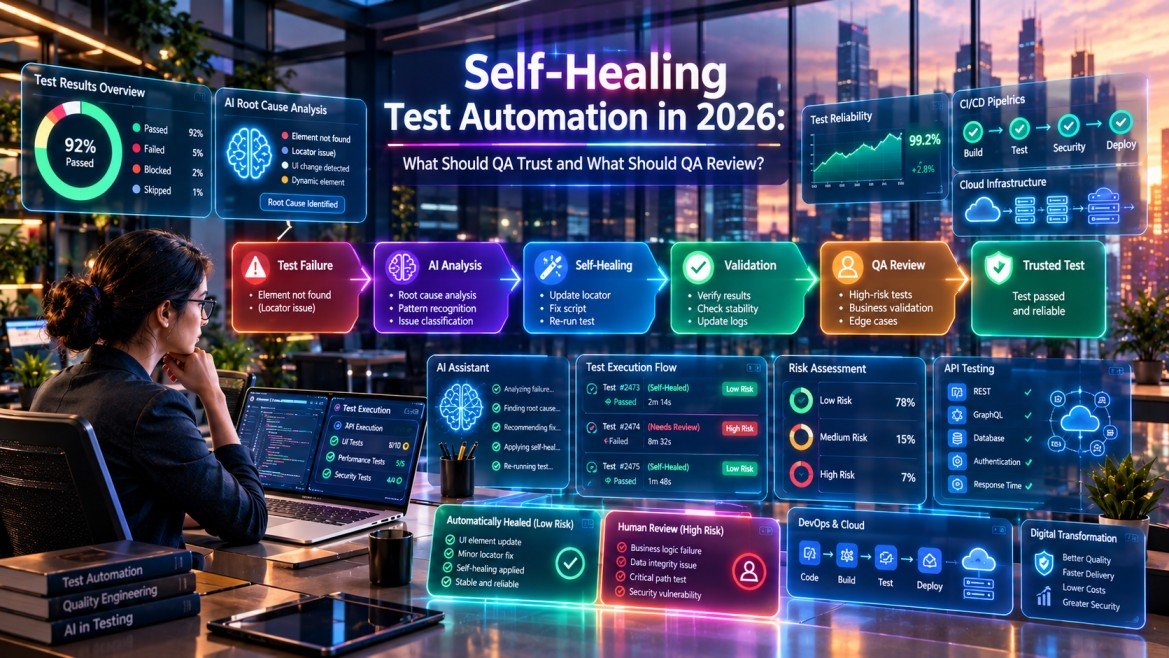
Test fails → System analyzes failure → Automation adapts → Test continues
But there is an important question for QA teams in 2026:
Should QA trust an automation framework simply because it can repair itself?
The answer requires a more careful approach.
Self-healing can reduce maintenance effort, but an automatically repaired test is not automatically a correct test. QA still needs to determine whether the repair preserves the original testing intent.
This distinction is becoming increasingly important as organizations accelerate digital transformation, AI adoption, cloud modernization, and continuous delivery.
Table of Contents
What Is Self-Healing Test Automation?
Self-healing test automation refers to automation systems that can detect certain changes or failures and automatically adjust test execution to continue operating.
Traditional automation might use a locator such as:
#login-button
If developers change the element to:
#sign-in-button
the automated test may fail.
A self-healing system could potentially analyze the page and identify the changed element using other available signals, such as:
- Element text
- Attributes
- DOM structure
- Nearby elements
- Historical locator information
- Element relationships
- Visual characteristics
- Application context
The automation can then attempt to repair the locator.
However, the key question remains:
Did the system repair the test correctly, or did it simply find something that allowed the test to continue?
That is where human QA review becomes essential.
Why Self-Healing Automation Matters in 2026
Modern software development moves rapidly.
Organizations increasingly use:
- Agile development
- DevOps
- Continuous Integration
- Continuous Delivery
- Cloud platforms
- Microservices
- AI-assisted development
- Frequent UI changes
- API-driven architectures
The faster applications change, the more frequently automation maintenance can become necessary.
Traditional automation maintenance can consume significant engineering time.
For example, imagine a regression suite containing 2,000 tests.
A UI redesign changes several element identifiers.
If 200 tests depend on those identifiers, QA engineers may have to investigate and update a large number of scripts.
Self-healing capabilities attempt to reduce this repetitive maintenance.
The potential value is therefore not just faster test execution.
It is lower test-maintenance friction.
How Does Self-Healing Test Automation Work?
The exact implementation differs between tools and frameworks, but a conceptual workflow can look like this:
Test Execution
↓
Failure Detection
↓
Failure Classification
↓
Change Analysis
↓
Alternative Identification
↓
Automatic Repair
↓
Validation
↓
Test Continuation or Review
The most important stage is often the last part.
A repair should ideally be validated before the result is treated as trustworthy.
Example: A Changed Login Button
Suppose an automation test contains:
Find "Login"
Click
The application changes the visible text from:
Login
to:
Sign In
A conventional test might fail.
A self-healing system may detect that:
- The button is in the same location.
- Its HTML structure is similar.
- Its surrounding elements are unchanged.
- Its action remains associated with authentication.
- Previous execution history points to the same component.
The system may update the locator.
But consider a different situation.
Suppose there are now two buttons:
- Sign In
- Sign In with SSO
An automated repair mechanism might select the wrong element.
The test could continue.
The automation might even report a pass.
Yet the test could be validating the wrong behavior.
This is the fundamental risk of self-healing automation:
A repaired test can become a misleading test.
What Should QA Trust?
Not every automated repair requires manual investigation.
QA teams can define different levels of trust based on risk.
Low-Risk Changes
Automation may be allowed to automatically adapt to relatively simple changes such as:
- Minor locator changes
- Non-functional DOM restructuring
- Stable element attribute changes
- Cosmetic UI modifications
Even then, teams should maintain evidence of what changed.
Repeatedly Validated Repairs
If a particular repair strategy has consistently produced correct results across many executions, teams may assign it a higher level of confidence.
For example:
Original locator → Alternative locator → Successful validation → Historical consistency
Repeated evidence can increase confidence.
However, confidence should not become blind trust.
Repairs With Strong Evidence
A repair becomes more trustworthy when multiple signals agree.
For example:
- Same semantic element
- Same expected action
- Same surrounding structure
- Same business workflow
- Same test outcome
- Same downstream validation
Multiple independent signals are stronger than relying on a single similarity measurement.
What Should QA Always Review?
Some situations deserve human review because the risk of false confidence is high.
Business-Critical Workflows
QA should carefully review self-healing behavior around:
- Payments
- Authentication
- Financial transactions
- Insurance claims
- Policy calculations
- Healthcare workflows
- Regulatory processes
- Security controls
A locator repair in a low-risk settings page is very different from an automated repair in a payment workflow.
Changed Assertions
A self-healing system should not casually modify what the test considers a successful result.
Consider:
Expected: Order Status = "Confirmed"
If the system changes the assertion to:
Expected: Order Status = "Processing"
because the application behavior changed, that should not be treated as ordinary self-healing.
The test’s business intent may have changed.
A human should review such modifications.
Locator Healing vs Test-Intent Healing
This distinction is critical.
Locator Healing
The system changes:
Old locator → New locator
while preserving the intended action.
This can be a reasonable candidate for automation.
Test-Intent Healing
The system changes:
What the test actually validates
This is much more sensitive.
For example:
Original requirement:
A customer cannot submit a claim without mandatory documents.
If the application changes its validation behavior, automatically modifying the test to accommodate the new behavior could hide a defect or an unauthorized requirement change.
Therefore:
Locator adaptation can potentially be automated.
Business-intent changes require stronger QA governance.
Self-Healing Automation Is Not the Same as Self-Testing
One common misconception is that self-healing automation can independently determine whether the application is correct.
That is not necessarily true.
Self-healing primarily addresses the ability of automation to adapt to changes.
It does not automatically establish that:
- Requirements are correct.
- Business logic is correct.
- Security behavior is correct.
- Regulatory rules are satisfied.
- User expectations are satisfied.
- The application’s new behavior is acceptable.
A test that successfully adapts can still validate the wrong behavior.
The QA Trust Model
A useful approach is to classify self-healing actions into three categories.
Level 1: Auto-Trust
Low-risk, highly predictable changes can potentially be automatically accepted.
Examples:
- Known locator variation
- Stable DOM restructuring
- Equivalent element attributes
Level 2: Auto-Heal + Monitor
The system performs the repair but records the change for later review.
Examples:
- New locator discovered through multiple signals
- Moderate UI restructuring
- Changes with historical precedent
Level 3: Mandatory Human Review
High-risk changes should require explicit QA validation.
Examples:
- Business-rule changes
- Expected-result changes
- Security behavior
- Payment logic
- Authorization
- Data integrity
- Regulatory workflows
This creates a practical balance between automation and human judgment.
Self-Healing Test Automation and AI
AI makes self-healing automation more powerful because modern AI systems can analyze more contextual information than simple rule-based scripts.
AI-assisted systems may examine:
- DOM structure
- Application screenshots
- Accessibility attributes
- Test history
- Execution logs
- API responses
- Error messages
- Previous failures
- Test descriptions
- Application metadata
This broader context can help identify probable causes of automation failures.
But AI introduces its own uncertainty.
AI systems can make incorrect assumptions.
Therefore, AI-powered self-healing should be treated as an intelligent recommendation or controlled automation mechanism, not an unquestionable authority.
The Difference Between Recovery and Quality
A test framework may report:
Before healing: Test failed.
After healing: Test passed.
That looks like improvement.
But QA should ask:
Did the test become healthy, or did the framework simply make the failure disappear?
This distinction is fundamental.
A successful recovery means the automation was restored.
A successful quality validation means the automation still tests the intended behavior.
These are not necessarily the same thing.
How QA Should Review a Self-Healed Test
A practical review can use a simple checklist.
1. What caused the original failure?
Was it:
- Locator change?
- UI redesign?
- Timing issue?
- Application defect?
- Environment problem?
- Data problem?
- API change?
2. What exactly changed?
Review the automatically generated modification.
3. Was the test objective preserved?
Ask whether the same business behavior is still being tested.
4. Did the assertion remain valid?
The expected result should not silently change without authorization.
5. Did the repaired test execute the intended component?
This is especially important when multiple similar elements exist.
6. Did downstream validations pass?
A click succeeding is not enough.
The complete workflow should produce the expected result.
Example: E-Commerce Checkout
Imagine a checkout test:
Add product → Checkout → Enter address → Select payment → Place order
A UI redesign changes the payment button.
Self-healing identifies the new button and successfully clicks it.
The test continues.
But suppose the new button opens a different payment flow.
The test may still pass several steps while validating the wrong business process.
A QA reviewer should therefore verify:
- Correct payment method
- Correct transaction
- Correct amount
- Correct customer
- Correct order status
- Correct backend transaction
- Correct confirmation
Self-healing should preserve test intent, not merely test execution.
Benefits of Self-Healing Automation
When implemented carefully, self-healing capabilities can provide several advantages.
Reduced Maintenance
Automation engineers may spend less time repairing predictable locator changes.
Faster Regression Recovery
Teams can restore broken automation more quickly.
Better Automation Resilience
Tests can become less sensitive to certain implementation changes.
Support for Continuous Delivery
More resilient automation can help teams maintain regression pipelines as deployment frequency increases.
Lower Maintenance Overhead
Engineering teams can redirect some effort from repetitive script maintenance toward higher-value quality activities.
Challenges of Self-Healing Test Automation
Self-healing introduces new risks alongside its benefits.
False Healing
The system may identify an incorrect replacement.
Hidden Defects
A self-healing mechanism could potentially hide application changes that QA should investigate.
False Confidence
Green test results may appear more trustworthy than they actually are.
Complex Debugging
When automation changes itself, engineers need visibility into what changed and why.
Maintenance of the Healing System
The self-healing mechanism itself requires monitoring, configuration, and governance.
Security and Privacy
AI-powered systems may process application data, screenshots, logs, or source code. Organizations need appropriate controls for sensitive information.
Observability Becomes Essential
Self-healing automation should not operate as a black box.
QA teams need visibility into:
- Original locator
- Replacement locator
- Reason for replacement
- Confidence level
- Evidence used
- Test result
- Historical repair success
- Reviewer decision
For example:
Original Locator:
#submit-claim

New Locator:
button[data-action="submit-claim"]

Reason:
Original element not found

Confidence:
High

Validation:
Element text + DOM relationship + workflow match

Reviewer:
Pending
This kind of evidence makes automated healing auditable.
Self-Healing Automation in API Testing
Self-healing concepts are not limited to UI automation.
API testing can also encounter changes.
For example:
Old:
customerName

New:
customer_name
An intelligent system might detect the schema change.
But automatically changing every test to accommodate the new response could be dangerous.
Why?
Because the API contract itself may have been unintentionally broken.
A QA engineer should determine whether the change is:
- Expected
- Backward-compatible
- Documented
- Approved
- Correctly versioned
In API testing, automatic adaptation must therefore be carefully separated from contract validation.
Self-Healing and Database Testing
Database changes present another challenge.
Suppose a column changes from:
claim_status
to:
status
An automation system could potentially update a query.
But the bigger question is:
Does the new column represent exactly the same business meaning?
Schema similarity is not business equivalence.
Database testing therefore requires domain and data-model awareness.
The Role of the QA Engineer in 2026
The QA role is evolving.
Earlier:
Write test → Execute test → Report defect
Modern:
Design quality strategy → Automate → Analyze → Review AI output → Validate evidence → Manage risk
The QA engineer increasingly becomes a quality decision-maker.
Technical automation skills remain important, but so do:
- Critical thinking
- Domain knowledge
- Risk analysis
- AI literacy
- Test architecture
- Data analysis
- Quality governance
Future Trends in Self-Healing Automation
AI-Powered Root Cause Analysis
Future systems may become better at distinguishing between:
- Automation failure
- Application defect
- Environment failure
- Data issue
- Infrastructure problem
This can reduce unnecessary investigation.
Autonomous Test Maintenance
AI agents may increasingly maintain parts of automation suites by:
- Detecting broken tests
- Finding candidate repairs
- Generating patches
- Executing validation
- Opening review requests
Human approval can remain necessary for higher-risk changes.
Risk-Aware Healing
Instead of treating every test equally, future systems may calculate risk based on:
- Business criticality
- Historical failures
- Production impact
- Security sensitivity
- Test importance
A low-risk UI test could receive automatic healing while a payment test triggers mandatory review.
Self-Healing Across the Entire Test Stack
The future may extend beyond UI locators.
Potential areas include:
- API contracts
- Test data
- Database queries
- Mobile elements
- Cloud environments
- Service dependencies
- Test configuration
- CI/CD pipelines
This could create a broader intelligent quality-engineering ecosystem.
Self-Healing and Digital Transformation
Digital transformation increases the pace of software change.
Organizations modernizing legacy systems often introduce:
- APIs
- Cloud infrastructure
- Microservices
- Mobile applications
- Digital customer journeys
- AI services
- Continuous deployment
Every additional technology layer creates new testing dependencies.
Self-healing automation can potentially reduce some of the maintenance friction created by this complexity.
However, the impact of digital transformation on QA is not simply about automating more.
It is about developing more resilient and intelligent quality processes.
Opportunities for QA Professionals
Self-healing technology creates opportunities for QA engineers to move toward higher-value roles.
Potential areas include:
- Quality Engineering
- Test Automation Architecture
- AI Testing
- AI Evaluation
- Test Reliability Engineering
- Continuous Quality Engineering
- QA Platform Engineering
- AI Quality Governance
QA professionals can prepare by learning:
- Modern automation frameworks
- API testing
- CI/CD
- Cloud technologies
- AI-assisted testing
- Test architecture
- Observability
- Risk-based testing
The ability to understand when not to trust automation may become just as valuable as knowing how to create automation.
A Practical Strategy for QA Teams
Organizations considering self-healing automation can start gradually.
Step 1: Identify Suitable Tests
Start with stable, low-risk regression scenarios.
Step 2: Define Healing Boundaries
Specify exactly what the system is allowed to change automatically.
Step 3: Require Evidence
Every automatic repair should generate an audit trail.
Step 4: Establish Risk Levels
Classify tests as:
- Low risk
- Medium risk
- High risk
- Business critical
Step 5: Introduce Human Approval
Require review for high-risk repairs.
Step 6: Measure Results
Useful metrics can include:
- Number of healed tests
- Successful healing percentage
- Incorrect healing percentage
- Manual maintenance hours saved
- Defects detected after healing
- Tests requiring human review
- False-positive and false-negative trends
What QA Should Never Blindly Trust
Even in highly advanced automation environments, QA should be cautious about automatically trusting:
- Business-rule changes
- Expected-result changes
- Security behavior
- Authorization logic
- Payment calculations
- Financial calculations
- Regulatory validations
- Data-integrity assertions
- Major API contract changes
- Changes affecting customer workflows
These areas require context that automated healing may not fully understand.
The Future: Human-Guided Autonomous Testing
The likely direction of software quality is not completely autonomous testing with humans removed from the process.
A more practical model is:
AI observes → AI recommends → Automation executes → QA validates → System learns
This combines machine speed with human judgment.
AI can handle repetitive analysis.
Automation can handle execution.
QA engineers can handle ambiguity, risk, business intent, and final quality decisions.
That combination may become increasingly important as software delivery accelerates.
Conclusion
Self-healing automation represents an important evolution in automated testing.
Its promise is compelling: fewer broken tests, lower maintenance effort, faster recovery, and greater resilience as applications change.
But self-healing should not be confused with self-validating.
A test that repairs itself is not necessarily a test that remains correct.
The central principle for modern QA teams should therefore be:
Trust automation for predictable recovery. Review automation whenever business intent, risk, or expected behavior changes.
As AI, DevOps, continuous delivery, and digital transformation accelerate software development, the role of QA will continue to evolve.
The future of testing will not simply be about creating more automated tests.
It will be about creating trustworthy automated evidence.
And that means QA engineers will increasingly need to understand not only how automation heals, but also whether the healing should be trusted.