
Introduction
Software quality has always depended on one deceptively difficult question: Did the system build what the business actually meant?
In traditional software projects, requirements may already contain gaps, contradictions, assumptions, or unclear business rules. With artificial intelligence, the problem becomes even more complex. AI systems can interpret natural language, generate content, make recommendations, classify information, write code, and take actions. Yet the same flexibility that makes AI powerful can make its behavior difficult to predict when requirements are ambiguous.
This is why Testing AI against unclear requirements is emerging as one of the most important Quality Engineering challenges of 2026.
A conventional application may fail because a developer implemented a clearly defined rule incorrectly. An AI-enabled application can produce a technically plausible result while still misunderstanding the user’s intention.
For QA teams, this changes the question from:
“Does the software follow the requirement?”
to:
“Can the software behave safely, consistently, and appropriately when the requirement itself is incomplete or open to interpretation?”
This shift has major implications for digital transformation, software quality, AI governance, automation, and the future of Quality Engineering.
Table of Contents
What Makes AI Requirements Different?
Traditional software requirements are generally expressed through structured statements, acceptance criteria, business rules, workflows, and expected outputs.
AI systems frequently operate with less deterministic inputs.
Consider a requirement such as:
“The application should provide a helpful response to customers.”
A traditional system may struggle to implement such a requirement because “helpful” is subjective. An AI system can generate an answer, but QA still needs to determine:
- What qualifies as helpful?
- How accurate must the response be?
- How should uncertainty be communicated?
- What happens when the customer’s question is incomplete?
- How should conflicting information be handled?
- When should the AI ask a clarification question?
- What information should never be generated?
- How consistent should responses be?
This creates a fundamental testing challenge: the expected behavior may not have a single deterministic answer.
Why Ambiguous Requirements Are a Major QA Challenge in 2026
1. Natural Language Is Inherently Ambiguous
AI applications increasingly accept requirements and user instructions written in natural language.
Natural language contains:
- Implicit assumptions
- Context-dependent meanings
- Missing information
- Contradictory statements
- Subjective terminology
- Business-specific interpretations
For example:
Requirement:
“Automatically prioritize high-value customers.”
A QA engineer immediately needs additional definitions:
- What is a high-value customer?
- Is value based on revenue, lifetime value, policy premium, or transaction frequency?
- What time period should be considered?
- What happens when two customers have similar values?
- Can the AI override a predefined business rule?
Without these definitions, creating traditional pass/fail test cases becomes difficult.
2. AI Can Produce Multiple Valid-Looking Answers
Deterministic applications often return the same result for identical inputs.
Generative AI systems can produce different responses while still appearing reasonable.
For example, a customer asks:
“Can I cancel my policy immediately?”
An AI assistant might respond with:
- A direct cancellation procedure
- A request for additional information
- A general explanation of cancellation rules
- A recommendation to contact an agent
Several responses may appear reasonable, but only some may satisfy the business requirement.
Testing AI therefore requires QA teams to define acceptable behavior rather than relying exclusively on one expected output.
3. “Correct” Does Not Always Mean “Useful”
An AI response can be factually correct but still fail the user’s objective.
Imagine an insurance assistant explaining a complex policy clause using highly technical terminology.
The information may be accurate, but if the customer cannot understand it, the experience may still be poor.
QA needs to evaluate multiple dimensions:
| Testing Dimension | Key Question |
|---|---|
| Accuracy | Is the information correct? |
| Relevance | Does it answer the actual question? |
| Completeness | Are important details missing? |
| Clarity | Can the user understand it? |
| Consistency | Does behavior remain reasonably stable? |
| Safety | Could the response create harm or risk? |
| Compliance | Does it follow applicable business rules? |
| Explainability | Can the result be appropriately understood? |
This is one of the reasons Testing AI requires a broader quality model than conventional functional testing.
How QA Teams Can Test AI Against Ambiguous Requirements
Step 1: Convert Ambiguity Into Testable Dimensions
QA teams should not immediately attempt to eliminate every ambiguous requirement.
Instead, ambiguity should first be categorized.
Common ambiguity categories
- Business ambiguity
- Data ambiguity
- Context ambiguity
- User-intent ambiguity
- Terminology ambiguity
- Policy ambiguity
- Ethical ambiguity
- Security ambiguity
- Regulatory ambiguity
Each category can then receive specific test conditions.
For example:
Requirement:
“AI should identify suspicious claims.”
Possible test dimensions include:
- False positives
- False negatives
- Missing information
- Conflicting information
- Unusual claim patterns
- New fraud patterns
- Borderline cases
- Human-review thresholds
This transforms an unclear statement into a structured QA problem.
Testing AI With Requirement Variations
A powerful approach is to create multiple interpretations of the same requirement.
Suppose the requirement says:
“The AI should provide a quick response.”
QA can test:
Interpretation A
Response should arrive within two seconds.
Interpretation B
Response should be generated immediately whenever possible.
Interpretation C
Response can take longer when additional validation is necessary.
Interpretation D
The AI should prioritize accuracy over response speed.
The goal is not merely to determine which interpretation is correct. The test reveals where the requirement needs clarification.
Use Ambiguity-Based Test Scenarios
Traditional test cases often focus on expected input and expected output.
AI testing needs additional scenario types.
Example
Requirement:
“AI should recommend the appropriate insurance product.”
QA scenarios could include:
- Clear customer profile
- Incomplete customer profile
- Contradictory customer information
- Multiple suitable products
- No suitable product
- Customer provides vague requirements
- Customer uses unfamiliar terminology
- Customer changes requirements midway
- Customer asks a leading question
- Customer provides incorrect information
The AI should not simply produce an answer in every situation.
Sometimes the correct behavior is to ask for clarification, explain uncertainty, or transfer the interaction to a human.
Testing AI for Clarification Behavior
One of the most important capabilities to evaluate is whether the AI knows when it does not have enough information.
Consider:
User:
“Show me the cheapest insurance option.”
The requirement is ambiguous.
Cheapest based on:
- Premium?
- Deductible?
- Total annual cost?
- Coverage limits?
- Customer eligibility?
A robust AI system should avoid confidently selecting an option without sufficient context.
QA can therefore create a clarification test suite.
Example test cases
| Scenario | Expected AI Behavior |
|---|---|
| Missing critical information | Ask clarification |
| Conflicting information | Identify conflict |
| Multiple valid interpretations | Explain or clarify |
| Unsupported assumption | Avoid inventing facts |
| No valid solution | Clearly communicate limitation |
| High-risk decision | Apply appropriate safeguards |
This moves AI testing from simple output validation toward behavioral evaluation.
Testing AI With Boundary and Edge Cases
Ambiguous requirements often become visible at the boundaries.
For example:
Requirement:
“Customers above a certain age should receive additional verification.”
What happens when the customer is:
- Exactly at the threshold?
- One day below it?
- One day above it?
- Missing date-of-birth information?
- Providing conflicting dates?
- Using a different calendar format?
AI systems can introduce another layer of uncertainty because the model may interpret contextual information differently.
QA teams should therefore combine:
- Boundary-value analysis
- Equivalence partitioning
- Negative testing
- Exploratory testing
- Prompt variation
- Adversarial scenarios
- Data-quality testing
Prompt Variation as a QA Technique
Different prompts can express essentially the same intent.
For example:
- “Can I get a refund?”
- “How do I request my money back?”
- “I want my payment returned.”
- “What is the refund process?”
- “Please reverse this transaction.”
A mature AI testing strategy should determine whether these variations receive appropriately consistent treatment.
The objective is semantic consistency, not necessarily identical wording.
Testing AI for Contradictory Requirements
Contradictions are particularly important in enterprise AI systems.
Suppose a product requirement says:
- AI responses must be concise.
- AI responses must include all relevant details.
- AI must explain every recommendation.
- AI responses should take less than two seconds.
These requirements may conflict depending on the use case.
QA can expose such contradictions before production by creating conflict scenarios.
Example
Input:
“Give me a one-line answer explaining all important exclusions.”
The AI may have to balance:
- Brevity
- Completeness
- Accuracy
- Legal wording
- User comprehension
The resulting behavior should be evaluated against clearly established acceptance criteria.
The Role of Human Review in Testing AI
AI does not eliminate the need for human judgment.
In ambiguous situations, human review can become an explicit quality control mechanism.
A QA workflow may look like:
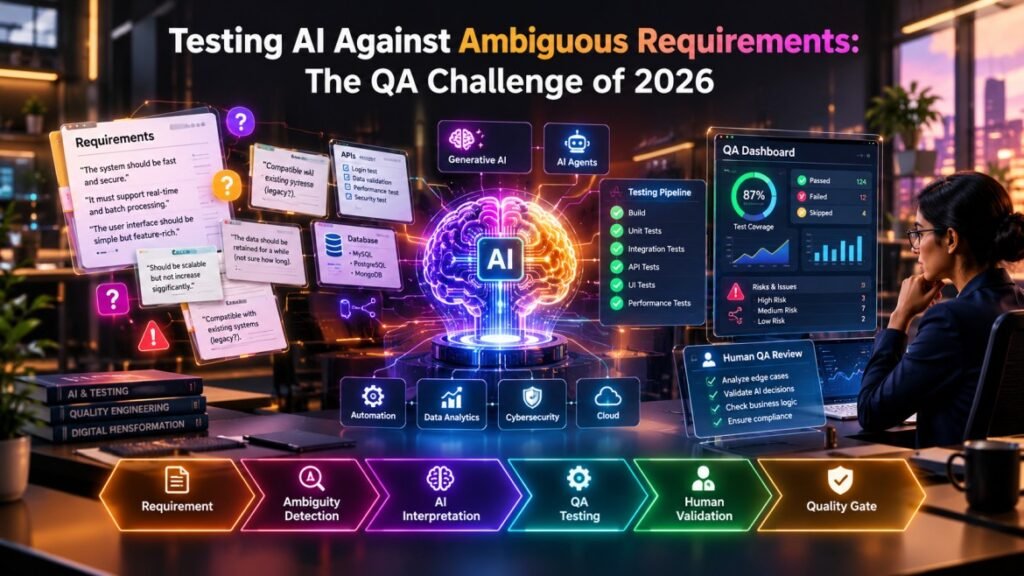
Requirement → Ambiguity Analysis → AI Behavior → Automated Evaluation → Human Review → Defect / Acceptance
Human review is especially valuable when evaluating:
- Complex business decisions
- Regulatory content
- Customer-impacting recommendations
- Safety-sensitive responses
- Financial decisions
- Insurance claims
- Legal information
- High-impact automated decisions
The objective is not to manually inspect every AI response forever. Instead, human review can help establish evaluation criteria that can later support scalable automated testing.
Building an AI Ambiguity Test Matrix
A practical QA organization can create an ambiguity matrix.
| Requirement Area | Ambiguity | Test Approach | Quality Signal |
|---|---|---|---|
| Customer intent | Vague request | Prompt variations | Intent accuracy |
| Business rule | Undefined threshold | Boundary tests | Rule compliance |
| Data | Missing fields | Incomplete data tests | Safe handling |
| Context | Multiple meanings | Context switching | Interpretation accuracy |
| Output | Subjective quality | Human evaluation | Relevance |
| Safety | High-risk request | Negative testing | Safe response |
| Compliance | Regulatory constraint | Policy validation | Compliance |
This matrix can become part of the organization’s AI Quality Engineering framework.
Automation Strategies for Testing AI
AI testing should not depend entirely on manual execution.
QA teams can automate several layers.
Automated Functional Validation
Validate:
- API responses
- HTTP status codes
- Schema compliance
- Required fields
- Authentication
- Integration behavior
- Response-time thresholds
- Data persistence
Automated AI Evaluation
Depending on the application, automated evaluators can assess:
- Relevance
- Similarity
- Completeness
- Toxicity
- Policy violations
- Hallucination indicators
- Instruction following
- Format compliance
However, automated evaluation itself needs validation.
A model-based evaluator can make mistakes too.
Therefore:
AI evaluating AI must itself become a testable system.
The Impact on Quality Engineering
The rise of ambiguous AI requirements is changing the role of the QA professional.
Traditional QA primarily emphasizes:
Requirement → Test Case → Execution → Defect
AI Quality Engineering increasingly involves:
Requirement → Intent Analysis → Risk Modeling → Evaluation Criteria → AI Behavior → Evidence → Human Judgment
This requires stronger skills in:
- AI fundamentals
- Prompt engineering
- API testing
- Data validation
- Model evaluation
- Risk-based testing
- Observability
- Security testing
- Domain knowledge
- Statistical thinking
The future QA professional will increasingly operate as an AI quality investigator, not simply a test executor.
Challenges of Testing AI Against Ambiguous Requirements
1. Lack of a Single Expected Result
Many AI responses cannot be validated through exact string matching.
2. Subjective Evaluation
Words such as “helpful,” “professional,” “natural,” and “appropriate” require measurable definitions.
3. Model Variability
Model updates, configuration changes, retrieval changes, and prompt modifications can alter behavior.
4. Evaluation Bias
An evaluator may prefer certain response styles even when multiple responses are valid.
5. Requirement Drift
AI systems frequently evolve as business teams update prompts, data, models, and policies.
6. Hidden Context
AI behavior can depend on conversation history, retrieved documents, system instructions, or user profiles.
7. Data Dependency
Poor-quality or outdated data can produce incorrect results even when the underlying model behaves as designed.
Opportunities for QA Teams in 2026
The challenges also create significant opportunities.
AI Quality Engineering
Organizations can establish dedicated AI quality practices covering:
- Model behavior
- Prompt quality
- Data quality
- Retrieval quality
- Guardrails
- AI security
- Evaluation frameworks
- Production monitoring
Intelligent Test Generation
AI can help testers generate:
- Test scenarios
- Boundary cases
- Negative tests
- API payloads
- SQL validation queries
- Requirement questions
- Regression candidates
The tester remains responsible for reviewing and validating generated tests.
Continuous AI Evaluation
Instead of testing AI only before release, organizations can continuously monitor:
- Response quality
- Drift
- Failure patterns
- User feedback
- Safety violations
- Retrieval accuracy
- Model changes
This creates a continuous quality feedback loop.
Future of Testing AI and Ambiguous Requirements
The future of Testing AI will likely move toward continuous, risk-aware evaluation rather than isolated test execution.
Several trends are emerging.
1. Requirement-to-Evaluation Automation
Future platforms may convert natural-language requirements into:
- Ambiguity questions
- Risk categories
- Test scenarios
- Evaluation criteria
- Regression suites
The QA engineer will review and refine these outputs.
2. AI-Powered Requirement Review
AI tools will increasingly identify phrases such as:
- “as soon as possible”
- “user-friendly”
- “high priority”
- “appropriate”
- “reasonable”
- “quick”
- “accurate”
- “secure”
These terms can trigger clarification workflows.
3. Behavioral Contracts for AI
Instead of defining only exact outputs, organizations will define behavioral contracts.
For example:
When critical information is missing, the AI must request clarification rather than inventing an answer.
Such contracts are more suitable for probabilistic systems.
4. Continuous Production Testing
AI applications will increasingly be evaluated after deployment using controlled monitoring, sampled interactions, synthetic scenarios, and regression benchmarks.
5. AI Quality Governance
As AI becomes part of enterprise digital transformation, organizations will need stronger governance around:
- Traceability
- Accountability
- Evaluation evidence
- Risk classification
- Human oversight
- Data lineage
- Model changes
How QA Teams Can Prepare Today
QA professionals can begin with a practical five-step approach.
Step 1: Learn AI Application Architecture
Understand:
- LLMs
- RAG
- AI agents
- Embeddings
- Vector databases
- APIs
- Prompt pipelines
Step 2: Build AI-Specific Test Cases
Add scenarios for:
- Ambiguity
- Hallucination
- Prompt injection
- Context switching
- Missing information
- Conflicting information
- Unsafe requests
Step 3: Strengthen API and Data Testing
AI applications depend heavily on APIs, databases, retrieval systems, and external services.
Strong API and SQL testing therefore remains highly relevant.
Step 4: Develop Evaluation Skills
Learn how to evaluate AI responses using measurable criteria rather than relying only on personal opinions.
Step 5: Combine Automation With Human Judgment
Automate repetitive checks while retaining expert human evaluation for complex and high-risk scenarios.
Example: Testing an AI Insurance Assistant
Consider an AI assistant used by an insurance company.
Requirement
“Help customers understand their policy coverage.”
This sounds simple but contains significant ambiguity.
QA should ask:
- What policy documents can the AI access?
- How current is the information?
- Can it interpret exclusions?
- Can it answer claim-related questions?
- What happens when documents conflict?
- Should it provide financial recommendations?
- When should it escalate to a human?
- How should uncertainty be communicated?
Example test
Customer:
“Does my policy cover this damage?”
The AI should not confidently answer without understanding:
- Policy type
- Effective dates
- Coverage terms
- Exclusions
- Applicable conditions
- Available policy documents
- Description of the damage
The QA objective is therefore not simply to verify the final sentence.
It is to determine whether the AI follows an appropriate decision and communication process.
Testing AI: A New QA Mindset
The biggest shift is philosophical.
Traditional testing asks:
“Is this output correct?”
AI Quality Engineering increasingly asks:
“Is this behavior appropriate for the context, evidence, risk, and user intent?”
That distinction matters.
An AI system may generate thousands of technically acceptable responses but still fail because it:
- Assumes missing information
- Misinterprets intent
- Overstates confidence
- Ignores business constraints
- Fails to escalate
- Uses outdated information
- Produces inconsistent decisions
Testing must therefore examine the behavior surrounding the answer, not merely the answer itself.
Conclusion
Testing AI against ambiguous requirements is becoming one of the defining QA challenges of 2026.
As AI becomes embedded in enterprise applications, customer service, insurance platforms, healthcare systems, financial technology, software development, and broader digital transformation, requirements will increasingly be expressed in natural language and interpreted by intelligent systems.
That creates a new quality problem: the requirement may be uncertain before the software even starts executing it.
QA teams must respond by combining traditional testing disciplines with AI evaluation, exploratory testing, data validation, risk analysis, human review, and continuous monitoring.
The future of Testing AI will not be about proving that every AI response is identical. It will be about demonstrating that the system behaves accurately, safely, consistently, transparently, and appropriately within defined boundaries—even when requirements and user inputs are imperfect.
For QA professionals, this represents more than another testing technique. It is an opportunity to become a critical part of how organizations build trustworthy AI during the next phase of digital transformation.
Key Takeaways
- Ambiguous requirements are especially challenging for AI because AI can interpret natural language in multiple ways.
- QA teams should test intent, context, uncertainty, safety, compliance, and behavioral consistency.
- Exact output matching is often insufficient for AI applications.
- Clarification behavior should become an explicit test category.
- Human evaluation remains important for subjective and high-risk scenarios.
- Automated AI evaluation should itself be validated.
- AI Quality Engineering will increasingly combine automation, data testing, risk analysis, and continuous evaluation.
- The future of Testing AI will focus on behavioral contracts and continuous quality monitoring.
- Strong domain knowledge will remain a major advantage for QA professionals working with enterprise AI.