
Introduction
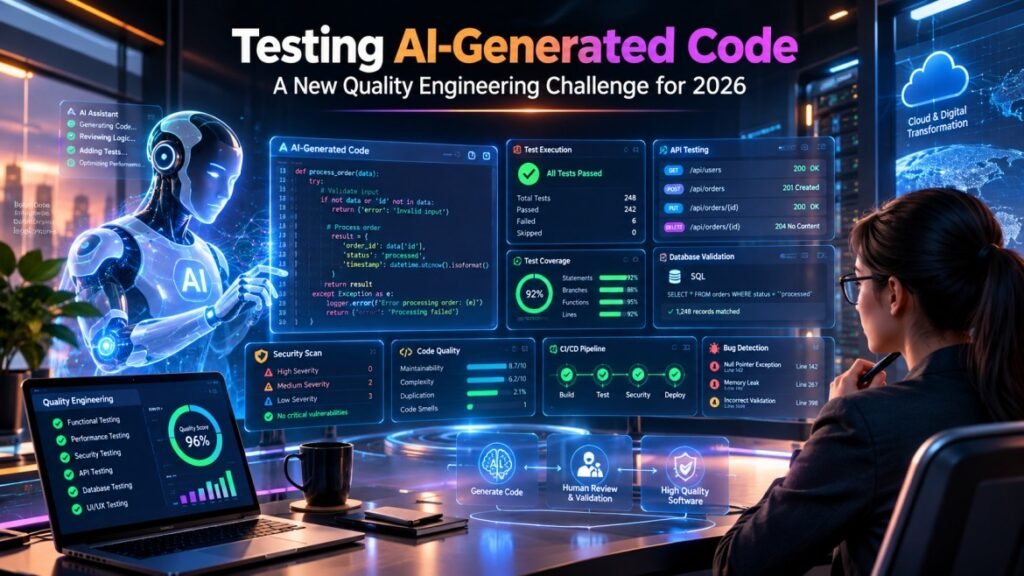
Artificial intelligence is changing how software is designed, developed, tested, and maintained. In 2026, AI coding assistants can generate functions, APIs, test scripts, database queries, documentation, and even complete application components within seconds.
This acceleration is becoming an important part of digital transformation. Development teams can produce software faster, experiment with ideas more quickly, and reduce repetitive coding work. However, faster code generation introduces a critical question: Who validates the code produced by AI?
This is where Testing AI-Generated Code becomes a major Quality Engineering challenge.
AI-generated code may look clean and technically correct while still containing logical defects, security weaknesses, incorrect assumptions, poor error handling, performance problems, or business-rule violations. A successful compilation does not necessarily mean that the software is reliable.
For Quality Engineers, the future is therefore not simply about testing applications faster. It is about understanding how AI-created software behaves, determining what should be tested, and building quality controls around increasingly autonomous development workflows.
Table of Contents
What Is AI-Generated Code?
AI-generated code refers to software code produced partially or entirely by artificial intelligence systems.
Developers can provide natural-language instructions such as:
“Create a REST API that validates customer information and stores the result in a database.”
An AI coding system may generate the controller, service logic, validation rules, database queries, error handling, and sometimes accompanying tests.
Common AI-assisted development activities include:
- Code generation
- Code completion
- Unit-test generation
- API creation
- SQL query generation
- Refactoring
- Debugging
- Documentation generation
- Test-script creation
- Infrastructure configuration
- Code migration between programming languages
The productivity benefits can be significant, but the generated output still requires engineering validation.
Why Testing AI-Generated Code Matters in 2026
Traditional software development usually follows a relatively predictable process:
Requirement → Design → Development → Testing → Deployment
AI-assisted development can compress several of these stages:
Prompt → AI Generation → Developer Review → Testing → Deployment
This acceleration creates a new quality risk.
An AI model can generate thousands of lines of code much faster than a human developer can manually review them. If the validation process does not scale with code generation, defects can move through the delivery pipeline faster.
The impact of it can appear in several areas:
- Functional defects
- Security vulnerabilities
- Incorrect business logic
- Data-quality problems
- API contract violations
- Performance bottlenecks
- Poor maintainability
- Unexpected dependencies
- Inadequate error handling
- Regression defects
The central challenge is therefore not whether AI can write code. It is whether engineering teams can reliably validate what AI produces.
Testing AI-Generated Code: How Is It Different?
Testing AI-generated software is not completely separate from conventional software testing. Functional, integration, API, security, performance, and regression testing remain important.
However, AI-generated code introduces additional dimensions.
1. The Source of the Code Is Different
Traditional code generally reflects the developer’s understanding of the requirement.
AI-generated code is based on patterns learned from data and the instructions supplied through a prompt or surrounding context.
This means the generated implementation may satisfy the apparent wording of a request without fully understanding the organization’s business rules.
2. Code Can Be Plausible but Wrong
One of the biggest risks is code that looks professionally written but implements the wrong behavior.
For example, an AI-generated insurance claims function might correctly calculate a numerical value but incorrectly apply a policy exclusion.
The code can pass basic unit tests while still violating the actual business requirement.
3. More Code Can Be Produced Faster
If AI allows developers to generate ten times more implementation code, manual review of every line becomes increasingly impractical.
Quality Engineering therefore needs stronger automation, risk-based testing, static analysis, and continuous validation.
A Practical Framework for Testing AI-Generated Code
A strong validation strategy should cover multiple layers rather than relying on a single testing technique.
1. Requirement Validation
Before testing the implementation, validate whether the AI-generated solution actually addresses the requirement.
Ask:
- Does the implementation match the acceptance criteria?
- Are business rules correctly represented?
- Are negative scenarios covered?
- Are edge cases understood?
- Are assumptions documented?
Requirement traceability becomes especially important when prompts are used as part of development.
2. Static Code Analysis
Static analysis can identify problems without executing the application.
Useful checks include:
- Code smells
- Security vulnerabilities
- Duplicated code
- Complexity
- Unsafe dependencies
- Incorrect coding patterns
- Potential null-pointer problems
- Resource-management issues
Static analysis should become part of the CI/CD pipeline rather than being treated as an optional review activity.
3. Unit Testing
AI-generated code should be supported by meaningful unit tests.
However, blindly accepting AI-generated unit tests creates another risk: the AI may generate tests that confirm its own incorrect assumptions.
Quality Engineers should therefore review:
- Test intent
- Assertions
- Boundary conditions
- Negative scenarios
- Mocking strategy
- Exception handling
- Data variations
4. API Testing
AI-generated APIs require comprehensive validation.
Testers should verify:
- HTTP status codes
- Request validation
- Response schemas
- Authentication
- Authorization
- Error messages
- Pagination
- Rate limiting
- Data consistency
- Contract compatibility
Tools such as Postman, REST-assured, and automated API frameworks can become important components of the validation pipeline.
5. Database and SQL Testing
AI systems can generate SQL quickly, but generated queries still need validation.
Quality Engineers should examine:
- SQL correctness
- Joins
- Filtering conditions
- NULL handling
- Duplicate records
- Transaction behavior
- Query performance
- Data integrity
- Authorization controls
A query that returns results is not automatically a correct query.
Example: AI-Generated Insurance Application
Imagine an insurance company asks an AI coding assistant to create a claims-calculation service.
The generated code may:
- Read policy information.
- Retrieve claim details.
- Calculate an eligible amount.
- Apply a deductible.
- Return the settlement amount.
At first glance, everything may appear correct.
But Quality Engineering should ask deeper questions:
- What happens when the policy is expired?
- What happens when the claim exceeds the coverage limit?
- Are excluded damages rejected?
- Is the deductible applied once or multiple times?
- What happens when policy data is missing?
- Can a customer submit duplicate claims?
- Are unauthorized users prevented from accessing claim information?
This demonstrates why Testing AI-Generated Code requires more than checking whether the generated program executes successfully.
The Role of Quality Engineers Is Changing
AI-assisted development does not eliminate the need for Quality Engineers. Instead, it changes where their expertise creates the most value.
The traditional tester often focuses heavily on finding defects in completed functionality.
The modern Quality Engineer increasingly needs to evaluate the entire software-generation lifecycle.
This includes:
- Requirement quality
- Prompt quality
- Generated code
- Generated tests
- Test data
- Security controls
- CI/CD validation
- Production behavior
- Observability
- Risk management
The future Quality Engineer will increasingly operate as a quality architect for AI-assisted software delivery.
AI-Generated Tests Can Create a New Testing Problem
There is an interesting paradox.
AI can generate application code.
AI can also generate tests for that application.
But who validates the tests?
If the same assumptions influence both the implementation and the tests, a defect can potentially remain hidden.
For example:
AI requirement interpretation → AI-generated code → AI-generated test → automated pass
Everything may appear successful even though the original business interpretation was incorrect.
Human review remains valuable because testers can challenge assumptions rather than simply verifying whether generated artifacts are internally consistent.
Human-in-the-Loop Quality Engineering
A practical 2026 approach is not “AI versus humans.”
It is AI plus human engineering judgment.
AI can accelerate:
- Test-case generation
- Data generation
- Test-script creation
- Log analysis
- Defect clustering
- Regression selection
- Code analysis
- Documentation
Humans should remain responsible for:
- Business-risk assessment
- Requirement interpretation
- Critical-path validation
- Security decisions
- Exploratory testing
- Ethical considerations
- Release-risk decisions
This combination can make Quality Engineering more scalable without removing accountability.
Challenges of Testing AI-Generated Code
1. Hallucinated Logic
AI can generate functions, libraries, parameters, or implementation approaches that appear valid but are incorrect.
2. Hidden Assumptions
The generated solution may make assumptions that were never stated in the requirement.
3. Security Risks
Generated code can introduce vulnerabilities such as:
- Improper authentication
- Weak authorization
- Injection risks
- Unsafe data handling
- Exposed secrets
- Insecure dependencies
4. Test Quality
Generated tests may provide high numerical coverage while failing to validate important business behavior.
5. Rapid Code Changes
AI-assisted development can increase the frequency of code changes, creating additional regression-testing requirements.
6. Lack of Explainability
Developers may not always understand why an AI system generated a particular implementation.
That creates a maintainability challenge for Quality Engineering teams.
Opportunities for Quality Engineers
The same transformation creating new risks also creates new career opportunities.
Quality Engineers can expand their skills into:
AI-Assisted Testing
Learn how AI can generate:
- Test scenarios
- Test cases
- Automation scripts
- Synthetic data
- API tests
- SQL validation queries
AI Quality Engineering
Organizations will increasingly need professionals who understand both traditional testing and AI-driven development workflows.
Prompt Engineering for QA
QA professionals can learn how to create structured prompts for:
- Boundary-value analysis
- Negative testing
- Risk identification
- API scenario generation
- Exploratory testing
AI Security Testing
Security validation of AI-assisted software can become an important specialization.
Quality Governance
Large organizations will need processes defining how AI-generated code is reviewed, tested, approved, monitored, and maintained.
Future Trends in AI Code Testing
The future of software quality is likely to involve increasingly automated validation pipelines.
Autonomous Test Generation
AI systems will increasingly analyze requirements and source code to propose test scenarios automatically.
Intelligent Regression Testing
Instead of executing every test after every change, AI-driven systems may prioritize tests based on code changes, dependencies, historical failures, and business risk.
Self-Healing Automation
Automation frameworks may increasingly detect changed application behavior and suggest updates to selectors, workflows, and test scripts.
Continuous AI Code Review
AI-based code-review systems can continuously inspect generated code for quality, security, and maintainability concerns.
Risk-Based Quality Gates
CI/CD pipelines may evaluate generated changes according to risk rather than simply checking whether builds pass.
For example:
Low-risk change → Automated validation
Medium-risk change → Automated validation + targeted human review
High-risk change → Extensive testing + mandatory engineering approval
How Digital Transformation Changes Quality Engineering
Digital transformation is no longer only about moving applications to the cloud or replacing manual processes.
It increasingly involves changing how software itself is created.
AI-assisted development can shorten the distance between an idea and a working software component.
That means Quality Engineering must also transform.
Instead of asking:
“Did we test the application?”
Teams increasingly need to ask:
“Did we validate the requirements, generated implementation, generated tests, security posture, data behavior, and production risks?”
This broader perspective can make quality a continuous engineering responsibility rather than a final project phase.
Best Practices for Testing AI-Generated Code
Organizations adopting AI coding tools should establish clear quality controls.
Recommended checklist
- Review AI-generated code before production use.
- Maintain automated unit and integration testing.
- Use static-analysis and security-scanning tools.
- Validate requirements independently.
- Test positive and negative scenarios.
- Include boundary and edge cases.
- Perform API and database validation.
- Monitor third-party dependencies.
- Use risk-based regression testing.
- Protect credentials and sensitive data.
- Maintain human approval for high-risk changes.
- Track production defects associated with AI-generated changes.
- Continuously improve AI coding and testing guidelines.
The objective is not to slow down AI adoption. It is to make rapid development compatible with engineering discipline.
What Skills Should QA Engineers Learn in 2026?
QA professionals preparing for the future should combine conventional testing expertise with modern engineering capabilities.
Important skills include:
- Functional testing
- API testing
- SQL and database testing
- Automation testing
- CI/CD
- Git
- Cloud fundamentals
- Security testing
- Performance testing
- AI-assisted testing
- Prompt engineering
- Test-data generation
- Observability
- Risk-based testing
- Quality engineering practices
For experienced testers, domain expertise remains particularly valuable because AI may generate technically plausible solutions without understanding complex business processes.
A New Quality Engineering Mindset
The biggest change may not be technological.
It may be cultural.
AI can generate code rapidly, but quality cannot simply be generated by increasing the volume of code or tests.
Quality Engineers need to become comfortable questioning AI output.
Instead of asking:
“Does the code work?”
ask:
“Does it solve the right problem?”
Instead of asking:
“Did the AI generate tests?”
ask:
“Do those tests challenge the implementation effectively?”
Instead of asking:
“Did automation pass?”
ask:
“What risk remains untested?”
These questions represent the mindset required for modern Quality Engineering.
Conclusion
Testing AI-Generated Code is becoming an important Quality Engineering challenge as AI-assisted software development becomes part of mainstream engineering workflows.
AI can accelerate development, automate repetitive tasks, and support digital transformation. But speed without validation can also accelerate defects.
The future of Quality Engineering will therefore depend on combining AI-powered automation with human reasoning, domain knowledge, exploratory testing, security awareness, and risk management.
AI may write more of the code in the years ahead. Quality Engineers will increasingly be responsible for proving whether that code deserves to be trusted.
That makes Testing AI-Generated Code not simply a new testing technique, but an evolving engineering discipline for the next generation of software development.