
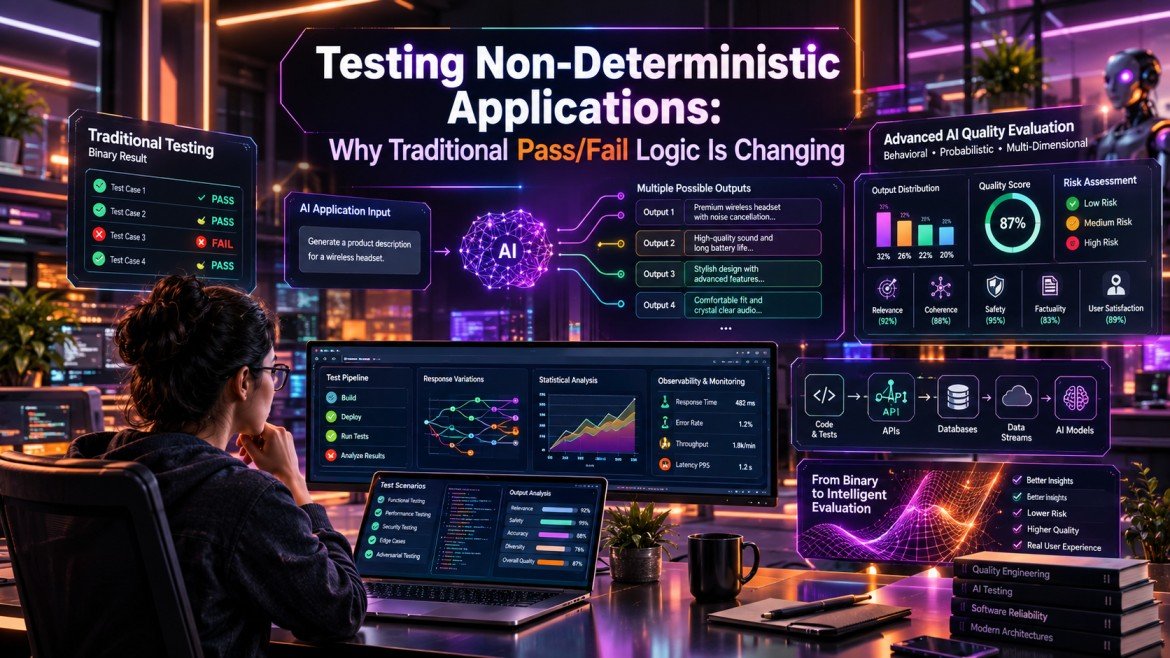
Software has traditionally been tested with a relatively simple question: Did the application produce the expected result?
If the actual result matched the expected result, the test passed. If it did not, the test failed.
This model works extremely well for deterministic software where the same input, environment, and conditions are expected to produce the same output.
But modern applications are becoming increasingly different.
Generative AI, machine learning, recommendation engines, autonomous agents, probabilistic services, natural-language interfaces, adaptive systems, and other intelligent technologies can produce different outputs for the same input.
This creates a fundamental challenge for modern Testing teams.
If an AI assistant provides two different but reasonable answers to the same question, should one automatically be considered a failure?
Not necessarily.
The industry is therefore moving toward more sophisticated approaches based on quality thresholds, behavioral expectations, statistical analysis, risk, safety, consistency, and human evaluation.
This shift is particularly important as digital transformation pushes organizations toward intelligent and autonomous applications.
Table of Contents
What Is a Non-Deterministic Application?
A non-deterministic application is software whose output can vary even when the same input is provided.
The variation may result from:
- Probabilistic models
- Machine-learning algorithms
- Randomness
- Changing data
- External services
- Dynamic environments
- Real-time information
- AI model behavior
- Autonomous decision-making
- Context-dependent processing
For example, consider an AI-powered customer-support assistant.
A user asks:
“How can I change my insurance policy address?”
The application may produce different wording each time.
One response might explain the process in three steps, while another might provide four steps.
The wording can differ while the underlying information remains correct.
A conventional exact-string assertion could incorrectly identify one response as a failure.
Why Traditional Pass/Fail Logic Is Becoming Less Effective
Traditional automated Testing generally follows a pattern:
Input → Expected Result → Actual Result → Pass/Fail
This approach works particularly well for:
- Calculation engines
- CRUD applications
- Deterministic APIs
- Database operations
- Business rules
- Fixed UI behavior
- Transaction processing
However, AI-driven applications frequently behave more like:
Input → Model/Environment → Variable Output → Quality Evaluation
The challenge is that there may not be one universally correct output.
Example: Traditional Application
Suppose an API calculates insurance premium.
Input:
Base Premium = $1,000
Tax = 10%
Expected result:
$1,100
If the application returns $1,100, the test passes.
If it returns $1,080, the test fails.
The expected result is deterministic.
Example: AI Application
Now consider an AI system generating a customer email.
Input:
Write a polite response explaining a delayed claim settlement.
There may be hundreds of acceptable responses.
Testing the exact text would therefore be inappropriate.
Instead, the evaluation could examine:
- Accuracy
- Relevance
- Tone
- Completeness
- Policy compliance
- Safety
- Hallucination risk
- Required information
- Customer experience
This represents a major change in modern Testing methodology.
Understanding the Sources of Non-Determinism
Before changing the testing strategy, QA teams need to understand why an application produces variable outputs.
1. Probabilistic AI Models
Large language models and other machine-learning systems can generate different responses based on model configuration and sampling behavior.
2. Changing Data
Applications dependent on live data may naturally produce different results.
For example:
- Stock prices
- Weather information
- Search results
- Product recommendations
- Fraud signals
3. External APIs
Third-party services can change their responses based on availability, timing, configuration, or underlying data.
4. Autonomous Agents
AI agents may choose different paths to accomplish the same objective.
For example, an AI agent might:
- Search a database.
- Call an API.
- Validate information.
- Ask another service.
- Generate the final response.
Another execution could follow a slightly different sequence.
5. Dynamic User Context
Personalized applications can change their behavior depending on:
- User history
- Location
- Preferences
- Previous interactions
- Permissions
- Device
- Session state
The New Testing Question: “Is the Output Acceptable?”
The central question is shifting from:
“Is this exactly the expected result?”
to:
“Does this result satisfy the defined quality and business requirements?”
This requires a different evaluation model.
Instead of one binary assertion, QA teams can define multiple dimensions.
Example Evaluation Model
An AI-generated insurance response might be evaluated on:
| Dimension | Evaluation |
|---|---|
| Factual accuracy | Is the information correct? |
| Relevance | Does it answer the question? |
| Completeness | Are important details included? |
| Safety | Could the answer cause harm? |
| Compliance | Does it follow business rules? |
| Tone | Is the communication appropriate? |
| Consistency | Does behavior remain within acceptable boundaries? |
The application can then be evaluated against predefined thresholds.
From Binary Testing to Quality-Based Evaluation
The traditional model is:
Pass / Fail
The emerging model can be:
Input → Output → Multiple Metrics → Thresholds → Risk Assessment
For example:
Accuracy >= 95%
Relevance >= 90%
Safety = 100%
Required fields = Present
Policy violations = 0
The result is not simply based on whether the output exactly matches a predefined string.
Instead, the system is assessed against measurable criteria.
This does not eliminate pass/fail decisions.
Rather, it moves the pass/fail decision to a higher-level evaluation based on multiple dimensions.
Key Techniques for Testing Non-Deterministic Applications
1. Property-Based Testing
Instead of checking one exact output, define properties that must always hold.
For example, an application processing customer information may need to guarantee:
- Personal data is not exposed.
- Mandatory fields are preserved.
- Invalid inputs are rejected.
- Security rules are respected.
The exact output can vary while these properties remain constant.
2. Metamorphic Testing
Metamorphic Testing is particularly useful when there is no simple expected output.
Instead of asking whether one output is correct, the QA team checks how the output changes when the input changes in a predictable way.
Example
Suppose an AI classification system categorizes customer complaints.
If the same complaint is rewritten with minor grammatical changes, the classification should ideally remain reasonably consistent.
The exact response does not need to remain identical.
The relationship between inputs and outputs becomes the testing target.
3. Statistical Testing
For probabilistic applications, QA teams can execute a scenario repeatedly.
For example:
Test Case: Customer Support Question
Executions: 1,000
Correct Responses: 963
Incorrect Responses: 37
Accuracy: 96.3%
A team could define an acceptable threshold based on business risk.
For high-risk applications, the acceptable threshold may need to be significantly stricter.
4. Golden Datasets
A curated dataset can contain representative scenarios and expected behavioral characteristics.
A golden dataset might include:
- Normal cases
- Boundary conditions
- Negative scenarios
- Sensitive content
- Ambiguous questions
- Security attacks
- Regulatory scenarios
- Domain-specific terminology
The application can be evaluated against this dataset repeatedly.
5. LLM-as-a-Judge Evaluation
For generative AI applications, another model can sometimes evaluate outputs according to predefined criteria.
For example:
Evaluate the response from 1–5 for:
- Accuracy
- Relevance
- Completeness
- Professional tone
However, this approach should not be treated as infallible.
The evaluator itself can introduce:
- Bias
- Inconsistency
- Calibration problems
- False positives
- False negatives
Human review and deterministic safeguards remain important for high-risk scenarios.
Testing AI Applications Requires More Than Functional Testing
Traditional functional testing remains important, but AI-powered applications introduce additional dimensions.
Functional Testing
Verifies whether core application functionality works.
Examples:
- Login
- Search
- API response
- Data persistence
- Workflow execution
AI Behavior Testing
Examines how an AI component behaves under different conditions.
Examples:
- Prompt variations
- Ambiguous requests
- Adversarial inputs
- Unexpected language
- Context changes
Security Testing
Evaluates threats such as:
- Prompt injection
- Data leakage
- Unauthorized access
- Insecure tool usage
- Malicious inputs
Performance Testing
Measures:
- Response time
- Throughput
- Concurrent users
- Resource consumption
- Model latency
Reliability Testing
Examines whether the application remains within acceptable behavioral boundaries over repeated executions.
The Role of QA Engineers Is Changing
Non-deterministic systems are not eliminating the need for QA professionals.
Instead, they are expanding the QA skill set.
Modern QA engineers may need knowledge of:
- AI fundamentals
- Prompt engineering
- API Testing
- Data validation
- Statistical concepts
- Model evaluation
- Security Testing
- Automation
- Observability
- Risk analysis
The QA role can increasingly move from simply validating predefined requirements to evaluating system behavior under uncertainty.
A Practical Testing Strategy
Organizations building non-deterministic applications can adopt a layered approach.
Layer 1: Deterministic Validation
Use traditional assertions wherever possible.
Examples:
- HTTP status codes
- Database values
- Required fields
- Authentication
- Authorization
- Business rules
Layer 2: Behavioral Evaluation
Evaluate:
- Relevance
- Accuracy
- Completeness
- Consistency
- Safety
Layer 3: Statistical Evaluation
Run repeated scenarios and measure:
- Success rate
- Error rate
- Distribution of outcomes
- Variability
- Confidence intervals where appropriate
Layer 4: Risk-Based Evaluation
Not every scenario has the same business impact.
A harmless chatbot response and an automated insurance claim decision should not necessarily have the same acceptance criteria.
Risk should influence:
- Test depth
- Approval thresholds
- Human review
- Monitoring
- Release criteria
Example: Testing an AI Insurance Assistant
Consider an AI assistant that helps customers understand insurance policies.
A traditional test might expect:
Input:
"What is my deductible?"

Expected:
"Your deductible is $1,000."
But an AI system may respond:
"Your policy shows a $1,000 deductible for this coverage."
Another execution might say:
"The deductible listed for this coverage is $1,000."
Both responses may be acceptable.
The QA objective should therefore verify:
- Correct deductible
- Correct policy
- Correct customer
- No confidential data leakage
- Appropriate wording
- No unsupported assumptions
- Compliance with business rules
This demonstrates why modern Testing requires a broader definition of correctness.
Challenges in Testing Non-Deterministic Applications
Challenge 1: Defining Expected Behavior
The biggest challenge may be determining what “correct” means when multiple outputs are acceptable.
Teams need measurable evaluation criteria.
Challenge 2: Reproducibility
A failure may not reproduce exactly the same way.
QA teams therefore need to capture:
- Input
- Prompt
- Model version
- Configuration
- Temperature or sampling settings
- Retrieved context
- Tool calls
- Application version
- Environment
- Output
Challenge 3: False Positives
An overly strict evaluator may classify a valid variation as a failure.
Challenge 4: False Negatives
A response may sound convincing while containing incorrect information.
This is particularly important for generative AI.
Challenge 5: Data Drift
An AI application’s behavior can change as its underlying data, models, retrieval sources, or external services change.
Challenge 6: Test Data Complexity
AI systems often require large and diverse datasets.
A small collection of happy-path scenarios may provide a misleading view of quality.
Observability Becomes Critical
Traditional logs are often insufficient for intelligent applications.
Modern AI systems may require visibility into:
- Prompts
- Model versions
- Responses
- Tokens
- Retrieval results
- Tool calls
- Agent decisions
- Latency
- Errors
- Safety events
This creates an important connection between Testing, observability, and production monitoring.
A defect may not be discovered during a conventional test run.
Instead, production telemetry may reveal that a particular class of inputs is producing unacceptable behavior.
Continuous Testing for Non-Deterministic Systems
Because AI applications can change over time, testing cannot necessarily stop at deployment.
A continuous approach can include:
Build
  ↓
Automated Tests
  ↓
AI Evaluation
  ↓
Security Validation
  ↓
Release
  ↓
Production Monitoring
  ↓
New Test Scenarios
  ↓
Regression Evaluation
Production observations can become new regression scenarios.
This creates a feedback loop between real-world behavior and software quality.
The Future of Testing Non-Deterministic Applications
The future of software quality engineering is likely to involve a combination of deterministic automation and intelligent evaluation.
AI-Powered Test Generation
AI can help generate:
- Test scenarios
- Edge cases
- Synthetic datasets
- API tests
- Regression scenarios
- Adversarial prompts
QA engineers can then review and validate the generated tests.
Autonomous Evaluation Agents
Specialized agents may evaluate applications continuously across:
- Functionality
- Security
- Reliability
- Performance
- AI behavior
Risk-Based Quality Gates
Instead of applying identical release criteria everywhere, organizations may define different quality thresholds based on business impact.
For example:
Low-risk application: broader behavioral tolerance.
High-risk application: stricter thresholds, additional controls, and human approval.
Continuous AI Regression Testing
Future QA platforms may repeatedly evaluate models against large scenario libraries whenever:
- A model changes
- A prompt changes
- Retrieval data changes
- An API changes
- Application code changes
This can make regression evaluation an ongoing engineering activity rather than a final release step.
Opportunities for QA Professionals
The transition toward non-deterministic software creates opportunities for specialists in:
- AI Quality Engineering
- AI Test Automation
- Model Evaluation
- LLM Testing
- API Testing
- Data Quality
- AI Security Testing
- Quality Engineering
- AI Governance
- Observability
QA professionals who understand both traditional software testing and AI system behavior can contribute to a broader range of engineering activities.
How QA Teams Can Prepare
Organizations can start by developing a practical framework.
Step 1: Identify Non-Deterministic Components
Document where variable behavior exists.
Step 2: Separate Deterministic and Probabilistic Requirements
Use exact assertions where exact behavior is required.
Use quality thresholds where variation is acceptable.
Step 3: Define Evaluation Metrics
Create measurable criteria for:
- Accuracy
- Relevance
- Safety
- Reliability
- Consistency
- Compliance
Step 4: Build Representative Datasets
Include realistic and difficult scenarios.
Step 5: Automate Repeated Evaluation
Run scenarios at scale and track quality metrics.
Step 6: Monitor Production Behavior
Use real-world observations to identify new failure patterns.
Step 7: Establish Governance
Define who can approve model, prompt, data, and application changes.
Impact of Digital Transformation on Software Quality
Digital transformation is moving organizations from static software systems toward connected, intelligent, and continuously evolving platforms.
This changes the role of quality engineering.
Previously, QA teams could often validate a relatively fixed application.
Modern systems may involve:
- Cloud services
- AI models
- APIs
- Third-party platforms
- Real-time data
- Microservices
- Autonomous agents
- Continuous deployments
The result is a much larger quality landscape.
Testing therefore needs to evolve from simply verifying individual features toward understanding system behavior across changing environments.
Final Thoughts
Non-deterministic applications are changing the meaning of software correctness.
Traditional pass/fail assertions remain extremely valuable for deterministic functionality. They should not be abandoned.
Instead, they need to be complemented with behavioral, statistical, property-based, metamorphic, risk-based, and human evaluation techniques where appropriate.
The future of Testing will likely be less about asking whether every output is identical and more about determining whether system behavior consistently remains accurate, safe, useful, compliant, and within acceptable boundaries.
For QA and Quality Engineering professionals, this transition represents a significant opportunity.
The engineers who understand both conventional software validation and the complexities of AI-driven behavior will be better equipped to build reliable digital products in an increasingly intelligent technology landscape.