
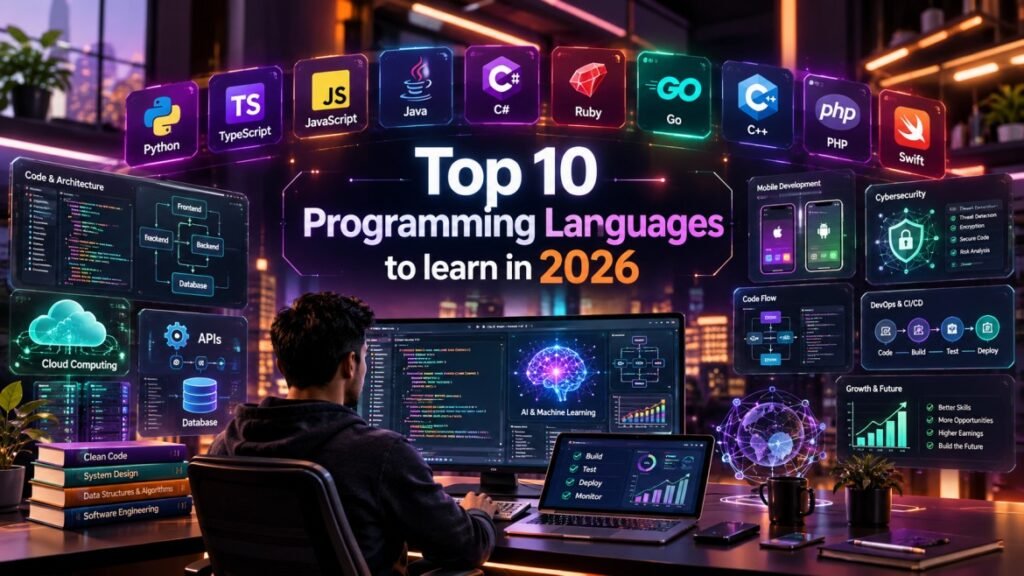
The technology industry is changing rapidly as artificial intelligence, cloud computing, automation, cybersecurity, and digital transformation reshape the way software is designed and delivered. For developers, choosing the right programming language is no longer only about learning syntax—it is about understanding which technologies are likely to remain useful across real-world applications.
In 2026, developers have more choices than ever. Some languages dominate artificial intelligence and data science, while others remain critical for enterprise platforms, mobile applications, cloud infrastructure, gaming, and web development.
This guide explores the Top 10 Programming Languages to learn in 2026, focusing on their applications, industry relevance, career opportunities, and indicative salary ranges in the United States and India.
Whether you are a beginner planning your first coding journey or an experienced developer looking to expand your technology stack, understanding these languages can help you make a more informed career decision.
Table of Contents
Why Learning the Right Programming Language Matters in 2026
The future of software development is being shaped by several major technology trends:
- Artificial intelligence and machine learning
- Generative AI and AI agents
- Cloud-native application development
- Web and mobile application modernization
- Data engineering and analytics
- Cybersecurity
- Internet of Things (IoT)
- Automation and DevOps
- Enterprise digital transformation
- High-performance computing
A programming language should therefore be evaluated according to more than popularity.
Developers should consider:
- Industry demand
- Ecosystem and community support
- Job availability
- Framework maturity
- Performance
- Learning curve
- AI and cloud compatibility
- Long-term career opportunities
Top 10 Programming Languages to Learn in 2026
1. TypeScript
Why Learn TypeScript?
TypeScript has become an important choice for building large-scale web applications. Developed as a superset of JavaScript, it introduces static typing and additional development features that can make complex codebases easier to maintain.
TypeScript is particularly valuable for organizations developing large applications where reliability, maintainability, and collaboration are important.
Major Applications
- Enterprise web applications
- Frontend development
- Backend development with Node.js
- Full-stack development
- SaaS platforms
- Cloud applications
- APIs
- Large-scale digital platforms
Popular technologies in the TypeScript ecosystem include React, Angular, Next.js, Node.js, and NestJS.
Career Opportunities
Developers can pursue roles such as:
- TypeScript Developer
- Frontend Engineer
- Full-Stack Developer
- Software Engineer
- Node.js Developer
- Web Application Engineer
Indicative Salary Range
United States: Approximately $80,000–$170,000+ annually
India: Approximately ₹5 lakh–₹30 lakh+ annually
Actual compensation depends heavily on experience, location, specialization, and employer.
2. Python
Python continues to be one of the most versatile technologies for modern software development.
Its simple syntax and extensive ecosystem make it particularly attractive for artificial intelligence, machine learning, data science, automation, backend development, and scripting.
Why Python Is Important
Python plays a major role in the rapidly expanding AI ecosystem.
It is widely used for:
- Artificial intelligence
- Machine learning
- Data science
- Generative AI applications
- Automation
- Data engineering
- Web development
- Scientific computing
- Testing and scripting
Frameworks and libraries such as Django, FastAPI, PyTorch, TensorFlow, Pandas, and NumPy have expanded its usefulness.
Example
A company could use Python to create an API that connects an AI model to a customer-support application.
Career Opportunities
- Python Developer
- AI Engineer
- Machine Learning Engineer
- Data Scientist
- Automation Engineer
- Backend Developer
- Data Engineer
Indicative Salary Range
United States: Approximately $85,000–$180,000+ annually
India: Approximately ₹5 lakh–₹35 lakh+ annually
Python’s growing connection with AI and automation makes it particularly relevant to the future of software engineering.
3. JavaScript
JavaScript remains fundamental to web development.
While newer technologies continue to emerge, JavaScript remains deeply embedded in the web ecosystem and can be used across both frontend and backend development.
Where JavaScript Is Used
- Interactive websites
- Web applications
- Frontend development
- Backend services
- APIs
- Mobile applications
- Server-side applications
- Browser-based applications
Popular technologies include React, Vue, Angular, Node.js, and Express.
Why It Matters
One of JavaScript’s major strengths is its enormous ecosystem.
A developer can use JavaScript to build the user interface, server-side application logic, APIs, and increasingly sophisticated full-stack systems.
Career Opportunities
- JavaScript Developer
- Frontend Engineer
- Full-Stack Engineer
- Node.js Developer
- Web Application Developer
Indicative Salary Range
United States: Approximately $75,000–$165,000+ annually
India: Approximately ₹4 lakh–₹28 lakh+ annually
4. Java
Java has remained an important enterprise technology for decades, and its relevance continues in large-scale business systems.
Banks, insurance organizations, telecommunications companies, governments, and large enterprises often operate applications built around Java and the JVM ecosystem.
Major Applications
- Enterprise applications
- Banking systems
- Insurance platforms
- Backend services
- APIs
- Android development
- Distributed systems
- Financial technology
- Large-scale transaction processing
Frameworks such as Spring and Spring Boot are especially important for enterprise backend development.
Why Learn Java?
Java offers:
- Strong enterprise adoption
- Mature tooling
- Extensive libraries
- Large developer community
- Strong performance
- Cross-platform capabilities
- Long-term enterprise relevance
Career Opportunities
- Java Developer
- Backend Engineer
- Software Engineer
- Enterprise Application Developer
- Spring Boot Developer
Indicative Salary Range
United States: Approximately $80,000–$170,000+ annually
India: Approximately ₹5 lakh–₹30 lakh+ annually
Java remains particularly relevant for developers interested in enterprise software and financial systems.
5. C#
C# is Microsoft’s major programming language for the .NET ecosystem.
It is widely used for enterprise software, backend services, desktop applications, cloud solutions, and game development through Unity.
Major Applications
- Enterprise software
- Web APIs
- Cloud applications
- Desktop applications
- Game development
- Business applications
- Microsoft ecosystem development
ASP.NET Core provides a modern framework for building web applications and APIs.
Unity has also made C# particularly important for developers interested in game development.
Career Opportunities
- C# Developer
- .NET Developer
- ASP.NET Developer
- Backend Engineer
- Software Engineer
- Unity Developer
Indicative Salary Range
United States: Approximately $80,000–$170,000+ annually
India: Approximately ₹5 lakh–₹30 lakh+ annually
C# can be especially useful for developers working with Microsoft’s enterprise and cloud ecosystem.
6. Ruby
Ruby is known for its readable syntax and developer-friendly philosophy.
Its most recognizable framework, Ruby on Rails, helped establish Ruby as a major technology for rapidly developing web applications.
Major Applications
- Web applications
- SaaS products
- Startup platforms
- Backend systems
- Prototypes
- Business applications
Why Ruby Still Matters
Although Ruby’s overall market presence is smaller than JavaScript or Python, it remains valuable in organizations with established Rails applications.
Ruby’s emphasis on developer productivity can also make it attractive for teams building products quickly.
Career Opportunities
- Ruby Developer
- Ruby on Rails Developer
- Backend Engineer
- Full-Stack Developer
- SaaS Engineer
Indicative Salary Range
United States: Approximately $75,000–$160,000+ annually
India: Approximately ₹5 lakh–₹25 lakh+ annually
Ruby demonstrates an important career lesson: a language does not need to dominate every market to remain professionally useful.
7. Go (Golang)
Go was designed with simplicity, concurrency, and efficient execution in mind.
It has become increasingly important in cloud-native development, infrastructure software, networking, and distributed systems.
Major Applications
- Cloud infrastructure
- Microservices
- Distributed systems
- DevOps tools
- Networking
- Container technologies
- Backend services
- Cloud-native applications
Go’s concurrency model makes it particularly useful for applications that need to handle many simultaneous operations.
Why Learn Go?
Developers interested in cloud engineering and infrastructure can benefit from learning Go.
It is particularly relevant to ecosystems surrounding containers, orchestration, APIs, and distributed services.
Career Opportunities
- Go Developer
- Backend Engineer
- Cloud Engineer
- Infrastructure Engineer
- Platform Engineer
- DevOps Engineer
Indicative Salary Range
United States: Approximately $90,000–$180,000+ annually
India: Approximately ₹6 lakh–₹35 lakh+ annually
Go is closely connected with the future of cloud-native engineering.
8. C++
C++ remains one of the most important high-performance programming technologies.
Its ability to provide low-level control and high execution performance makes it valuable in systems where speed, memory efficiency, and deterministic behavior matter.
Major Applications
- Game engines
- Gaming
- Financial systems
- Embedded systems
- Operating systems
- Robotics
- High-performance computing
- Systems programming
- Real-time applications
Why C++ Remains Relevant
Many performance-sensitive systems cannot simply replace low-level technologies with higher-level alternatives.
C++ therefore continues to be relevant in industries where computational efficiency is critical.
Career Opportunities
- C++ Developer
- Systems Engineer
- Game Developer
- Embedded Software Engineer
- Quantitative Developer
- Robotics Engineer
Indicative Salary Range
United States: Approximately $85,000–$180,000+ annually
India: Approximately ₹5 lakh–₹35 lakh+ annually
C++ can have a steeper learning curve than many modern languages, but it provides a strong foundation in memory management, algorithms, and systems concepts.
9. PHP
PHP remains deeply connected with web development.
Although the software industry has expanded significantly beyond traditional server-rendered websites, PHP continues to support a large installed base of websites and web applications.
Major Applications
- Websites
- Content management systems
- E-commerce platforms
- Web applications
- Backend development
- CMS development
- APIs
Technologies such as Laravel and Symfony provide modern development frameworks for PHP.
Why PHP Still Matters
A developer entering an existing web ecosystem may encounter PHP frequently.
The enormous installed base of PHP-based websites also creates opportunities for:
- Maintenance
- Modernization
- Security improvements
- Performance optimization
- Plugin development
- E-commerce development
Career Opportunities
- PHP Developer
- Laravel Developer
- Backend Developer
- WordPress Developer
- Web Application Developer
Indicative Salary Range
United States: Approximately $60,000–$140,000+ annually
India: Approximately ₹3 lakh–₹20 lakh+ annually
PHP illustrates how established technologies can continue to create employment opportunities even as newer technologies emerge.
10. Swift
Swift is Apple’s modern programming language for developing applications across its ecosystem.
It is particularly important for developers targeting iPhone, iPad, Mac, Apple Watch, and other Apple platforms.
Major Applications
- iOS applications
- macOS applications
- watchOS applications
- tvOS applications
- Apple ecosystem software
Swift works closely with Apple’s development frameworks and tooling.
Why Learn Swift?
Developers interested in mobile application development can use Swift to build applications specifically for Apple’s platforms.
The language combines modern syntax with features designed to improve safety and developer productivity.
Career Opportunities
- iOS Developer
- Swift Developer
- Mobile Application Developer
- macOS Developer
- Apple Platform Engineer
Indicative Salary Range
United States: Approximately $80,000–$170,000+ annually
India: Approximately ₹5 lakh–₹30 lakh+ annually
Programming Languages Comparison
| Language | Primary Areas | Key Strength |
|---|---|---|
| TypeScript | Web, Full Stack, SaaS | Type safety and scalable web development |
| Python | AI, Data, Automation | Versatility and AI ecosystem |
| JavaScript | Web, Backend, Full Stack | Universal web ecosystem |
| Java | Enterprise, Banking, Backend | Reliability and enterprise adoption |
| C# | Enterprise, Cloud, Gaming | .NET ecosystem and Unity |
| Ruby | Web, SaaS, Startups | Developer productivity |
| Go | Cloud, Infrastructure | Concurrency and simplicity |
| C++ | Systems, Gaming, Finance | Performance and control |
| PHP | Web, CMS, E-commerce | Large web ecosystem |
| Swift | Apple Platforms | Native Apple development |
How to Choose a Programming Language in 2026
There is no single language that is appropriate for every developer.
Your choice should depend on your career objective.
For AI and Data Science
Consider:
- Python
Python provides a broad ecosystem for machine learning, data analysis, AI experimentation, and automation.
For Web Development
Consider:
- TypeScript
- JavaScript
- PHP
- Ruby
Your choice can depend on whether you want to focus on frontend engineering, full-stack development, enterprise web applications, or existing platforms.
For Enterprise Software
Consider:
- Java
- C#
- TypeScript
These technologies are commonly used across large business applications and backend ecosystems.
For Cloud and Infrastructure
Consider:
- Go
- Python
- Java
- TypeScript
Go is particularly relevant for developers interested in infrastructure and distributed systems.
For Game Development
Consider:
- C++
- C#
C++ is prominent in performance-intensive game technologies, while C# is widely associated with Unity development.
For Apple Development
Consider:
- Swift
Swift is the natural starting point for developers focused on native Apple application development.
The Impact of Digital Transformation on Programming Careers
Digital transformation is changing how businesses develop and operate software.
Companies across banking, insurance, healthcare, retail, manufacturing, logistics, and telecommunications are modernizing legacy systems and introducing cloud-based applications.
This transformation is increasing demand for developers who understand more than one programming language.
For example, an enterprise developer may need to understand:
- Backend programming
- APIs
- Cloud platforms
- Databases
- Security
- CI/CD
- Containers
- Automated testing
- AI-assisted development
The ability to combine programming knowledge with architecture and business-domain expertise can therefore become increasingly valuable.
Future Trends in Programming
1. AI-Assisted Software Development
AI coding assistants are changing how developers write, test, debug, and document software.
The developer’s role is increasingly moving toward:
- Reviewing generated code
- Designing architecture
- Validating outputs
- Managing security
- Testing edge cases
- Understanding business requirements
Programming knowledge therefore remains important even when AI can generate code.
2. AI-Native Applications
More applications will incorporate:
- Large language models
- AI agents
- Retrieval-augmented generation
- Natural-language interfaces
- Automated decision workflows
This will increase demand for developers who can combine traditional software engineering with AI technologies.
3. Cloud-Native Development
Cloud platforms and distributed architectures will continue influencing application design.
Technologies such as Go, Java, Python, TypeScript, and C# are positioned across different parts of this ecosystem.
4. Polyglot Development
Developers increasingly use multiple languages rather than depending on one technology.
A modern engineering team might use:
- TypeScript for frontend applications
- Python for AI services
- Go for infrastructure
- Java for enterprise services
- SQL for data access
Understanding how these technologies interact can be more valuable than memorizing syntax for one language.
Challenges for Developers in 2026
Rapid Technology Changes
Frameworks and tools can change quickly.
A developer who focuses exclusively on one framework may struggle if market demand changes.
AI-Generated Code Quality
AI can accelerate development, but generated code still requires human review.
Potential concerns include:
- Security vulnerabilities
- Incorrect assumptions
- Poor architecture
- Hidden bugs
- Dependency problems
- Inadequate test coverage
Competition in the Job Market
Entry-level developers increasingly compete in a market where AI-assisted development can improve productivity.
Building practical projects, understanding software engineering fundamentals, and developing domain knowledge can help demonstrate capability.
Continuous Learning
Programming is not a one-time skill.
Developers should continually update their knowledge of:
- Frameworks
- Cloud platforms
- Security
- Databases
- AI
- DevOps
- Testing
- Software architecture
Opportunities for Developers
The changing technology landscape also creates new career opportunities.
Developers can specialize in areas such as:
- AI engineering
- Cloud engineering
- Platform engineering
- Full-stack development
- Cybersecurity
- Data engineering
- Mobile development
- DevOps
- Automation engineering
- Quality engineering
- Software architecture
Developers who combine programming with a specialized industry domain—such as insurance, finance, healthcare, or e-commerce—can also develop a differentiated professional profile.
Should Beginners Learn One or Multiple Languages?
Beginners should generally avoid trying to learn all ten languages simultaneously.
A practical approach is:
Step 1: Learn One Language Deeply
Start with one language and understand:
- Variables
- Data structures
- Functions
- Object-oriented programming
- Error handling
- Testing
- Debugging
- APIs
- Git
Step 2: Build Real Projects
Create applications rather than only completing tutorials.
For example:
- REST API
- E-commerce application
- Task management application
- Data dashboard
- Automation script
- Mobile application
Step 3: Add a Second Language
Once programming fundamentals are established, learning another language becomes significantly easier.
The objective should be to understand programming concepts rather than memorize language-specific syntax.
Final Thoughts
The Top 10 Programming Languages to learn in 2026 represent different areas of the modern technology ecosystem.
Python is strongly connected with AI, data science, and automation. TypeScript and JavaScript remain central to web development. Java and C# continue to support enterprise software. Go is important in cloud-native infrastructure, while C++ remains valuable for performance-intensive systems. PHP continues to support a large web ecosystem, Ruby remains relevant in Rails environments, and Swift is central to Apple-platform development.
The future of software engineering will likely involve increasingly intelligent development tools, cloud-native architectures, automation, and AI-powered applications.
Rather than asking which language is universally “best,” developers should consider which technology aligns with their desired industry, application type, career direction, and long-term learning goals.
The most valuable skill may not be knowing one particular language. It may be the ability to learn, adapt, design, test, and solve software problems across changing technology environments.