
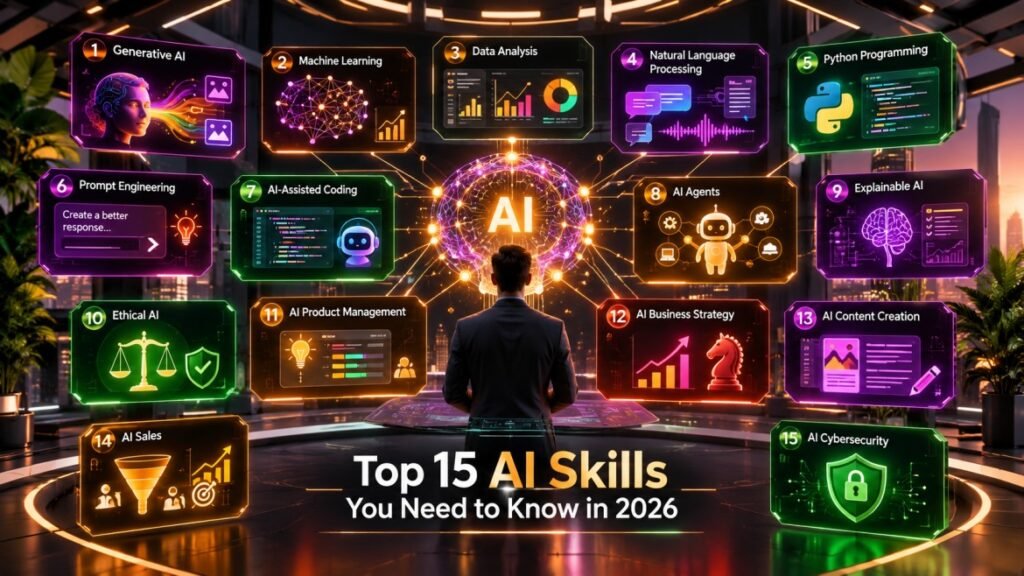
Artificial Intelligence is no longer limited to research laboratories or technology companies. From software development and marketing to cybersecurity, sales, finance, healthcare, and customer service, AI is becoming part of everyday professional workflows. As businesses accelerate digital transformation, professionals who understand how to work effectively with AI can gain a significant advantage.
The Top 15 AI Skills for 2026 are not limited to advanced programming or machine learning research. They combine technical knowledge, practical AI usage, strategic thinking, responsible implementation, and industry-specific expertise.
Whether you are a student, software professional, entrepreneur, manager, marketer, or someone planning a career transition, learning these skills can help you prepare for the future of technology.
Table of Contents
Why AI Skills Matter in 2026
AI is changing how organizations create products, analyze information, communicate with customers, write software, detect threats, and make decisions.
The important shift is that professionals are increasingly expected to work with AI rather than simply observe AI development.
For example:
- A developer can use AI-assisted coding to accelerate development.
- A marketer can use generative AI to create campaign concepts.
- A data analyst can use AI to identify patterns in large datasets.
- A cybersecurity professional can use AI to detect suspicious activity.
- A business manager can use AI agents to automate repetitive workflows.
The Top 15 AI Skills therefore represent a combination of technical capability and practical business value.
Top 15 AI Skills You Need to Know in 2026
1. Generative AI
Generative AI is one of the most important technologies professionals should understand in 2026.
It enables systems to generate new content such as:
- Text
- Images
- Audio
- Video
- Software code
- Presentations
- Summaries
- Marketing materials
Professionals should understand concepts such as large language models, multimodal AI, context windows, model limitations, hallucinations, and AI workflows.
Example
A marketing professional could use generative AI to create several campaign concepts, then use human expertise to validate the messaging, brand positioning, and target audience.
2. Machine Learning
Machine Learning remains a fundamental AI discipline.
Instead of explicitly programming every rule, machine-learning systems learn patterns from data and use those patterns to make predictions or classifications.
Important concepts include:
- Supervised learning
- Unsupervised learning
- Reinforcement learning
- Classification
- Regression
- Clustering
- Model evaluation
- Feature engineering
Understanding these concepts helps professionals evaluate AI solutions intelligently, even when they are not building models themselves.
3. Data Analysis
AI depends heavily on data. Consequently, the ability to understand, clean, analyze, and interpret data is becoming increasingly valuable.
Professionals should be comfortable with:
- Data cleaning
- Exploratory data analysis
- Statistical concepts
- Data visualization
- Pattern identification
- Data quality
- SQL
- Spreadsheet and BI tools
Example
A business analyst could combine SQL, dashboards, and AI-assisted analysis to identify declining sales and investigate the underlying causes.
4. Natural Language Processing
Natural Language Processing, or NLP, focuses on enabling computers to understand and process human language.
Modern NLP applications include:
- Chatbots
- Sentiment analysis
- Text classification
- Translation
- Document summarization
- Search
- Voice assistants
- Information extraction
With conversational AI becoming increasingly sophisticated, NLP knowledge can help professionals understand how language-based AI applications work.
5. Python and AI Programming
Python continues to be one of the most useful programming languages for AI and machine-learning work.
A professional interested in AI should understand Python fundamentals such as:
- Variables and data structures
- Functions
- Object-oriented programming
- APIs
- File handling
- Data processing
- Libraries and packages
For AI applications, familiarity with tools and frameworks used for data science and machine learning can provide an additional advantage.
Career Tip
You do not necessarily need to become an advanced software developer before beginning AI. Start with Python fundamentals and progressively build AI-oriented projects.
6. Prompt Engineering
Prompt Engineering is the ability to design effective instructions for AI systems to produce useful, reliable, and appropriately structured results.
Good prompting can involve:
- Clearly defining the objective
- Providing relevant context
- Specifying constraints
- Giving examples
- Defining output formats
- Asking the model to evaluate assumptions
- Iteratively improving prompts
Simple Example
Instead of asking:
“Analyze this data.”
A better instruction could specify the business objective, relevant metrics, expected output, assumptions, and desired format.
Prompt Engineering is particularly useful for professionals who regularly use AI but do not develop AI models.
7. AI-Assisted Coding
AI is changing the software-development workflow.
AI coding assistants can help developers:
- Generate code
- Explain existing code
- Create test cases
- Identify potential bugs
- Refactor code
- Generate documentation
- Convert code between languages
However, AI-generated code still requires human review.
Developers need to understand security, performance, maintainability, testing, and software architecture rather than blindly accepting generated code.
8. AI Agents
AI agents represent an important evolution beyond simple question-and-answer systems.
An AI agent can potentially:
- Understand a goal.
- Break the goal into tasks.
- Select appropriate tools.
- Perform actions.
- Evaluate results.
- Continue until the objective is completed.
For example, an AI agent could potentially gather information, organize it, prepare a report, and update a connected business system.
Why It Matters
As organizations automate multi-step processes, professionals who understand agent workflows, tool use, orchestration, permissions, and human oversight will become increasingly valuable.
9. Explainable AI
AI systems can influence important decisions, making transparency increasingly important.
Explainable AI focuses on understanding why an AI system produced a particular result.
This is especially relevant in areas such as:
- Insurance
- Banking
- Healthcare
- Recruitment
- Credit assessment
- Cybersecurity
Explainability can improve trust, auditing, debugging, and regulatory compliance.
Example
If an AI system recommends rejecting an insurance claim, an organization may need to understand which factors contributed to that recommendation.
10. Ethical AI
AI innovation must be accompanied by responsible implementation.
Ethical AI focuses on areas such as:
- Fairness
- Privacy
- Security
- Transparency
- Accountability
- Bias mitigation
- Human oversight
Professionals should understand that technically impressive AI can still create business and societal risks when implemented without appropriate safeguards.
Responsible AI should therefore become part of the development lifecycle rather than an afterthought.
11. AI Product Management
AI Product Management combines traditional product management with AI-specific considerations.
AI product managers may need to understand:
- User requirements
- AI model capabilities
- Data requirements
- Model evaluation
- Product-market fit
- AI costs
- User experience
- Risk management
- Feedback loops
Unlike conventional software, AI products can produce probabilistic rather than deterministic outputs. Product teams therefore need appropriate evaluation and monitoring strategies.
12. AI Business Strategy
Understanding AI technology is useful, but understanding where AI creates business value is even more important for organizational leaders.
AI Business Strategy involves identifying opportunities where AI can:
- Reduce operational costs
- Increase productivity
- Improve customer experience
- Automate repetitive processes
- Generate new revenue
- Improve decision-making
- Strengthen competitive advantage
Example
Instead of adopting AI simply because competitors are doing so, a company could identify a specific workflow where automation can reduce processing time while maintaining quality and compliance.
13. AI Content Creation
AI is transforming content production across blogs, social media, advertising, video, and digital publishing.
Professionals can use AI to support:
- Content ideation
- Research
- Drafting
- Editing
- Image generation
- Video creation
- Voice generation
- Content repurposing
However, successful content still requires human creativity, fact-checking, editorial judgment, originality, and audience understanding.
The future is likely to favor professionals who combine AI productivity with strong communication skills.
14. AI in Sales
AI is becoming increasingly useful throughout the sales lifecycle.
Potential applications include:
- Lead qualification
- Customer segmentation
- Personalized communication
- Sales forecasting
- Customer research
- Meeting summaries
- CRM assistance
- Next-best-action recommendations
Sales professionals who understand AI can spend less time on repetitive administrative tasks and more time building relationships and closing opportunities.
15. AI in Cybersecurity
Cybersecurity is becoming an increasingly important AI application area because digital threats can evolve rapidly.
AI can assist security teams with:
- Threat detection
- Anomaly identification
- Log analysis
- Security monitoring
- Phishing detection
- Incident prioritization
- Vulnerability analysis
At the same time, attackers can also use AI to improve their capabilities. This creates an ongoing technology race between offensive and defensive security teams.
Professionals therefore need to understand both AI capabilities and cybersecurity fundamentals.
How These 15 AI Skills Fit Together
These skills should not be viewed as 15 completely separate subjects.
They form an interconnected AI skill ecosystem.
Foundational layer:
- Machine Learning
- Data Analysis
- NLP
- Python
- Generative AI
Practical application layer:
- Prompt Engineering
- AI-Assisted Coding
- AI Agents
- AI Content Creation
Strategy and governance layer:
- Explainable AI
- Ethical AI
- AI Product Management
- AI Business Strategy
Industry application layer:
- AI in Sales
- AI in Cybersecurity
This combination allows professionals to move from simply using AI tools to understanding, implementing, managing, and strategically applying AI.
Future Trends in AI Skills
The future of technology will increasingly reward professionals who can combine domain expertise with AI capabilities.
Several trends are likely to remain important:
Multimodal AI
AI systems are increasingly capable of working with multiple information formats, including text, images, audio, video, and structured data.
Agentic AI
AI agents are moving toward more autonomous execution of multi-step workflows.
AI-Assisted Software Engineering
AI will increasingly participate throughout the software lifecycle, including coding, testing, documentation, debugging, and maintenance.
AI Governance
As organizations deploy AI at scale, governance, compliance, security, transparency, and risk management will become increasingly important.
Human-AI Collaboration
Rather than replacing every professional role, AI will increasingly change how people perform their existing jobs.
The most valuable professionals may be those who know which tasks should be automated and which require human judgment.
Challenges of Learning AI Skills
Learning AI can be challenging because the field changes rapidly.
1. Technology Changes Quickly
Tools and models can become outdated within a relatively short period.
2. Too Many Tools
Professionals can become overwhelmed by the growing number of AI platforms.
3. Lack of Practical Experience
Watching tutorials is not enough. Real projects are necessary to understand how AI behaves in practical situations.
4. AI Reliability
AI-generated outputs can contain errors, fabricated information, bias, or inappropriate recommendations.
5. Security and Privacy
Organizations must carefully consider what data can be shared with AI systems.
6. Skill Fragmentation
Knowing a collection of AI tools without understanding underlying concepts can create shallow expertise.
The solution is to build strong fundamentals and continuously apply them to real-world problems.
Career Opportunities Created by AI Skills
AI skills can support career opportunities across numerous industries.
Potential roles include:
- AI Engineer
- Machine Learning Engineer
- Data Analyst
- Data Scientist
- AI Product Manager
- AI Business Analyst
- Prompt Engineer
- AI Automation Specialist
- AI Content Strategist
- AI Solutions Consultant
- AI Security Specialist
- Software Engineer
- QA Engineer
- AI Governance Specialist
Importantly, professionals do not necessarily need to become AI researchers.
A software tester, marketer, financial analyst, sales professional, designer, or business manager can develop AI capabilities relevant to their existing domain.
How to Start Learning AI Skills in 2026
You do not need to learn all 15 skills simultaneously.
A practical learning roadmap is:
Step 1: Learn AI Fundamentals
Understand generative AI, machine learning, NLP, and basic AI terminology.
Step 2: Build Data Skills
Learn data analysis, SQL, statistics, and visualization.
Step 3: Learn Python
Focus on practical programming rather than attempting to master every Python feature.
Step 4: Practice Prompt Engineering
Use different AI models and experiment with structured prompts.
Step 5: Build AI-Assisted Workflows
Use AI for coding, research, documentation, content creation, testing, or data analysis.
Step 6: Explore AI Agents
Understand how AI agents use tools and execute multi-step tasks.
Step 7: Learn Responsible AI
Study privacy, fairness, explainability, security, and human oversight.
Step 8: Apply AI to Your Industry
This is where theoretical knowledge becomes career value.
For example, an insurance professional could explore AI-powered claims analysis, fraud detection, document processing, customer support, and risk assessment.
Final Thoughts
The AI job market is moving beyond the idea that only machine-learning specialists need AI knowledge. AI is becoming a cross-functional capability that can enhance software engineering, data analysis, sales, marketing, cybersecurity, product management, and business operations.
The Top 15 AI Skills provide a practical framework for building this capability. The goal should not be to collect certificates or learn every new AI tool. Instead, professionals should develop a combination of technical understanding, practical experimentation, business awareness, and responsible AI practices.
As digital transformation continues across industries, the professionals who can combine AI with existing domain expertise may have a stronger position in the changing employment landscape.
The biggest impact of it may not simply be the creation of new AI jobs. It may be the transformation of existing jobs—and the emergence of professionals who can use AI intelligently to solve problems that previously required significantly more time and resources.
For anyone preparing for the future of technology, 2026 is an excellent time to start building AI skills that can remain useful even as individual tools continue to change.