
Introduction: Why AI Needs a Universal Connection Layer
What is MCP – Artificial intelligence has moved far beyond answering questions and generating text. Modern AI systems can analyze information, write code, summarize documents, reason through complex problems, and assist with business decisions.
But there is an important limitation: an AI model cannot automatically interact with every application, database, or digital service it knows about.
Imagine asking an AI assistant to:
- Check your calendar and find a suitable meeting time.
- Retrieve a confidential document from a company database.
- Search customer records.
- Review recent financial transactions.
- Send information to another business application.
- Analyze live data and take an action based on the result.
Without a standardized connection method, every AI application may need a separate integration for every tool it wants to use. That approach quickly becomes complicated, expensive, and difficult to maintain.
This is where the Model Context Protocol (MCP) enters the picture.
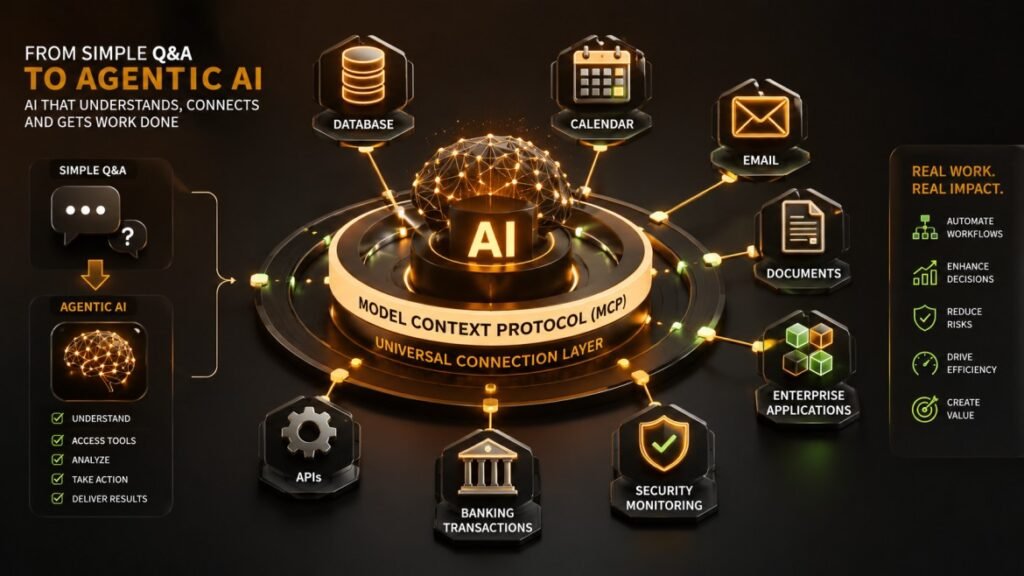
MCP is designed as an open standard for connecting AI applications with external tools, services, data sources, and workflows. A useful way to understand it is as a “universal USB port” for AI: instead of building a completely different connection for every device, developers can use a common interface.
The result could be one of the most important developments in the future of technology—AI systems that do not simply tell us what to do, but can actually interact with the digital systems required to get the work done.
Table of Contents
What Is Model Context Protocol (MCP)?
The Model Context Protocol (MCP) is a standardized way for AI applications to communicate with external systems.
At a high level, MCP creates a common communication layer between an AI application and capabilities such as:
- Databases
- File systems
- Calendars
- Email platforms
- Business applications
- APIs
- Search systems
- Internal company tools
- Specialized software
Instead of creating a unique integration whenever an AI application needs to communicate with a new system, developers can use an MCP-compatible architecture.
The Simple Idea Behind MCP
Think about a laptop.
A laptop can connect to keyboards, storage devices, cameras, and other hardware through standardized interfaces such as USB. The laptop does not need an entirely new physical connection every time a new compatible device is introduced.
MCP applies a similar concept to AI.
AI application → MCP → External tools and data
This standardization can make AI integrations more reusable, scalable, and easier to manage.
Why Was MCP Needed?
Large language models are powerful, but their knowledge and capabilities are not automatically connected to the systems around them.
An AI model may understand what a calendar is, for example, but understanding a calendar is different from having permission to access someone’s actual calendar.
The same distinction applies to databases, email accounts, customer records, and enterprise software.
The Traditional Integration Problem
Suppose a company wants an AI assistant to interact with five internal systems.
Without a standardized protocol, developers may need to build and maintain multiple custom integrations.
As the number of AI applications and tools grows, the integration problem becomes increasingly complex.
A standardized protocol changes the model.
Instead of thinking:
AI application + custom integration + custom integration + custom integration
organizations can move toward:
AI application + standardized protocol + compatible tools
This is an important part of the broader digital transformation taking place across businesses.
How Does MCP Actually Work?
To understand how MCP works, it helps to break the architecture into a few basic components.
1. The AI Application
The AI application is the environment where the user interacts with an AI model.
This could be an AI assistant, coding environment, enterprise application, or another intelligent system.
The AI determines what information or capability it needs to complete a task.
2. The MCP Client
The client acts as the communication component between the AI application and an MCP server.
It helps establish communication and allows the AI application to interact with available MCP capabilities.
3. The MCP Server
An MCP server exposes specific capabilities or information to the AI application.
For example, an MCP server could provide controlled access to:
- A company’s internal documents
- A customer database
- A calendar
- A project management system
- A financial data platform
- A search engine
- A business API
The server does not simply give the AI unrestricted access to everything. It can expose specific tools and resources according to the way the integration has been designed.
4. Tools and Resources
This is where MCP becomes especially useful.
An external system can expose capabilities that an AI can use.
For example, a calendar integration might provide tools to:
- View available appointments
- Find open time slots
- Create meetings
- Retrieve event information
A document system might provide capabilities to:
- Search documents
- Retrieve specific files
- Read relevant information
- Locate records based on a query
The AI can then use these capabilities as part of a larger workflow.
A Practical MCP Example
Consider a simple scheduling request:
“Find a suitable time for a meeting with the marketing team next week.”
A standalone AI model might be able to suggest reasonable meeting times, but it cannot know the team’s actual availability without access to calendar information.
With an appropriate MCP connection, the workflow could look like this:
- The user asks the AI to schedule a meeting.
- The AI determines that calendar information is required.
- The MCP client communicates with the relevant MCP server.
- The server provides access to the permitted calendar functionality.
- The AI retrieves availability.
- The AI identifies an appropriate time.
- The user confirms the meeting.
- The AI can use the available calendar tool to create the event.
The important point is that the AI is no longer operating only on information contained within the model.
It can interact with external digital systems.
MCP and Agentic AI
One of the biggest reasons MCP is attracting attention is its relationship with agentic AI.
Traditional AI often follows a question-and-answer model:
User → AI → Answer
Agentic AI aims to create a more action-oriented workflow:
User → AI → Reason → Use tools → Evaluate results → Take action
MCP can provide part of the infrastructure required for this transition.
An AI agent might need to retrieve information from one system, analyze it, access another system, and then perform an action.
A standardized connection mechanism can make these workflows easier to build.
Example: AI Fraud Detection in Banking
Consider a bank monitoring thousands or millions of transactions.
A fraud-detection AI could potentially need access to several sources simultaneously:
- Real-time transaction information
- Customer profiles
- Historical transaction patterns
- Risk-scoring systems
- Account information
- Fraud-monitoring tools
The AI could analyze these sources together instead of evaluating a transaction in isolation.
For example, suppose a transaction appears unusual because:
- The purchase is significantly larger than normal.
- The transaction occurs in an unusual location.
- Several transactions happened within a short period.
- The customer’s historical behavior looks different.
- The risk-monitoring system has detected related activity.
An agentic AI system could combine these signals and potentially trigger a predefined response, such as flagging the transaction for investigation.
This illustrates the impact of IT when intelligent systems become connected to real operational data and tools.
MCP vs. Traditional APIs
MCP does not eliminate APIs.
Instead, it can provide a standardized way for AI applications to interact with tools and resources that may themselves rely on APIs.
A traditional API might expose a particular service directly to software developers.
MCP provides an AI-oriented communication framework that can help an AI application discover and use capabilities in a structured manner.
A simplified comparison looks like this:
| Traditional API | MCP |
|---|---|
| Connects software to a specific service | Connects AI applications with tools and resources |
| Often requires application-specific integration | Designed around standardized AI-tool interaction |
| Primarily developer-driven | Designed to support AI-driven tool use |
| Service-specific interface | Common protocol approach |
The two technologies can work together rather than being competitors.
Key Benefits of MCP
1. Standardized AI Integrations
A common protocol can reduce the need to create completely different integration approaches for each AI application.
2. Better Reusability
Once a tool is made available through a compatible MCP implementation, multiple AI applications can potentially use it.
3. Faster AI Development
Developers can spend less time creating repetitive connection logic and more time building useful AI experiences.
4. Greater AI Capabilities
An AI model can become much more useful when it can access relevant external tools and information.
5. More Powerful Enterprise Automation
Organizations can connect AI systems to internal workflows and business applications, supporting increasingly sophisticated automation.
6. A Path Toward Agentic Systems
MCP can help provide the tool-access layer required for AI agents that need to perform multi-step tasks.
Security and Privacy Challenges
The benefits of connected AI also create serious security considerations.
Giving an AI access to external systems is fundamentally different from asking it to generate text.
If an AI can read data, modify records, send messages, or trigger workflows, mistakes can have real consequences.
Important Security Questions
Organizations adopting MCP-based systems should consider:
- What information can the AI access?
- Which tools can the AI use?
- What actions require user approval?
- How are permissions managed?
- How is sensitive information protected?
- How are tool calls logged?
- What happens when an AI makes an incorrect decision?
- How can access be revoked?
The Principle of Least Privilege
A useful security principle is to give an AI agent only the permissions it actually needs.
For example, an AI assistant may need permission to read calendar information but not permission to delete appointments.
Similarly, an AI analyzing financial information may need access to specific transaction records without having permission to transfer funds.
MCP adoption should therefore be accompanied by strong identity, authorization, auditing, monitoring, and data-governance practices.
Challenges of MCP Adoption
MCP is promising, but it is not a magic solution.
Integration Complexity
Organizations still need to understand their existing systems and determine which capabilities should be exposed.
Data Governance
Connecting AI to private business information requires clear policies around data access, retention, privacy, and compliance.
Incorrect AI Decisions
A connected AI agent can potentially perform actions based on incorrect reasoning or incomplete information.
Human oversight may remain essential for high-risk decisions.
Tool Reliability
An AI agent is only as effective as the systems it depends on. If an external service is unavailable or returns incorrect information, the agent’s workflow can be affected.
Growing Attack Surface
Every new connection can introduce another potential security risk.
Organizations therefore need to treat AI tool access as part of their broader cybersecurity strategy.
Opportunities for Businesses
The potential business opportunities are significant.
Customer Service
AI agents could retrieve customer information, check order status, search knowledge bases, and assist with service workflows.
Finance
AI systems could analyze financial records, identify anomalies, generate reports, and support risk-management workflows.
Healthcare
With appropriate safeguards and regulatory compliance, connected AI systems could help retrieve approved information from multiple healthcare systems.
Software Development
AI coding assistants can potentially interact with repositories, testing systems, issue trackers, documentation, and development tools.
Human Resources
AI assistants could help employees locate policies, manage scheduling, and navigate internal systems.
Operations
Businesses could connect AI to inventory systems, logistics platforms, monitoring tools, and enterprise applications to automate repetitive workflows.
The Future of MCP
The long-term importance of MCP may extend beyond simply connecting today’s AI assistants to today’s software.
As AI agents become more capable, they will need reliable ways to interact with the digital world.
This could create a future where users communicate their goals rather than manually operating every application.
Instead of:
- Open the calendar.
- Search for availability.
- Open the email application.
- Write a message.
- Search the document system.
- Copy the required information.
- Update another application.
A future AI agent could potentially coordinate these steps through connected tools.
MCP and the Future of Technology
The future of technology is increasingly moving toward systems that are intelligent, interconnected, and capable of acting on information.
MCP fits into this larger movement by addressing a fundamental problem: how AI systems communicate with the tools and data they need to perform useful work.
If adoption continues, standardized AI-to-tool communication could become an important foundation for enterprise automation and agentic computing.
MCP and Digital Transformation
Digital transformation has traditionally involved connecting software systems, automating business processes, and moving information between applications.
AI introduces another layer.
Organizations now want software that can not only process information but also reason about it and take actions.
MCP can support this evolution by helping connect AI applications with the existing digital infrastructure of an organization.
This means companies may not need to replace every existing application to benefit from AI.
Instead, they can potentially build an intelligent layer around their existing technology ecosystem.
What Could MCP Enable in the Next Few Years?
Several trends are worth watching.
More Autonomous AI Agents
AI agents are likely to become increasingly capable of completing multi-step workflows.
Enterprise-Wide AI Connectivity
Businesses may connect AI systems to a broader range of internal applications and databases.
Human-in-the-Loop Automation
High-impact tasks may increasingly use AI for analysis while requiring human approval before important actions are executed.
AI-Native Applications
Future software may be designed from the beginning to be used not only by humans but also by AI agents.
Standardized AI Ecosystems
Common protocols could make it easier for developers and businesses to build interoperable AI systems.
How MCP Could Change the Way We Use Software
For decades, people have learned how to use software by navigating interfaces.
We click buttons, fill out forms, search menus, copy information, and move between applications.
Agentic AI introduces a different model.
Users could increasingly describe an objective, while AI systems determine which tools and information are needed to accomplish it.
That does not mean traditional applications will disappear.
Instead, the interface between humans and software may evolve.
From:
“Tell me how to do this.”
Toward:
“Do this for me, within these rules.”
That shift could have a major impact of IT across organizations, particularly in repetitive knowledge-work processes.
Final Thoughts
The Model Context Protocol (MCP) addresses a fundamental challenge in modern artificial intelligence: connecting capable AI models to the external tools, applications, and information they need to accomplish real-world tasks.
Its value is not simply that an AI can access another application.
The larger opportunity is interoperability.
When AI systems can securely communicate with calendars, databases, documents, enterprise software, monitoring systems, and other digital tools, they can move beyond being passive answer generators.
They can become active participants in business processes.
MCP is therefore best understood as one piece of a much larger transformation toward connected, agentic AI.
The technology still faces challenges involving security, permissions, reliability, privacy, governance, and responsible automation. However, if these challenges are addressed effectively, standardized AI-to-tool communication could become an important foundation for the next generation of digital systems.
The future may not be about choosing between AI and traditional software.
It may be about AI working through software to accomplish real objectives.
And that is why understanding MCP today could be important for anyone interested in AI, enterprise automation, digital transformation, and the future of technology.
Frequently Asked Questions About MCP
What does MCP stand for?
MCP stands for Model Context Protocol. It is an open standard designed to help AI applications communicate with external tools, resources, and data sources.
Is MCP an AI model?
No. MCP is not an AI model. It is a protocol that provides a standardized way for AI applications to interact with external capabilities.
Is MCP the same as an API?
No. APIs and MCP serve different purposes, although they can work together. MCP provides a standardized AI-oriented communication layer, while APIs generally expose functionality from a particular software service.
Can MCP make AI agents autonomous?
MCP can provide access to tools and resources that agents need, but it does not automatically make an AI autonomous. Agent behavior also depends on the AI model, orchestration logic, permissions, safeguards, and application design.
Why is MCP important for businesses?
MCP can help businesses connect AI systems with existing data and software, potentially reducing integration complexity and enabling more sophisticated automation.
Is MCP secure?
Security depends on how an MCP implementation is designed and deployed. Organizations should apply strong authentication, authorization, least-privilege access, monitoring, auditing, data protection, and human-approval controls where appropriate.
Conclusion
The evolution of AI is moving from generating answers to performing actions.
MCP represents an important step toward that future by providing a standardized way for AI applications to communicate with external tools and information sources.
For developers, it can simplify AI integration. For businesses, it can open new automation opportunities. For users, it could eventually mean AI assistants capable of completing tasks across multiple applications instead of simply explaining how those tasks should be performed.
The most important question is no longer only:
“What can AI tell us?”
It is increasingly:
“What can AI securely do for us?”
MCP is part of the technology infrastructure that could help answer that question.