
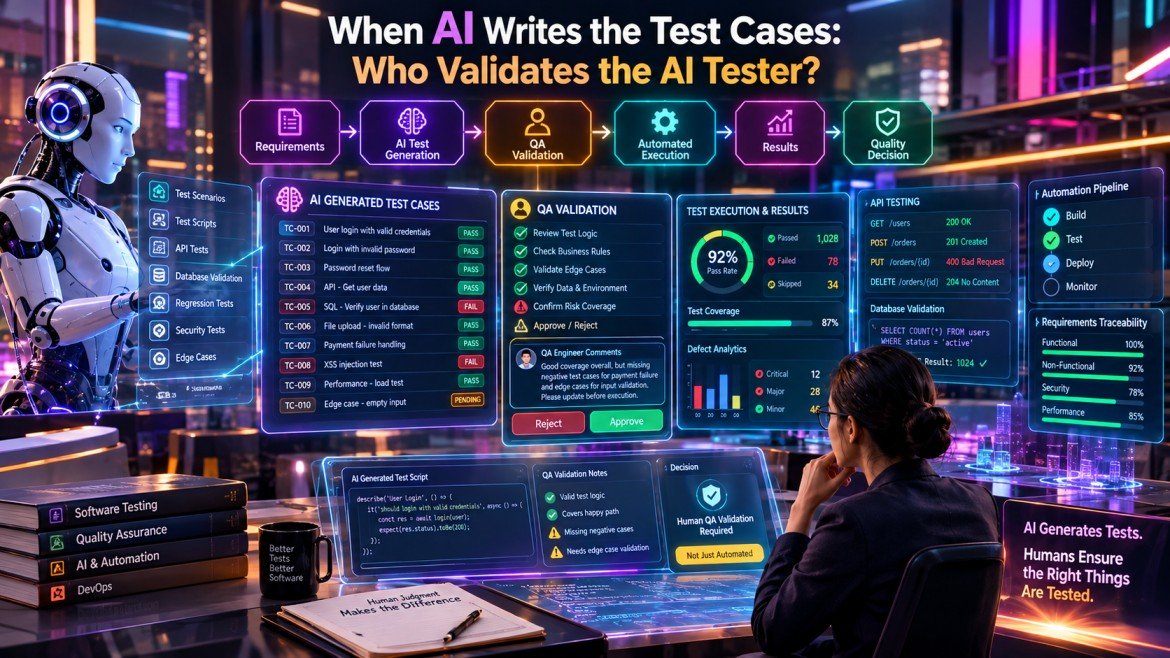
Introduction
Software testing has always depended on one fundamental principle: someone must decide what should be tested and whether the result is correct.
For decades, QA engineers have converted requirements, user stories, business rules, and technical specifications into test cases. They analyze edge cases, identify risks, prepare test data, execute scenarios, and determine whether software behaves as expected.
Artificial intelligence is now changing that workflow.
Modern AI tools can analyze requirements, generate test scenarios, create automation scripts, identify potential edge cases, and even execute tests. This can dramatically accelerate software quality processes.
But a new question emerges:
If AI creates the test cases, who validates the AI tester?
This question is becoming increasingly important as organizations integrate AI into software development and quality engineering. The concept of AI Writes the Test Cases represents more than automated test generation. It represents a shift in responsibility from manually creating every test to supervising, evaluating, and governing AI-generated testing.
The future of QA will therefore not simply be about testing software faster. It will be about ensuring that AI-driven testing itself is trustworthy.
Table of Contents
What Does It Mean When AI Writes Test Cases?
AI-powered testing systems can analyze software requirements and automatically generate potential test scenarios.
For example, imagine a requirement:
“Customers must be able to reset their password using a registered email address.”
A traditional QA engineer might create test cases for:
- Valid registered email
- Invalid email
- Unregistered email
- Empty email field
- Incorrect verification code
- Expired verification code
- Weak new password
- Previously used password
- Account lockout
- Multiple reset attempts
An AI testing assistant can potentially identify many of these scenarios automatically.
It can also generate:
- Positive test cases
- Negative test cases
- Boundary conditions
- API test cases
- UI automation scripts
- Data-driven scenarios
- Regression scenarios
- Security-oriented cases
The productivity potential is significant.
However, automatically generating a test does not necessarily mean that the test is correct, complete, or valuable.
That distinction is at the heart of AI-assisted quality engineering.
Why AI-Generated Test Cases Need Validation
AI systems learn patterns from data and instructions. They do not automatically understand every business rule, organizational policy, regulatory requirement, or hidden risk.
An AI-generated test case can look technically impressive while still missing an important requirement.
Example
Suppose an insurance application contains this business rule:
A claim above a defined threshold requires manual approval.
An AI system might generate tests verifying that claims can be submitted, calculated, and processed.
But if it does not understand the approval threshold, it may fail to test whether high-value claims are correctly routed to a human reviewer.
The test case may be syntactically correct.
The automation may execute successfully.
The test report may show a green status.
Yet the most important business risk could remain untested.
This creates a new QA principle:
A passing AI-generated test does not automatically prove adequate coverage.
Who Validates the AI Tester?
The responsibility ultimately remains with people.
QA engineers, Quality Engineering teams, developers, product owners, business analysts, security professionals, and domain specialists can all contribute to validating AI-generated tests.
The role of the QA engineer, however, becomes particularly important.
Instead of manually writing every test case, the engineer increasingly becomes responsible for:
- Defining testing objectives
- Establishing acceptance criteria
- Reviewing AI-generated scenarios
- Identifying coverage gaps
- Validating expected results
- Assessing business risk
- Checking test data
- Reviewing automation logic
- Monitoring AI behavior
- Maintaining evaluation datasets
The AI becomes a productivity multiplier, while human expertise remains responsible for determining whether the testing strategy makes sense.
AI Test Generation vs. Human Test Design
AI and human testers have different strengths.
| Area | AI-Assisted Testing | Human QA Expertise |
|---|---|---|
| Test case generation | Very fast | More deliberate |
| Repetitive scenarios | Strong | Time-consuming |
| Pattern detection | Strong | Context-dependent |
| Business context | Limited by available information | Usually stronger |
| Exploratory thinking | Variable | Strong |
| Domain knowledge | Depends on training/context | Potentially deep |
| Risk prioritization | Needs rules/context | Human judgment |
| Test execution | Highly automatable | Supervisory |
| Validation | Requires defined criteria | Critical responsibility |
The most effective model is therefore not necessarily AI versus QA engineer.
It is AI plus QA engineer.
What Should QA Engineers Validate?
When AI Writes the Test Cases, QA teams should review more than whether the generated test runs successfully.
1. Requirement Coverage
The first question should be:
Does the generated test suite actually cover the requirements?
QA engineers can map:
Requirement → Risk → Scenario → Test Case → Expected Result
This traceability helps identify missing scenarios.
Example
Requirement:
Customers cannot withdraw more than their available balance.
Potential tests should include:
- Withdrawal below available balance
- Withdrawal equal to available balance
- Withdrawal above available balance
- Zero withdrawal
- Negative withdrawal
- Decimal values
- Concurrent withdrawals
- API manipulation
- Currency conversion scenarios
AI may generate many of these automatically, but a human should verify that the complete business rule is represented.
2. Expected Results
Generating an input is relatively easy.
Defining the correct expected behavior can be much harder.
AI-generated test cases may contain assumptions that are technically plausible but incorrect.
For example:
Test: Submit an insurance claim with incomplete documentation.
AI-generated expected result: Claim rejected.
But the actual business rule may be:
Claim status → Pending Documentation
That difference matters.
QA engineers must therefore validate expected results against authoritative requirements and business rules.
3. Negative Testing
AI can generate positive scenarios effectively, but QA engineers should pay particular attention to negative and adversarial cases.
Examples include:
- Invalid inputs
- Missing fields
- Incorrect permissions
- Expired sessions
- Malformed API requests
- Duplicate transactions
- Unexpected data types
- Concurrent requests
- Service failures
- Database failures
- Unauthorized access
A high-quality test strategy should deliberately challenge the system rather than simply demonstrate that normal workflows work.
4. Boundary Testing
Boundary conditions are another area where human review remains valuable.
Suppose a system accepts an age between 18 and 65.
Important tests include:
- 17
- 18
- 19
- 64
- 65
- 66
- Blank value
- Negative value
- Extremely large value
- Decimal value
AI can generate these scenarios, but QA engineers should verify whether the boundaries reflect the actual business requirement.
Testing the AI’s Generated Automation
AI can generate Selenium, Playwright, Cypress, Appium, API, or other automation scripts.
But generated code can contain defects.
For example, an AI-generated script might:
- Use unstable selectors
- Ignore synchronization issues
- Hard-code test data
- Miss cleanup steps
- Implement incorrect assertions
- Introduce duplicate logic
- Handle exceptions poorly
- Create false positives
- Create false negatives
Therefore, automation code generated by AI is software and must itself be reviewed and tested.
A green automation result is meaningful only when the automation correctly verifies the intended behavior.
The Danger of False Confidence
One of the biggest risks of AI-assisted testing is false confidence.
Imagine an AI system generates 2,000 test cases.
The dashboard reports:
1,950 Passed
50 Failed
That may appear impressive.
But what if the generated suite missed:
- A critical payment workflow?
- A regulatory requirement?
- A security vulnerability?
- A concurrency issue?
- A data integrity problem?
- A critical business rule?
The number of test cases is not the same as quality.
Coverage Quality Matters More Than Test Quantity
QA teams should measure:
- Requirement coverage
- Risk coverage
- Business-rule coverage
- Code coverage
- API coverage
- User journey coverage
- Security coverage
- Edge-case coverage
AI can increase test volume.
Human quality engineering must ensure that the volume represents meaningful coverage.
How to Validate AI-Generated Test Cases
A practical validation process can use multiple stages.
Stage 1: Requirement Analysis
Compare generated tests against approved requirements.
Ask:
- Is every requirement represented?
- Are ambiguous requirements identified?
- Are business rules covered?
- Are acceptance criteria reflected?
Stage 2: Risk Analysis
Prioritize tests based on business impact.
For example:
High Risk
- Payments
- Authentication
- Authorization
- Claims settlement
- Financial transactions
- Personal data
Medium Risk
- Notifications
- Search
- Reporting
Lower Risk
- Cosmetic UI changes
High-risk areas deserve deeper human review.
Stage 3: Test Review
QA engineers review:
- Test steps
- Preconditions
- Test data
- Expected results
- Assertions
- Dependencies
- Cleanup
Stage 4: Execution Validation
Execute a sample of generated tests manually or through controlled automation.
The objective is to determine whether the tests actually detect known defects.
Stage 5: Continuous Feedback
Failed or incomplete AI-generated scenarios should be added to the organization’s evaluation dataset.
This creates a feedback loop:
Generate → Review → Execute → Analyze → Improve → Regenerate
Can AI Validate Another AI Tester?
This is one of the most interesting questions for the future.
An organization could use one AI system to generate tests and another AI system to evaluate those tests.
For example:
AI Test Generator
↓
Creates test cases
↓
AI Test Reviewer
↓
Checks requirements, risk, assertions, and coverage
↓
Human QA Engineer
↓
Approves critical testing strategy
This architecture could significantly increase testing speed.
However, it also creates a potential problem:
If both AI systems share similar weaknesses, one AI may fail to detect the other’s mistakes.
Human oversight therefore remains important, particularly for high-risk software.
AI Writes the Test Cases: What Changes for QA Engineers?
The role of QA engineers is likely to evolve rather than disappear.
Traditional responsibilities may increasingly shift toward higher-value activities.
Traditional Model
Requirement → QA writes tests → QA executes tests → QA reports defects
AI-Assisted Model
Requirement → AI generates tests → QA validates strategy → AI executes tests → QA analyzes risk → Team improves product
This means QA professionals can spend more time on:
- Exploratory testing
- Risk analysis
- Domain validation
- Architecture-level quality
- Security
- Data quality
- AI evaluation
- Production monitoring
AI can handle more repetitive work while humans focus on judgment-intensive work.
The Impact on Digital Transformation
AI-powered testing is becoming part of broader digital transformation initiatives.
Organizations are modernizing their software delivery pipelines by combining:
- Cloud computing
- DevOps
- CI/CD
- AI
- Automation
- Observability
- Data analytics
AI-generated testing can potentially shorten feedback cycles and increase testing capacity.
For large organizations, the impact of it can extend across thousands of test cases and multiple applications.
However, digital transformation is not simply about adopting new tools.
Organizations must also establish:
- AI governance
- Testing standards
- Security policies
- Human approval processes
- Data protection controls
- Quality metrics
- Auditability
Technology without governance can increase speed while simultaneously increasing risk.
Challenges of AI-Generated Testing
1. Hallucinated Test Scenarios
AI can invent functionality that does not exist.
For example, it might generate a test for a “Download PDF” button when the application has no such feature.
QA engineers need to distinguish actual requirements from AI assumptions.
2. Incomplete Business Context
AI may not know undocumented business rules.
This is particularly important in:
- Insurance
- Banking
- Healthcare
- Government
- Enterprise applications
Domain expertise remains essential.
3. Poor Test Data
A generated test case is only useful if its data represents realistic conditions.
QA teams need to validate:
- Data relationships
- Boundary values
- Sensitive information
- Production-like scenarios
- Data dependencies
4. Automation Maintenance
AI-generated scripts can increase the number of automated tests dramatically.
But every additional script creates maintenance responsibility.
Poorly designed automation can produce technical debt instead of productivity.
5. False Positives and False Negatives
Incorrect assertions can create:
False Positive: Test reports success when the application is defective.
False Negative: Test reports failure even though the application behaves correctly.
Both reduce trust in the test suite.
Opportunities for QA Professionals
The growth of AI-assisted testing creates new opportunities for Quality Engineers.
Professionals can develop expertise in:
- AI-assisted test generation
- LLM testing
- AI evaluation
- Agent testing
- Prompt testing
- API automation
- AI security
- Data validation
- AI observability
- Model-risk testing
- Responsible AI
Traditional QA skills remain highly relevant.
For example, knowledge of:
Functional Testing + API Testing + SQL + Automation + AI Evaluation
can create a powerful modern Quality Engineering skill set.
Future Trends in AI Testing
AI-Powered Exploratory Testing
Future testing systems may independently explore applications and discover unusual workflows.
Instead of following only predefined scripts, AI agents could interact with applications like exploratory testers.
Self-Healing Automation
AI systems can potentially detect changes in application interfaces and suggest or implement updated selectors.
However, changes should still be validated to avoid hiding genuine application defects.
Autonomous Regression Testing
AI could analyze application changes and automatically determine which regression scenarios are most relevant.
This could reduce unnecessary execution while concentrating testing resources on changed functionality.
Risk-Aware Test Generation
Future systems may combine requirements, production data, defect history, and business impact to prioritize test generation.
A critical financial workflow could automatically receive deeper testing than a low-risk UI change.
Continuous AI Test Evaluation
AI testing will increasingly become part of the continuous delivery pipeline.
Instead of asking only:
“Did the build pass?”
teams may ask:
“Did the new release maintain the required level of functional, security, business, and AI quality?”
A Practical Framework for Organizations
Organizations adopting AI-generated testing can establish a five-layer quality framework.
Layer 1: Requirements
Ensure AI has access to accurate requirements and acceptance criteria.
Layer 2: Test Generation
Allow AI to generate candidate test cases.
Layer 3: Human Validation
QA engineers review critical scenarios and business rules.
Layer 4: Automated Execution
Approved tests execute through CI/CD pipelines.
Layer 5: Continuous Evaluation
Monitor defects, coverage, false positives, false negatives, and production behavior.
This approach balances automation with human accountability.
Example: AI-Generated Tests for an E-Commerce Application
Suppose an e-commerce system contains the requirement:
Customers receive free shipping when their eligible order value reaches a defined threshold.
An AI testing tool might generate:
- Order below threshold
- Order at threshold
- Order above threshold
- Multiple products
- Discounted products
- Cancelled products
- Invalid coupon
- Multiple currencies
A QA engineer should then ask additional questions:
- Are taxes included?
- Are shipping charges included?
- Are excluded products handled correctly?
- What happens when the order crosses the threshold after a coupon?
- What happens when an item is removed?
- What happens with concurrent cart updates?
- Is the rule different by customer region?
This demonstrates the difference between test generation and test intelligence.
AI can generate possibilities.
QA expertise determines whether those possibilities accurately represent the business.
The Future Role of the QA Engineer
The QA engineer of the future may spend less time manually creating repetitive test cases and more time designing quality systems.
Important skills will include:
Technical Skills
- API testing
- SQL
- Automation
- CI/CD
- Cloud
- Git
- Test frameworks
- Observability
AI Skills
- Prompt engineering
- LLM evaluation
- AI test generation
- AI agent testing
- RAG evaluation
- AI security
- Model behavior analysis
Quality Skills
- Risk-based testing
- Exploratory testing
- Requirements analysis
- Business-rule validation
- Test strategy
- Defect analysis
The strongest QA professionals will understand not only how to use AI, but also how to challenge AI.
Conclusion
AI-generated test cases can transform software quality engineering.
They can accelerate test creation, expand scenario coverage, reduce repetitive work, and help development teams obtain feedback faster.
But automation does not remove responsibility.
When AI Writes the Test Cases, humans still need to determine whether the tests represent the real requirements, business rules, risks, security expectations, and customer journeys.
The central challenge is therefore not simply teaching AI to generate more tests.
It is building a system in which AI-generated testing can be reviewed, measured, challenged, monitored, and continuously improved.
The future of QA is likely to be a partnership between intelligent automation and human quality expertise.
AI can generate the questions.
AI can execute the scenarios.
AI can analyze large volumes of results.
But experienced QA professionals remain essential for asking the most important question:
“Are we testing the right thing?”
That question will remain at the heart of quality engineering throughout the future of software development and digital transformation.
Frequently Asked Questions
Can AI completely replace manual test case creation?
AI can automate a significant portion of test case generation, but human review remains valuable for business rules, risk assessment, exploratory testing, and ambiguous requirements.
How do QA engineers validate AI-generated test cases?
They can compare generated tests against requirements, acceptance criteria, business rules, risk models, expected results, security requirements, and historical defects.
What is the biggest risk of AI-generated testing?
One major risk is false confidence: a large number of passing tests can create the appearance of strong quality while important requirements or risks remain untested.
Can AI-generated automation contain defects?
Yes. AI-generated automation code can contain incorrect selectors, assertions, test data, synchronization logic, or business assumptions. Generated automation should therefore undergo code and behavior review.
What skills should QA engineers learn for AI testing?
Useful skills include API testing, SQL, automation, CI/CD, LLM evaluation, prompt engineering, AI security, AI observability, data validation, and risk-based testing.
What does the future of AI testing look like?
The future is likely to include autonomous test generation, AI-assisted exploratory testing, self-healing automation, risk-based regression selection, continuous AI evaluation, and stronger human oversight for high-impact systems.